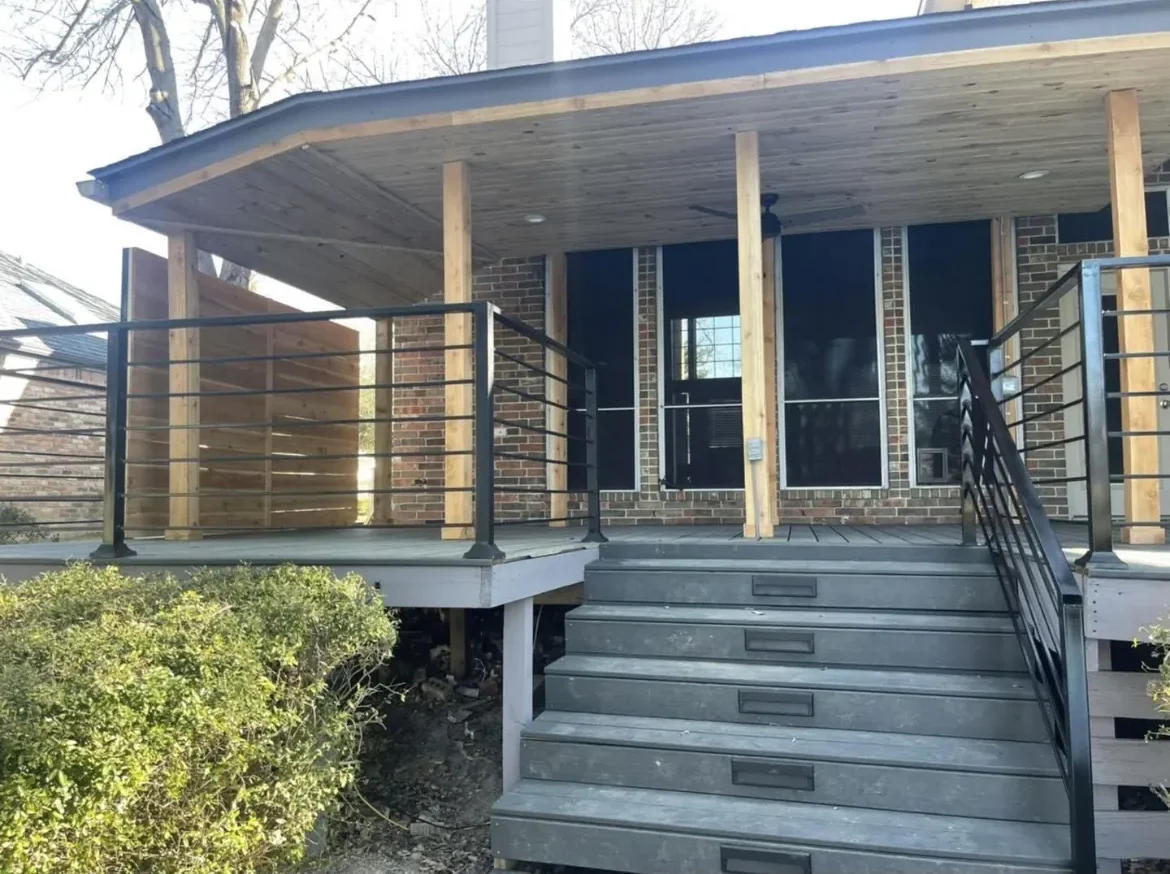
What makes building a deck in Texas different?
Texas is several climates in one state: average yearly rainfall runs from over 55 inches at Beaumont to under 10 inches at El Paso, and outside the wet east, evaporation is higher than rainfall, so most of the state is semiarid and Far West Texas is arid.
Some risks are shared by the whole state. Texas had more major hail events than any other state in 2025, Texas A&M AgriLife tells homeowners in every part of Texas to watch for native subterranean termites, and the number of 100°F days has roughly tripled over the past 50 years at stations in three of Texas's four regions. Other risks depend on where you live.
| Region | Climate and soil | Main deck risks |
|---|---|---|
| North Texas (DFW) | Blackland Prairie clay starts north of Dallas; February 2021 brought a -2°F low and 139 straight hours at or below freezing at DFW | Shrink-swell clay, hail, rising 100°F days, native and Formosan termites (Formosans reported in Dallas and Tarrant counties) |
| Central Texas (Austin, San Antonio) | Blackland Prairie clay runs south to San Antonio; in February 2021 San Antonio's airport stayed below freezing for 4 days 12 hours | Shrink-swell clay, heat, native and Formosan termites (Formosans reported in Travis and Bexar counties) |
| Upper coast (Houston, Beaumont) | The wettest part of the state (over 55 inches of rain a year at Beaumont); Coastal Prairie soils include shrink-swell clays | Expansive clay, Formosan termites (first found in Texas at Pasadena in 1956), windstorm certification in the first-tier coastal counties |
| Lower coast and Rio Grande Valley | The hottest average highs in the state (about 82°F a year in the Lower Rio Grande Valley) | Windstorm certification in the first-tier coastal counties, Formosan termites (reported in Hidalgo County), native termites that swarm as early as January |
| West Texas, Panhandle, El Paso | Dry: under 10 inches of rain a year at El Paso and over 90 inches of lake evaporation in Far West Texas; about 70°F average highs in the northern Panhandle | Rising wildfire risk in western Texas, hail, native termites (Panhandle swarms in April and May) |
The main deck styles, from ground-level platforms to multi-level designs, are compared in our guide to types of decks.
Texas residential deck building requirements: is there a statewide code?
No. State law makes the International Residential Code (IRC), as it stood on May 1, 2012, the residential building code for Texas cities, and lets each city adopt newer editions and its own amendments by ordinance.
The law is Texas Local Government Code Section 214.212. It says the IRC "as it existed on May 1, 2012" applies to construction, alteration, remodeling, enlargement and repair of homes in a city. A city may add local amendments after a public hearing, and it may review and consider changes the International Code Council has made since May 1, 2012. That is why one Texas city builds to the 2021 IRC and another to the 2024 IRC. The current wording comes from HB 738, effective January 1, 2022. We quote Texas statutes from Public.Law, a mirror of the official statutes site.
| Where you build | Residential code that applies | Source |
|---|---|---|
| Any Texas city (state baseline) | IRC as it existed on May 1, 2012, plus any newer edition and local amendments the city adopts | Local Government Code 214.212 |
| Houston | 2021 IRC, effective January 2, 2024 | International Code Council |
| Austin | 2024 IRC, effective July 10, 2025 | City of Austin Development Services |
| Dallas, Plano, Frisco, McKinney | Set by each city; see the city permit guides linked in the permit section below | City code |
| Unincorporated land in counties that have opted in (new houses) | IRC published as of May 1, 2008, or the version used in the county seat | Local Government Code 233.153 |
| Coastal windstorm areas (TDI certificate) | 2024 IRC or 2024 IBC for Certificate of Compliance applications starting April 1, 2026 | Texas Department of Insurance |
Cities also fill in the IRC's climate design table themselves. As one example, the North Central Texas Council of Governments' recommended regional amendments to the 2021 IRC (approved July 2021) list a 115 mph wind speed (3-second gust), Moderate weathering, a 6-inch frost line depth and a Very Heavy termite rating. Those are regional recommendations that DFW cities may adopt, not the law in every DFW city.
Footings, railings and stairs: the numbers that matter
The American Wood Council's DCA 6 deck guide, based on the 2015 IRC, is the common reference for deck basics. It is a guide; your city's adopted code is what the inspector enforces. Three of its rules come up on almost every deck:
- Footings: they bear on undisturbed soil at least 12 inches below the undisturbed ground surface or below the frost line, whichever is deeper. DCA 6 says to ask the authority having jurisdiction (your building department) for the frost line, and the building official checks the bearing before concrete is placed.
- Guards: every deck more than 30 inches above grade needs one.
- Stairs: at least 36 inches wide, with rectangular landings at least 36 inches long in the direction of travel.
Guard height and baluster spacing are in our deck railing height code guide, and riser, tread and handrail numbers are in the deck stair code for Texas. Whether to bolt the deck to the house or let it stand on its own is covered in attached vs freestanding decks, and decks off an upper floor in elevated and second-story deck cost.
Do you need a permit to build a deck in Texas?
Usually yes. In Austin and San Antonio, a deck skips the building permit only if it is small (200 square feet or less), low (30 inches or less above grade at every point) and not attached to the house, and each city adds more conditions. Other cities set their own tests.
| City | A deck needs no building permit only if it... | Source |
|---|---|---|
| Austin | is no more than 200 sq ft, no more than 30 in above grade at any point, not attached to a dwelling or townhouse, does not provide egress from the dwelling, and is not in a flood hazard area | City of Austin, Work Exempt from Building Permits |
| San Antonio | meets all four: not over 200 sq ft, not more than 30 in above grade at any point, not attached to a dwelling, and does not serve the dwelling's exit door | City of San Antonio Development Services |
| Dallas | Dallas has its own test; see our Dallas deck and patio cover permit guide | City of Dallas |
| Plano, Frisco, McKinney | Each city sets its own rules; see deck permits in Plano, Frisco and McKinney | Each city |
Under both cities' rules, an attached deck needs a permit whatever its size. Miss any one condition and you need a permit.
One rule on fees applies to every Texas city. Since May 21, 2019 (HB 852), Local Government Code Section 214.907 says a city may not consider the value of the home or the cost of the work when it sets a residential building permit or inspection fee.
A city permit and homeowners association approval are two separate steps. If your neighborhood has an HOA, see deck HOA approval in DFW for how that process works.
What rules apply outside city limits?
Outside city limits there is usually no city permit, but that does not mean there are no rules. In counties that have opted in, state law requires new houses and large additions to meet the 2008 IRC (or the county seat's code), and a city's code can still apply in its extraterritorial jurisdiction (ETJ).
The law is Subchapter F of Local Government Code Chapter 233, and it applies only in counties that have opted in by resolution or order. There, new single-family houses and duplexes begun after September 1, 2009 must meet the IRC published as of May 1, 2008, or the version used in the county seat.
The statute defines "new residential construction" as a new house or duplex on a vacant lot, or an addition that increases the existing home's square footage or value by more than 50 percent. It does not mention decks, so it does not answer whether a deck counts. Ask the county before you build.
Three more points from the same subchapter:
- If a city has adopted a building code for its ETJ, the city's code controls there.
- The subchapter does not let the county require approval before construction starts, and the county may not charge a fee to cover enforcement.
- The builder arranges the code inspections, done by a licensed engineer, a registered architect, a TREC-licensed inspector, an ICC-certified residential combination inspector or a similar inspector. A new house gets at least three (foundation; framing and mechanical; completion), and additions get them as needed.
On rural land, call the county and ask whether a nearby city's ETJ code applies. In the first-tier coastal counties, the windstorm rules below still apply.
Expansive clay soil: where it is and what it does to a deck
Much of the Dallas to San Antonio belt and the upper coast sits on shrink-swell clay: the Blackland Prairie runs from north of Dallas south to San Antonio, and the Coastal Prairie around Houston has expansive clays of its own.
Houston Black, the Texas state soil, covers about 1.5 million acres of the Blackland Prairie. A USDA state soil sheet says it is recognized worldwide as the classic Vertisol: it shrinks and swells markedly as its moisture changes, and in metro areas its very high shrink-swell potential commonly limits building site development. In dry seasons, the official soil series description records cracks 0.5 to 4 inches wide that reach 12 inches or more deep.
Clay is not only a DFW, Austin and San Antonio issue. The Texas-Louisiana Coastal Prairie, which runs along the Gulf Coast and includes the Houston area, sits on the Beaumont and Lissie Formations. Texas Parks and Wildlife describes its soils as including non-saline Vertisols, often with gilgai from shrink-swell clays.
In North Central Texas, the regional recommendation puts the frost line at just 6 inches, while DCA 6 already sets a 12-inch minimum below undisturbed ground, and Houston Black cracks can reach 12 inches or more. Here the clay, not the frost, is the bigger question. Elsewhere in Texas, ask your building department for its frost line, as DCA 6 advises.
Footing depth, pier types and Dallas clay detail are covered in deck footings in Dallas clay soil. Low decks that sit close to the ground have their own trade-offs, explained in ground-level and floating decks.
Heat, sun and humidity: choosing decking for your part of Texas
Heat is the one risk every Texas deck shares, and it is growing. The Office of the Texas State Climatologist found that 100°F days roughly tripled over the past 50 years at stations in three of four Texas regions, and calls a quadrupling from the 1970s and 1980s to 2036 a reasonable projection, with more 100-degree days in urban areas.
Beyond heat, the wet east and the dry west pull in different directions: in the east, moisture and termites weigh more in the choice of framing and boards; in the west, sun and wildfire weigh more.
Which board suits which part of Texas is in our deck materials guide for Texas, and which boards stay coolest underfoot in summer sun is in the coolest decking for Texas heat. How many years each material lasts here is in how long a deck lasts in Texas, and wood care is in deck staining and sealing in Texas. For DFW projects, see our page on composite decks.
Shade is the most direct way to deal with sun. For a roof over all or part of the deck, see covered decks and pavilions.
Plan for heavy rain, too. The State Climatologist expects extreme rainfall intensity to rise statewide by more than 20 percent by 2036 compared with 1950 to 1999, and projects more urban flooding. On an elevated deck, think about where the water from the boards and the roof goes, so it drains away from the footings instead of pooling under the deck.
Hail, storms and hard freezes
Texas led the nation with 902 major hail events in 2025, and the State Climatologist says no corner of the state is immune to severe thunderstorms.
The Insurance Information Institute, using NOAA Storm Prediction Center data, counts hail 1 inch or larger. Texas had 902 of 5,432 such events nationally, with Kansas second at 375; by our calculation from those figures, that is 16.6 percent of the US total. Very large hail may increase early in spring, but the State Climatologist says the trend is too uncertain to quantify.
Hard freezes are rare but real. In February 2021, Winter Storm Warnings covered the entire state on February 14. At DFW the low hit -2°F on February 16, the airport logged 139 straight hours at or below freezing (February 13 to 19), and 5.0 inches of snow fell. In South-Central Texas, 3 to 8 inches of snow fell along I-35 and up to 11 inches near Del Rio. San Antonio's airport stayed below freezing for 4 days 12 hours, one hour short of the 1951 record, and burst water pipes were among the impacts.
The State Climatologist says extreme cold and snow are becoming less frequent, and widespread snow events like February 2021 are extremely rare. What to check on a deck after hail or a big storm is in deck hail and storm damage in Texas.
Coastal decks: windstorm certification (TDI and TWIA)
If you build in one of the 14 first-tier coastal counties or the listed Harris County cities east of SH 146, a deck needs a Texas Department of Insurance (TDI) windstorm certificate to be eligible for Texas Windstorm Insurance Association (TWIA) wind and hail coverage.
TDI's designated catastrophe area covers these counties:
- Aransas, Brazoria, Calhoun, Cameron, Chambers, Galveston, Jefferson
- Kenedy, Kleberg, Matagorda, Nueces, Refugio, San Patricio, Willacy
- Parts of Harris County east of SH 146: La Porte, Morgan's Point, Pasadena, Seabrook and Shoreacres
In those areas, TDI says new structures, alterations, additions and repairs must be built and inspected to the building specifications TDI has adopted. TWIA lists decks and patio covers among the improvements that need windstorm certification, and warns that without a certificate a property may be considered uninsurable and ineligible for TWIA coverage.
How the process works, from TDI:
- Notify TDI with Form WPI-1 before construction begins.
- Inspections happen while the work is in progress, by a TDI inspector or an appointed Texas-licensed engineer.
- When the inspections pass, TDI issues the Certificate of Compliance (WPI-8).
- The WPI-8 is required for TWIA wind and hail coverage.
Starting April 1, 2026, TDI uses the 2024 IRC or 2024 IBC for WPI-1 applications. Because the WPI-1 comes first, sort out windstorm inspection before the first footing is dug.
Termites: every region has them, and Formosans are in the big metros
Native subterranean termites are a concern in every part of Texas, and the Formosan subterranean termite has been reported in all the major Texas metro areas, from Houston and Dallas to Austin and San Antonio.
Texas A&M AgriLife's urban entomology team says homeowners in all areas of Texas should watch for native subterranean termites. They get into buildings through wood in direct contact with soil, and they swarm as early as January and February in South Texas and as late as April and May in the Panhandle.
Formosan subterranean termites were first found in Texas in 1956, near the Houston Ship Channel in Pasadena. AgriLife has recorded them in more than 30 counties, including Harris, Galveston, Brazoria, Dallas, Tarrant, Travis, Bexar and Hidalgo, and says a typical colony may exceed 1 million insects.
Because wood touching soil is the way in, how posts meet the footings matters on a Texas deck. Termite risk for deck framing and boards is covered in termites and wood decks in Texas.
Wildfire: decks in the wildland-urban interface
Texas has 3.2 million housing units in the wildland-urban interface, second only to California, and 85% of Texas wildfires start within two miles of a community, according to the Texas Comptroller.
The Comptroller also estimates 244,617 Texas homes were at significant wildfire risk in 2024. The 2024 Smokehouse Creek Fire burned over 1 million acres, the largest in Texas history, and since 2005 more than 243,000 wildfires have burned 13.9 million acres. The State Climatologist says weather has raised wildfire risk in western Texas, mainly through higher temperatures, while wetter trends have made eastern Texas less favorable to wildfire.
For a deck, the danger is mostly embers. Texas A&M Forest Service's Firewise fact sheet says wind-blown embers are the single biggest wildfire hazard to homes, and that nothing that can ignite should be stored under a deck. In IBHS tests, ember fires started in the gaps between boards and grew in the area under the deck, and even a 12 mph wind let the fire spread.
To check your own address, the Forest Service's Texas Wildfire Risk Explorer (TxWRAP) shows wildland-urban interface zones, housing unit risk and ember-load sources. Decking options for fire risk are compared in fire-resistant decking.
What does a deck cost in Texas?
In Remodeling's 2025 Cost vs Value report, the same 16x20 ft wood deck cost $14,807 in Austin and San Antonio, $15,841 in Dallas and $16,118 in Houston; the composite version ran $22,613 to $24,412.
| Area (2025) | Wood: job cost | Wood: resale value | Wood: cost recouped | Composite: job cost | Composite: resale value | Composite: cost recouped |
|---|---|---|---|---|---|---|
| Dallas | $15,841 | $15,813 | 99.8% | $23,519 | $21,658 | 92.1% |
| Houston | $16,118 | $14,967 | 92.9% | $24,412 | $20,048 | 82.1% |
| San Antonio | $14,807 | $15,408 | 104.1% | $22,613 | $21,558 | 95.3% |
| Austin | $14,807 | $13,906 | 93.9% | $22,613 | $19,394 | 85.8% |
| West South Central region | $15,709 | $16,743 | 106.6% | $23,631 | $22,304 | 94.4% |
| National | $18,263 | $17,323 | 94.9% | $25,096 | $22,199 | 88.5% |
All the figures are for one spec: a 16x20 ft deck with pressure-treated joists on 4x4 posts anchored to concrete piers, a built-in bench and planter, three steps to grade and a full railing. The composite version uses composite decking and railing on the same frame.
Per square foot, by our calculation from Remodeling's 2025 job costs and its 320 sq ft spec, the wood deck works out to about $49.50 in Dallas, $50.37 in Houston and $46.27 in San Antonio and Austin. The composite deck works out to about $73.50 in Dallas, $76.29 in Houston and $70.67 in San Antonio and Austin. Those include the bench, planter, stairs and railing, so they are not a bare-deck price.
On resale, San Antonio's wood deck was the only one of the four cities to recoup more than its cost (104.1%), and in every city the composite deck recouped a smaller share than the wood one.
These are estimates for one design, not quotes. Real prices change with size, height, material and site. For DFW price ranges, see deck cost in Dallas; for how size changes the total, deck cost by size; and for what a deck adds when you sell, deck ROI and resale value.
Building in Dallas itself? The Dallas deck guide covers the city code, permit test and local costs.
Which questions depend on your city (and who to ask)?
Four things change from place to place in Texas: the IRC edition, the permit exemption, the climate values written into the local code (frost depth, wind speed, termite rating), and whether you are in a coastal windstorm county or a flood hazard area. Before you build, ask:
- Which IRC edition does my city use? Houston uses the 2021 IRC and Austin the 2024 IRC; ask your building department for yours.
- Does my deck qualify for a permit exemption? In Austin and San Antonio, only small, low, freestanding decks do.
- What frost depth, wind speed and termite rating does my city's code list? In North Central Texas the regional recommendation is a 6-inch frost line, 115 mph and Very Heavy.
- Is my lot in a flood hazard area? In Austin, that alone takes a deck out of the permit exemption.
- Am I in a first-tier coastal county? If so, file the WPI-1 with TDI before work starts.
- Outside city limits, has my county opted in to the state code rules, and does a city's ETJ code apply? Ask the county.
- Does my HOA need to approve the plans? That is separate from the city permit.
Questions to ask before you hire are in how to choose a deck builder, and what happens at each stage of the job, from the 811 call to the final inspection, is in the deck building process step by step.
If you are in the Dallas area, Archetex Outdoor Design Co. is a Dallas deck builder that designs and builds custom composite and wood decks in Dallas, Plano, Frisco, McKinney, Richardson, Garland, Rockwall, Rowlett, Addison and Farmers Branch, with a free site visit and written price. Elsewhere in Texas, take this list to a local builder and to your city or county building department.