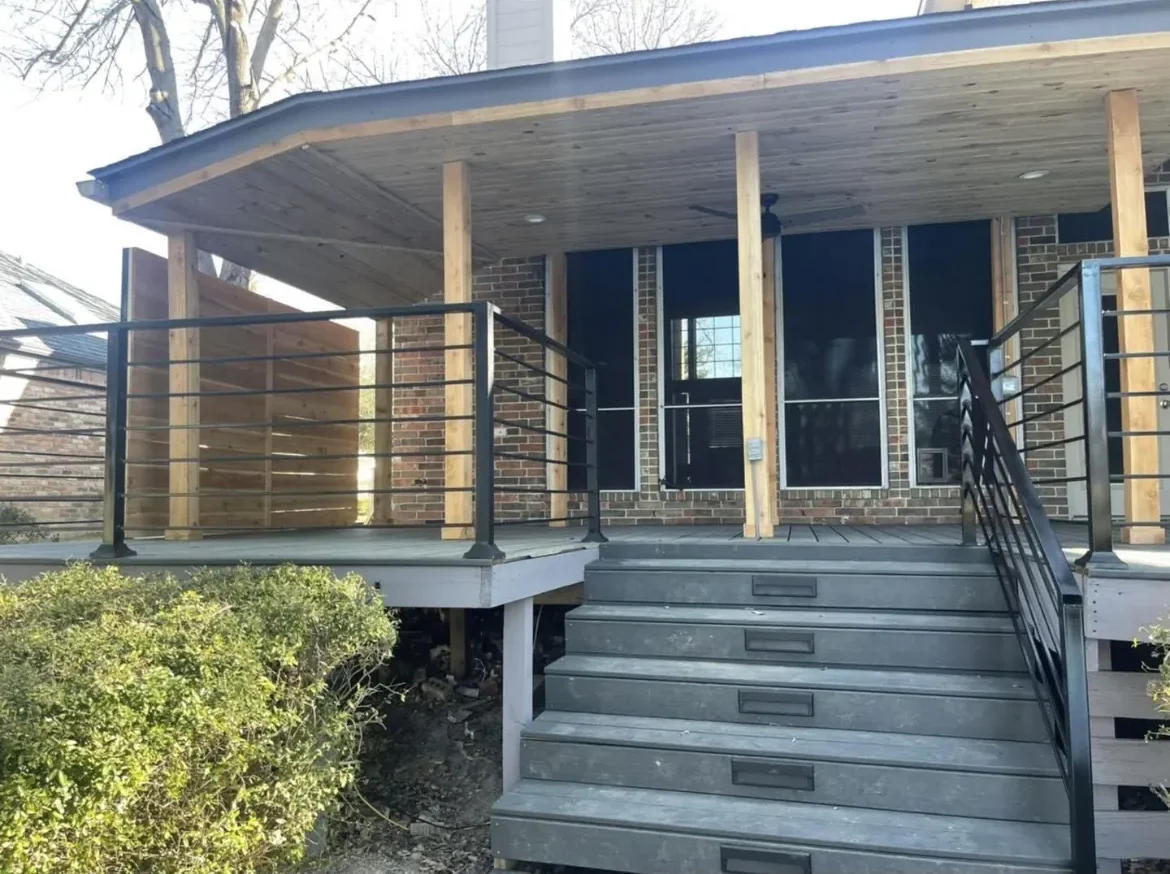
This guide is for the North Texas homeowner who just found mud tubes, wings or soft wood on a deck, and for the one planning a new deck who wants to keep termites out. Treatment itself is a job for a pest control company licensed by the Texas Department of Agriculture (TDA), not for a deck builder.
Do termites eat deck wood?
Yes. Subterranean termites eat the cellulose in wood, and the parts of a deck they reach first are the posts, joists and stair stringers closest to the soil. Texas A&M calls subterranean termites the most destructive insect pests of wood in the United States and says that wherever wood touches soil, the risk of termite entry is high.
The damage is done by the workers: wingless, white to creamy insects 1/4 to 3/8 inch long. They tunnel along the grain and leave a shell of sound wood on the outside, so a joist can look fine and still be hollow inside. Penn State Extension notes that when damage finally shows, it is usually the result of years of infestation, not a sudden attack.
The frame matters more than the boards. The USDA Forest Products Laboratory (FPL) says the termite hazard is greatest in any substructure wood close to the ground or an earth fill. A deck with composite boards on an untreated wood frame still has plenty of wood near the soil.
Texas A&M AgriLife Extension's 2010 termite guide put subterranean termite damage in Texas at about $500 million a year and gave an unprotected home about a 70% chance of some termite damage within 25 years. TDA says termites have been found in buildings as early as four days after construction.
Which termites live in Dallas-Fort Worth?
DFW decks face two subterranean termites, the native eastern subterranean termite and the invasive Formosan termite. Drywood termites are found across Texas too, but they are mainly a Gulf Coast problem.
Native (eastern) subterranean termite. A&M names the native species Reticulitermes flavipes, the eastern subterranean termite, and says homeowners in all areas of Texas should watch for subterranean termites.
Formosan subterranean termite. Texas A&M reports Formosan termites in 31 Texas counties, with more added each year, including Dallas, Collin, Denton, Tarrant and Rockwall. A&M says there is little chance of meeting them outside the upper Gulf Coast, but says homeowners should watch for isolated infestations anywhere in Texas.
Where they show up, Formosans are the bigger worry. A typical colony may exceed 1 million insects, they attack more kinds of wood faster than natives, and they build above-ground nests inside structures as well as in soil. The Texas Invasive Species Institute says larger colonies can severely damage an unprotected home in 2 years.
Drywood termites. These live in sound, dry wood above ground and need no soil contact. TDA says they are more common in coastal areas such as Houston and Corpus Christi.
| Termite | Where in Texas | Needs soil? | Swarmers | Damage looks like |
|---|---|---|---|---|
| Native (eastern) subterranean | Statewide; major populations coastal | Yes, soil or another steady moisture source | 1/4 to 3/8 inch, coal black to pale yellow-brown; swarm in spring and early summer | Soft springwood eaten, galleries along the grain lined with mud |
| Formosan subterranean | 31 counties, including Dallas, Collin, Denton, Tarrant and Rockwall | Nests in soil, but also builds above-ground nests in structures | Yellowish-brown, 0.5 to 0.6 inch, hairy clear wings; swarm at night in late May and early June, drawn to lights | Both springwood and summerwood eaten, soil in galleries, no pellets |
| Drywood | Throughout Texas; highest numbers on the Gulf Coast | No | I. snyderi: light yellow, 7/16 inch, swarm at night. I. minor: dark body, 9/16 inch, swarm in daytime | Smooth, sculpted galleries with piles of tiny pellets |
A&M gives no swarm month for DFW: native swarms start in January and February in South Texas and not until April and May in the Panhandle. Formosan soldiers have teardrop-shaped heads, rounder than the rectangular heads of native soldiers.
How do termites get into a deck?
Subterranean termites reach a deck from the soil, either through wood that touches the ground or through mud shelter tubes they build up a post, a footing or the house foundation. Texas A&M says any cellulose touching soil, including trees, vines and grade stakes left after construction, can give them a path in.
They live close to the surface, usually in the top 4 to 6 inches of soil. They need constant moisture, from the soil or from sources such as leaky plumbing and roofs, air conditioner condensate and poorly kept gutters. A&M also warns that watering soil around a foundation can attract foraging termites, and that wood next to a pool that gets splashed often deserves a careful look.
Wet wood is doubly risky. A&M says termites are attracted to the odors of wood-decaying fungi, which also make wood easier to chew, so the moisture that starts rot can also invite termites. A&M's Formosan guide lists deck supports among the earth-to-wood contacts that inspectors check outside a house.
TDA's list of conditions that invite termites includes wood touching soil, firewood against the foundation, wood mulch within 3 feet of the foundation, faulty grade, poor ventilation and moisture. And termites need a gap of only 1/32 inch to get in.
One more warning: old railroad ties and shoring timbers reused for terraces and planting beds are thought to be the main way Formosan termites spread in Texas, because the creosote often doesn't reach the core. A&M also names mulch and sod from infested areas.
What are the signs of termites in a deck?
The clearest signs are mud tubes on posts, footings or the foundation, shed wings, wood that sounds dull or hollow when you tap it, and, for drywood termites, small piles of pellets. Texas A&M and TDA both list these.
A&M suggests breaking a suspected tube open with a screwdriver to check for live termites, and tapping wood, then probing anything that sounds dull with a screwdriver or ice pick.
| What you found | What it likely means |
|---|---|
| Mud tubes on a post, pier, footing or foundation wall | Subterranean termites (native or Formosan) traveling from the soil |
| Shed wings or swarmers, often on windowsills or near lights | A swarm; subterranean termites swarm in spring |
| A joist that sounds hollow, with galleries along the grain lined with mud or pale spotted waste | Native subterranean termites |
| Damage through both the soft and hard layers of the wood, with soil in it and no pellets | Possibly Formosan termites |
| Smooth, sculpted galleries and piles of tiny pellets about 1/32 inch long, the color of the wood, with lengthwise ridges | Drywood termites |
| Blistered wood surface | Termites; TDA lists it for both subterranean and drywood |
| Smooth, clean galleries with debris piled below an opening | Carpenter ants, which use wood for shelter rather than food |
| Soft, dark, crumbly wood with no galleries, mud or pellets | More likely decay (rot), which also attracts termites |
Termites or rot?
Often you can't tell by eye: A&M says fungal decay can be confused with termite damage, and decay odors attract termites. Mud-lined galleries along the grain point to termites; soft, crumbly wood without tunnels points more toward rot.
A homeowner can look, but A&M recommends that licensed professional inspectors do the inspection. For the rest of the deck (ledger, railings, stairs and connections), use our deck safety inspection checklist.
Which deck woods resist termites?
Ipe resists both subterranean and drywood termites, a few other tropical hardwoods such as greenheart are also rated termite resistant, redwood heartwood has some resistance, and ordinary pine needs pressure treatment. The FPL says only a few US-grown woods have marked natural termite resistance.
| Deck wood | Termites (what the sources say) | Decay rating, FPL Wood Handbook Table 14-1 |
|---|---|---|
| Untreated pine | Not termite resistant; only very resinous southern pine heartwood is practically immune, and it is seldom available | Slightly or nonresistant (pines other than those listed) |
| Western red cedar | North Carolina's residential code definition (quoted by the NC fire marshal) lists its heartwood as termite resistant; the FPL does not count it among termite-resistant woods; A&M lists cedar among plants Formosan termites attack | Resistant |
| Redwood | Close-grained heartwood has some resistance, especially above ground | Old growth resistant; young growth moderately resistant |
| Ipe | Highly resistant, including subterranean and drywood termites | Very resistant |
| Greenheart | Heartwood very resistant to decay fungi and termites | Very resistant (imported woods) |
| Courbaril | Moderately to very resistant to decay and drywood termites | Resistant (imported woods) |
Two FPL cautions apply to every row: decay resistance may be lower in ground contact or warm, humid climates, and under severe decay conditions pressure-treated wood is generally recommended over resistant heartwood. In practice, that means a ground-contact treated frame under whatever boards you pick.
About cedar. Both statements in the table are true. North Carolina's IRC-based 2018 Residential Code defines naturally durable wood, and its list, as quoted in a July 2024 North Carolina Office of State Fire Marshal interpretation, names western red cedar heartwood as termite resistant. That is North Carolina's wording; we could not check the model IRC text directly. But the FPL leaves cedar off its short list of termite-resistant woods, and A&M lists cedar among the more than 47 plants Formosan termites attack. Cedar may meet that code definition, but don't count on it to keep termites out in DFW. Our cedar deck cost and care guide covers cedar in more detail.
About ipe. In the same North Carolina file, the requester noted that tropical hardwoods such as ipe are not on that code's naturally durable list, so where a code uses that list, ipe framing may need the building official's approval; treated framing under ipe boards is simpler. For hardness, decay class and price by species, see which deck woods hold up best in Texas.
Do termites eat pressure-treated wood?
Pressure-treated wood resists termites, but it isn't a guarantee. Texas A&M says pressure-treated lumber in critical areas "may help prevent" infestation, and the weak spots are untreated cut ends, untreated wood touching the frame, and lumber rated only for above-ground use placed where it stays wet.
The American Wood Protection Association (AWPA) says deck boards, railings and stairs above ground need Use Category 3B (UC3B) or higher, while posts and ledgers need UC4A, the ground-contact rating. Joists and beams can be UC3B above ground or UC4A in ground contact. AWPA's 2025 standard U1 adds that above-ground parts must be treated to UC4A when:
- Soil or debris can build up against them
- Air can't circulate under the deck and between the boards
- They sit less than 6 inches above final grade on supports that let moisture through, without a moisture barrier
- They touch untreated wood that isn't naturally durable, or older decayed construction
- They get wet often, for example from a fixed sprinkler system
The building code backs this up. The 2021 IRC requires ground-contact treated wood for any wood touching the ground, or embedded in concrete that touches the ground, that supports an occupied structure, and it requires field-cut ends, notches and drilled holes in treated wood to be retreated in the field per AWPA M4.
Borate-treated wood is a separate case. A&M says borate-treated framing is beneficial but isn't a full pre-construction treatment, and that borates may not penetrate far enough to protect the core of the lumber. To read an end tag and tell UC3B from UC4A at the lumber yard, see our pressure-treated deck guide.
Do termites eat composite or PVC decking?
Composite and PVC boards are sold as termite resistant, and one maker admits termites can nibble composite, but makers' claims are their own tests and statements, not guarantees. The frame under a composite deck is usually still wood.
| Maker | What the maker claims about termites or insects |
|---|---|
| Trex | "Trex decking resists termites, won't rot, warp, or splinter" (Trex FAQ) |
| TimberTech (AZEK) | Advanced PVC Vintage tech sheet: termite resistance per ASTM D3345 "Equivalent to Preservative treated lumber." Composite FAQ: "resistant to rot, decay, and insect damage" |
| Fiberon | Good Life line: solid composite construction "to prevent splintering, cracking, insect infestation, and decay" |
| MoistureShield | Termites have "been known to nibble a bit" at composite, but infestations are "very rare" |
The best independent data is from the USDA. In a 2024 summary of 20 years of tests, the FPL reported that termites were present at its Mississippi test site, and that cracking, decay and termite attack on its wood-plastic composites showed up 1 to 10 years after exposure, depending on site and conditions. After 17 years in the ground in Mississippi, the blend made with no biocide and no colorant averaged a termite rating of 5.9 (the no-biocide blend with colorant averaged 8.0), where 10 is sound and 6 means attack on 30% to 50% of the cross-section. The caveat: the FPL mostly made its own blends, and these were stakes buried in soil, so it is not a rating of any brand's deck boards.
Formosan termites are also known to chew through thin soft metal, asphalt, rubber and plastic while searching for food and moisture. The 2021 IRC gives composite deck boards that contain wood their own rules (R317.4, pointing to R507.2.2).
The frame decides most of it. Cold-formed steel framing is one of the six termite protection methods the IRC lists, so steel joists under composite or PVC boards take the wood out of the substructure. See steel deck framing in Texas and PVC vs composite decking for the trade-offs.
What does the building code say about termites and decks in Dallas and Plano?
Dallas and Plano both rate termite damage risk "Very Heavy" in their adopted residential codes, which brings in the IRC's termite protection section. That is R318 in the 2021 IRC that Dallas adopted, and R305 in the 2024 IRC that Plano adopted.
The sources are Dallas Ordinance 32424 (council file 23-0471, Table R301.2: termite "Very heavy") and Plano Ordinance 2025-6-15 (Table R301.2: termite "Very Heavy"). The ICC Evaluation Service confirms the section moved from R318 to R305 in the 2024 IRC.
The rules below are the 2021 IRC text as reproduced in the Town of Easton, Maryland's 2021 IRC deck packet.
| 2021 IRC section | What it says, in plain terms |
|---|---|
| R318.1 | Where Table R301.2 shows termite risk, protection must be one or more of 6 methods: chemical termiticide, a baiting system used per its label, pressure-treated wood, naturally durable termite-resistant wood, physical barriers, or cold-formed steel framing |
| R318.2 | Chemical treatment means soil treatment or field-applied wood treatment at the concentration, rate and method on the label |
| R507.2.1 | Deck lumber must be No. 2 grade or better, treated or approved naturally durable, "and termite protected where required" |
| R317.1.2 | Wood in ground contact, or in concrete that touches the ground, supporting an occupied structure must be ground-contact treated wood |
| R318.1.2 and R317.1.1 | Field-cut ends, notches and drilled holes in treated wood must be retreated per AWPA M4 |
| R317.1, items 5 and 8 | Structural supports of uncovered porches, balconies and similar additions must be durable or treated; wood siding and framing need 6 inches of clearance from the ground and 2 inches above patio and porch slabs, or must be treated or durable |
DFW cities also make builders certify termite protection on new homes. Lancaster requires a notarized "Protection Against Termites" form with the provider's state license number, Prosper requires a Termite Protection Statement before final inspection, and Dallas has used a similar certificate. These are new-home forms. We found no city page saying a deck permit needs one, so ask your city's permit office if you're unsure.
How do you build a deck that doesn't invite termites?
Keep wood out of the soil, keep soil and wood dry, leave space you can inspect, and use termite-resistant materials where wood can't stay dry.
- Set wood on concrete. A&M says wood porches, steps and stair carriages should sit on solid concrete bases at least 6 inches above the soil.
- Use ground-contact (UC4A) lumber for posts and the ledger, and for joists that are low, poorly ventilated or often wet.
- Treat every field cut, as the code requires.
- Clean up after the build: no form stakes, wood scraps or stumps left under or around the deck.
- Slope soil away from the house and keep it 6 to 8 inches below the top of the foundation, which makes tubes visible.
- Keep sprinklers and AC condensate off the frame.
- Keep wood mulch and firewood back, at least 3 feet from the foundation for mulch.
- Skip reused railroad ties and landscape timbers near the deck.
- Leave airflow under low decks, or use UC4A lumber where the frame sits under 6 inches above grade.
- Consider composite or PVC boards on steel framing for the least wood near the soil.
- Call your termite company before digging beside a treated foundation. TDA allows retreatment when a barrier is disrupted "due to construction, excavation or landscaping," so footing holes next to the house are worth a call before and after the build.
Who can treat termites in Texas?
Anyone who treats termites for pay in Texas must hold a TDA structural pest control license under the Structural Pest Control Act (Occupations Code chapter 1951), and "Termite control" is its own license category, covering homes, wood fences, docks and other structures. Homeowners treating the home they own or lease are exempt, with narrow exceptions.
A&M notes treatment takes specialized drills, pressure injectors, pumps and large tanks, and is usually best left to professionals licensed by TDA's Structural Pest Control Service (SPCS). A deck builder without that license can't treat termites for pay.
What Texas requires from the company:
- A WDI report. Texas law requires a Wood Destroying Insect report with each formal termite inspection and treatment, plus a sticker under the kitchen sink or on the electrical box or water heater.
- Disclosure documents with the bid, before any treatment: a diagram of what will be treated, the pesticide label and proposed concentration, full warranty details, definitions of the treatment types, and a licensed applicator's or technician's signature.
- Warranty terms in writing: the time period, renewal options and cost, whether the company retreats or repairs damage, and what owner actions could void it.
A WDI inspection covers only readily accessible areas and isn't a structural damage report. TDA suggests getting several bids, since prices and terms vary a lot, asking for proof of licensure, and calling SPCS to confirm a license. Complaints go to 866-918-4481 or spcs@TexasAgriculture.gov.
What termite treatments will a company offer?
Termite companies use liquid soil termiticides, bait stations, borate wood treatments and, for drywood termites, fumigation. Texas A&M says liquid termiticides should be the primary product for most homes.
| Method | How it works | What the sources note |
|---|---|---|
| Liquid soil termiticide | Soil treatment, applied at the label's rate and method | A&M's first choice for most homes; lethal products give about 5 years of protection, repellent ones up to 5 years |
| Bait stations | Suppress the colony rather than block entry | Control can take several months to more than a year; no residual protection once stopped; no drilling of slabs and patios, less insecticide. TDA notes baits "do not attract termites" |
| Borate wood treatment | Applied to wood, including spot treatments | May not reach the core of the lumber |
| Fumigation | Gas fumigant, normally for drywood termites | TDA calls it the only sure way to get all drywood termites; spot treatment or removing infested wood are the other options |
Whatever the method, the FPL says the job is to break the contact between the soil colony and the wood: block runways, treat the soil and fix leaks. For outdoor posts it says full-length pressure treatment is the best protection.
TDA prohibits routine annual retreatment for subterranean termites without clear evidence of reinfestation or a disrupted barrier. We found no reliable published treatment prices for Texas, so this guide gives none. TDA says inspection fees vary but are usually small, and it advises getting several bids.
Found termites in your deck? What to do next
Don't panic: TDA says most termites work very slowly, so there is time to get a licensed inspection, several written bids and a check of the framing before you decide to repair or replace.
- Leave the damage in place until it is inspected. If a past treatment failed, TDA advises not repairing or retreating before its inspector investigates (TDA's typical complaint response time is about three weeks), since visible damage allows a more thorough investigation.
- Get a WDI inspection and report from a TDA-licensed company.
- Compare written bids that include the diagram, label, warranty and licensed signature.
- Have the frame checked for strength. A WDI report is not a structural damage report, and termite galleries can hide behind a shell of sound wood. Our deck safety inspection guide lists what to look at.
- Decide repair or replace. How much of the frame is damaged drives it. Our guide on whether to repair or replace a damaged deck walks through that decision.
If you end up replacing the deck, that's the time to change the materials: ground-contact framing on concrete bases, or composite boards on steel framing. Archetex Outdoor Design Co. designs and builds new composite and wood decks in Dallas and nearby cities, but it does not inspect for, treat or repair termite damage. That work belongs to a TDA-licensed pest control company.