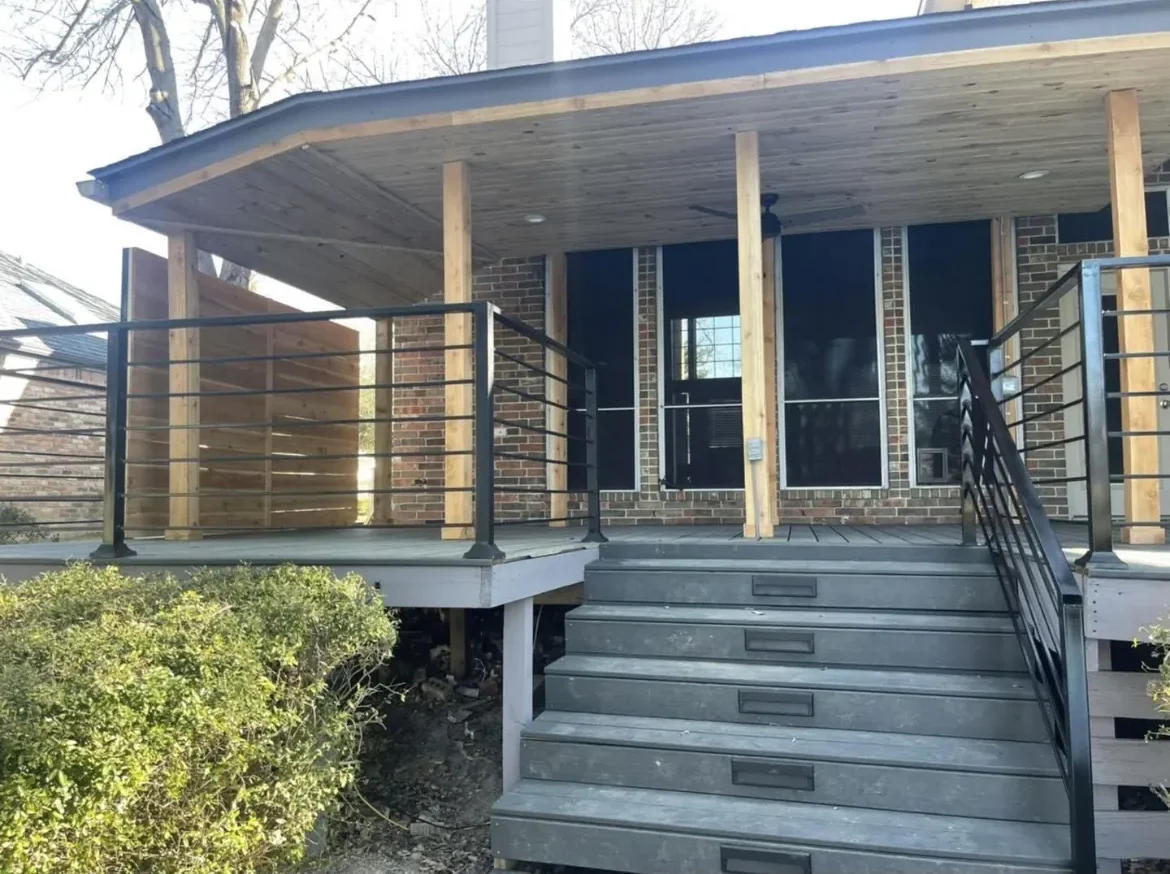
Even TimberTech, which sells Class A boards, says "No typical decking material is truly fireproof." What you can do is pick surfaces that burn slowly or not at all, and set up the deck so embers have nowhere to start.
What is the most fire resistant decking?
Surfaces that don't burn come first: concrete, stone or tile set in mortar, porcelain pavers on steel pedestals, and metal. After those come Class A rated PVC boards, then Class B composites and untreated wood, and no common deck board is fireproof.
Here is the order, from least to most likely to burn:
- Concrete slab, or flagstone and tile on a mortar bed.
- Porcelain pavers on steel pedestals (maker claims; no US fire test number found).
- Metal: aluminum boards and steel framing.
- Exterior fire-retardant-treated (FRT) wood, Class A but still wood.
- Class A PVC boards such as Trex Refuge, TimberTech Vintage and Landmark, and Fiberon Promenade (makers' ratings).
- Class B composites such as Trex Select and Transcend (Trex's rating).
- Untreated lumber, Class B for Southern pine, Douglas-fir, redwood and western red cedar.
The research below shows the joists and what sits under the deck matter as much as the board.
Most fire resistant decking materials compared: Class A, porcelain pavers, concrete, steel, fire retardant treated wood and composite
Here is every option in one table, from noncombustible to combustible, with the source of each rating and the catch that goes with it. "Maker's claim" means the rating comes from the company selling the product.
| Material | Does it burn? | Published rating | Source | The catch |
|---|---|---|---|---|
| Concrete slab (plain or stamped) | No | No flame spread class needed; a continuous concrete surface stalled under-deck fire in IBHS tests | IBHS | Ground level only |
| Flagstone or tile on a mortar bed | No | "Close to fireproof" | Fine Homebuilding | Ground level or on a slab |
| Porcelain pavers on steel pedestals | No (maker's claim) | No US test number found | Archatrak, Tile Tech | Plastic pedestals are combustible |
| Aluminum boards | No | Metal is a noncombustible deck board type | Texas A&M Forest Service | A wood frame under them still burns |
| Steel framing (Fortress Evolution) | No | Class A, flame spread 0, smoke 15 (ASTM E84) | Fortress test by Intertek | Framing only, boards on top still matter |
| Exterior FRT lumber (Hoover Exterior Fire-X) | Yes (treated to slow flame spread) | Class A, flame spread 25 or less | Hoover spec sheet | Not a substitute for preservative-treated wood |
| Class A PVC (Trex Refuge, TimberTech Vintage and Landmark, Fiberon Promenade) | Yes | Class A (Promenade: flame spread 15) | Maker's claim | Not fireproof; Refuge is a limited launch |
| Class B composite (Trex Select, Transcend, Lineage; Fiberon Sanctuary FR, Good Life FR; Deckorators Altitude) | Yes | Class B | Maker's claim (Deckorators via trade press) | Wood-plastic composites are combustible |
| Untreated pine, fir, redwood, cedar | Yes | Flame spread 45 to 70 (Class B) | American Wood Council | Covers untreated wood only |
| Imported hardwoods (such as ipe) | Yes | Some sellers claim Class A | Seller claims (noted by USDA) | Ask for the test report |
For metal boards in detail, see our guide to aluminum decking and its Class A claims. For hardwood, the USDA Forest Products Laboratory noted that some sellers of imported species market them with Class A flame spread claims, which makes them seller claims, not code listings. Our post on whether ipe is fire resistant covers that wood.
What does a Class A fire rating mean for decking? (ASTM E84 flame spread)
Class A means a flame spread index of 0 to 25 in the ASTM E84 tunnel test. Class B is 26 to 75, Class C is 76 to 200, and untreated Southern pine scores about 70.
ASTM E84 is the standard test for surface burning of building materials. A sample about 24 ft long and 20 in wide burns in a long tunnel, and its result is compared with select-grade red oak and fiber-cement board. The test reports two numbers: a flame spread index and a smoke developed index. The IBC, NFPA 101 and NFPA 5000 use these classes, each with a smoke index of 0 to 450.
Class A isn't the same as noncombustible: ASTM says the flame spread index alone can't be used to call a material noncombustible. Flame spread also isn't ignition. TimberTech describes flame spread as how quickly and how far flames travel across the surface, while ignition resistance is about the moment a flame or ember first touches the material.
Here is how plain, untreated lumber scores, from the American Wood Council's DCA 1 table for 1 in nominal boards. The Council says lumber and wood products typically fall into Class B or Class C.
| Untreated species (1 in nominal) | Flame spread index | Class |
|---|---|---|
| Southern yellow pine | 70 | B |
| Douglas-fir | 70 | B |
| Redwood | 55 | B |
| Western red cedar | 45 | B |
That table is for untreated wood. It doesn't give a class for pressure-treated pine deck boards, and we found no published class for them. The treatment that stops rot and termites is a different product from fire-retardant treatment; our pressure-treated pine guide covers the grades.
Class A isn't the wildfire test: under-deck (ASTM E2632) and burning brand (ASTM E2726, SFM 12-7A-4)
Wildfire rules test a whole deck two other ways: a flame underneath and a burning brand on top, because that is how decks catch in a wildfire. California's SFM 12-7A-4 test was the model, and ASTM wrote E2632 and E2726 from its two parts.
The under-deck test. ASTM E2632 uses a burner flame to stand in for things burning beneath a deck, and it measures heat release and how the decking breaks down. In California's version, Steve Quarles explains, the test deck gets an 80 kW flame underneath for three minutes and passes if heat release stays under the standard's limit.
The burning brand test. A burning wood lattice of set size and weight is placed on the boards. It is the ASTM E108 "A" brand from roof testing: a 1 sq ft block of three layers of nailed 3/4 in square sticks. ASTM E2726 was the burning-brand standard for decks, and ASTM now lists it as withdrawn in 2026 with no replacement.
What a pass looked like on paper. A 2013 International Code Council proposal for the wildfire code (WUIC3-13, from the Composite Lumber Manufacturers Association) proposed a peak heat release of no more than 25 kW per sq ft in the under-deck test, no flaming or glowing at the end of a 40-minute watch, a Class A brand result, and a Class A flame spread in an E84 test extended by 20 minutes. Its alternatives paired the under-deck limit with a Class B board, or allowed a Class C board where the wall within 10 ft is noncombustible or ignition-resistant. That was the threshold proposed in 2013 to match California's rule, not current code text.
The 30-minute tunnel. The same ICC document quotes the wildfire code's test at the time for "ignition-resistant material": ASTM E84 run for 30 minutes, a flame spread of 25 or less, no progressive burning, a flame front that goes no more than 10 1/2 ft past the burner, and the same result after weathering (ASTM D2898 for FRT wood, wood-plastic composites and plastic lumber). When Trex says Refuge meets the wildfire code's "ASTM E2768 Ignition Resistance Standards," E2768 is that extended 30-minute tunnel test.
These tests have limits. NIST researchers wrote that California's test doesn't capture "the dynamic process of multiple firebrands bombarding decking materials," and that embers are expected to pile up in gaps and crevices. A USDA Forest Products Laboratory study of a burning deck next to a wall found winds of 6.5 mph and 12 mph produced the highest wall temperatures, and its authors wrote that deck rules are partly based on anecdotal evidence.
Board shape matters too. In UC Forest Products Lab tests reported in 2009, channeled boards did poorly in the under-deck test, hollow boards did poorly under the brand, and solid boards did best overall. Products have changed since then, so read that as "solid beats hollow," not as a brand ranking.
WUI compliant vs Class A: why a Class C board can still be wildfire listed
A CAL FIRE listing says a board passed California's deck tests under set conditions. It doesn't say the board is Class A: TimberTech's Pro Reserve Grooved composite is listed for wildland-urban interface (WUI) use with a Class C flame spread.
California's State Fire Marshal (OSFM) publishes these listings. Two TimberTech listings, both issued May 31, 2026 and expiring June 30, 2027, show what to read:
- Rating line. TimberTech Landmark (advanced PVC), listing 8110-2042:0503, reads "Class A Flame Spread." Pro Reserve Grooved composite, listing 8110-2042:0502, reads "Class C Flame Spread."
- Test protocol. Landmark was tested to SFM 12-7A-4. Pro Reserve was tested to a different protocol, SFM 12-7A-4A.
- Conditions. Pro Reserve was tested with board gaps of 1/8 in to 3/16 in on 2x6 Douglas-fir joists at 16 in on center.
- The wall. Both listings approve WUI use only when the house wall attached to the deck is also noncombustible or ignition-resistant.
- Who checked it. OSFM states it "does not make an independent verification of any claims."
So "WUI listed" and "Class A" are two separate claims, and a listing can depend on your siding. MoistureShield Vision capped composite, for example, was approved for California's WUI listing in 2020, and we found no flame spread class published for any MoistureShield line.
Keep California's scope in mind. Its Chapter 7A wildfire rules were adopted in 2008, apply to new construction, and aren't used as statewide code outside California.
Fire ratings by brand: Trex, TimberTech, Fiberon, Deckorators and MoistureShield
Among the big composite makers, the Class A ratings are on PVC lines. Their wood-plastic composites are rated Class B or Class C.
Ratings below are the makers' own claims unless noted.
| Brand and line | Material | Flame spread class | WUI claim | Source |
|---|---|---|---|---|
| Trex Refuge | PVC | Class A | "IWUIC compliant" | Trex, 2026 (limited launch, select regions) |
| Trex Select, Transcend, Transcend Lineage | Composite | Class B | Approved for WUI areas | Trex FAQ |
| Trex Enhance | Composite | Class C | Not stated | Per TimberTech's comparison table |
| TimberTech Vintage and Landmark | Advanced PVC | Class A | WUI compliant; Landmark OSFM listed | TimberTech; OSFM listing |
| TimberTech Harvest+ | Advanced PVC | Class A | Not stated | TimberTech table |
| TimberTech Harvest and Porch | Advanced PVC | Class B | Not stated | TimberTech table |
| TimberTech Reserve (fire-resistant boards only) and Premier (square-shouldered boards only) | Composite | Class C | Pro Reserve Grooved is OSFM listed | TimberTech; OSFM listing |
| Fiberon Promenade | PVC (cellular foam polymer, capped 4 sides) | Class A, flame spread 15 | Approved for all WUI zones | Fiberon product page |
| Fiberon Paramount | PVC | Conflicting: "Class A, FSI 30" on the product page; "Class B" at 30 on the FAQ page | Cites BML 8110-2045:0008 | Two Fiberon pages |
| Fiberon Sanctuary FR and Good Life FR | PE composite | Class B | Fiberon says its WUI decking is tested and approved (lines not named) | Fiberon fire page |
| Deckorators Altitude; Vista Class B option | Composite | Class B | Not seen | Deckorators release, via Extreme How-To, 2025 |
| MoistureShield Vision | Capped composite | None published that we found | Approved for California's WUI listing | JLC, 2020 |
Notes on the rows that need them:
- Fiberon Paramount. The product page says "ASTM E84 Class A, FSI 30." Fiberon's ProTect Advance FAQ says flame spread 30 is Class B with 3/16 in edge-to-edge spacing. A flame spread of 30 falls in the 26 to 75 range the codes call Class B. We can't tell you which page is current, so ask Fiberon or your supplier for the test report.
- Trex Refuge launched January 13, 2026 as a limited launch, "available only in select regions," in two colors, Martis Valley and Point Reyes. Check that it is sold here.
- Deckorators. Per Extreme How-To's report of the company's DeckExpo 2025 release, Deckorators says Altitude has a fire-resistant core and a Class B rating, and that Vista "will now be available in the Class B fire-rated option." TimberTech's comparison table lists other Deckorators lines (Voyage, Vault and Frontier) as Class C, so check the exact board before you buy.
For warranty, fade and price tiers by brand, see our comparison of Trex vs TimberTech vs Fiberon.
Is fire retardant treated wood good for decks?
Exterior-rated FRT lumber can reach Class A and is named in the wildfire code, but it doesn't make the wood rot resistant and can't replace pressure-treated wood.
Steve Quarles notes that the IWUIC and NFPA 1144 call for decking that is noncombustible (such as steel framing or aluminum decking) or ignition-resistant (such as exterior FRT lumber).
Hoover's Exterior Fire-X spec sheet shows what "exterior" means:
- Flame spread of 25 or less (Class A) in ASTM E84, with no significant progressive burning when the test runs an extra 20 minutes and a flame front under 10 1/2 ft.
- No change in rating after ASTM D2898 weathering.
- Rated for AWPA Use Category UCFB (exterior, above ground).
- Kiln-dried after treatment, with a UL label on each piece.
The same sheet says Exterior Fire-X can be rained on but "cannot be substituted for preservative treated wood." Crosscuts and drilling on site are fine, but you must not rip or mill it. Fine Homebuilding adds that the treatment "does not make the wood rot resistant," which is why exterior FRT is usually cedar.
On cost, Fine Homebuilding put FRT lumber at 40% to 60% more than untreated. That is an older trade-press estimate, and we found no current FRT deck price.
Porcelain pavers, concrete and stone: the noncombustible deck surfaces
Porcelain, concrete and stone don't burn, and IBHS found a continuous concrete surface stalled fire spreading under a deck. If you raise porcelain on pedestals, the pedestals must be steel, not plastic.
Porcelain wood-effect decking means porcelain pavers made to look like boards, set on pedestals. Archatrak, which sells porcelain pavers and pedestals, says that in some regions every part of an elevated deck must be rated noncombustible, and it pairs porcelain with steel pedestals "rather than plastic pedestals," since plastic is combustible. Its Incendio steel pedestals adjust from 1 in to 19 1/2 in. Tile Tech says kiln-fired porcelain "can withstand extremely high temperatures without cracking or combusting". Those are maker claims, and we found no US fire test number for porcelain pavers or pedestal systems.
At ground level the simpler answer is a patio. A stamped concrete or flagstone patio right against the house gives you an outdoor floor with nothing to burn. Archetex builds both, along with composite and wood decks for raised spots.
Steel framing and aluminum boards: metal decks and fire
Metal doesn't burn, and IBHS found metal substructures "significantly reduced the vulnerability" of decks to wildfire. Its tests also showed that where a joist wasn't engulfed in flames, the boards above it didn't burn.
Fortress Evolution steel framing tested Class A in ASTM E84 at Intertek, with a flame spread of 0 and smoke of 15. TimberTech says its aluminum framing is non-combustible and Class A. On top, aluminum boards count as noncombustible: the Texas A&M Forest Service lists metal as a noncombustible deck board type.
Our guides to steel deck framing in Texas and aluminum decking (linked above) cover cost and framing details.
Embers, joists and what's under your deck matter more than the board
In IBHS ember tests, every deck fire started as embers smoldering in the board gaps, usually where the boards cross the joists, and embers that fall through the gaps can light whatever is stored underneath. A Firewise fact sheet on the IBHS tests calls wind-blown embers "the single biggest hazard wildfires pose to homes." A Texas A&M Forest Service expert told NBC 5 DFW that "most home losses occur because of ember wash."
What the IBHS ember tests found:
- Every ember-started deck fire began in the board gaps as a small smoldering fire, usually where embers collected at the joist crossings.
- A mild 12 mph wind was enough to let the fire spread.
- Fire took more than an hour to travel 4 to 6 ft to the house.
- Fire grew under the deck when joists were 8 to 12 in apart.
- Once a joist caught, it could burn a long time. Where a joist wasn't engulfed, the boards above it didn't burn.
Embers also fall through the gaps onto anything stored below, which is why the Texas A&M Forest Service says to remove all combustibles from under the deck. The Firewise fact sheet puts it simply: "Nothing that can ignite should be stored under a deck." Quarles adds the 5 ft zone around the house to that list.
Should you close in the underside? The wildfire code has an option to sheathe the bottoms of the joists, but the Texas A&M Forest Service warns it causes moisture problems with gapped boards. If a low deck is enclosed, it has to drain and dry.
A checklist for the deck you already have:
- Clear everything that can burn from under the deck: firewood, cushions, lumber, leaves, plastic bins.
- Clear combustibles within 5 ft of the house.
- Sweep the board gaps, especially over the joists, where embers lodge.
- For redwood and cedar decks, IBHS suggests widening board gaps from 1/8 in to 1/4 in and putting foil-faced self-adhering bitumen tape on top of each joist.
- IBHS also suggests joists at 24 in instead of 16 in for redwood and cedar decks. Do this only where your decking maker's span table allows 24 in spacing; many composite boards need 16 in or less, and the maker's rules come first.
- If you replace boards, prefer solid boards over hollow or channeled ones.
Do Texas or Dallas codes require fire-resistant decking?
Austin is the only Texas city we found with a wildfire building code. Under its 2024 rules, decks must be ignition-resistant anywhere in Zone A, within 30 ft of a building in Zone B and within 10 ft in Zone C. We found no Dallas-area wildfire building code.
Austin. Austin became "the first major city in Texas to adopt" a WUI code, unanimously, on April 9, 2020. About 61% of Austin's homes sit in the wildland-urban interface, covering 64% of the city's land. The city now uses the 2024 IWUIC with local amendments, which took effect July 10, 2025 for new applications. Its rules:
- Decks, patios and pergolas must be ignition-resistant or other approved materials in the zone distances above.
- Deck framing may be heavy timber, metal, steel, masonry or cement-based. Ordinary wood framing is allowed only if the whole underside is enclosed with ignition-resistant skirting.
- A plain 6x6 wood post doesn't meet the rule for a patio cover.
- More than half of Austin is in Zones A, B or C, and the code applies to new construction.
Dallas. Dallas finished a Community Wildfire Protection Plan with Dallas Fire-Rescue and the Texas A&M Forest Service in 2017, the 53rd Texas city to do so. That is a plan, not a building code. We found no wildfire building code for Dallas or the suburbs around it, so in DFW a Class A deck is your choice, not something we found required. For the permit rules that do apply, see our Dallas deck permit guide.
National standards. NFPA 1144, the standard for reducing structure ignition hazards from wildland fire, is now part of NFPA 1140 (2022 edition), per a standards reseller's listing.
Your own risk. The Texas A&M Forest Service's Texas Wildfire Risk Explorer is the public map of wildfire risk in Texas, and NBC 5 DFW notes you can search your own address on it. NBC 5 DFW reported that much of metro DFW shows minimal direct wildfire impact on the map, but zooming in shows some high-risk neighborhoods even in Dallas County. Grass fire is the local risk to take seriously. On July 25, 2022, a grass fire in Balch Springs, a Dallas suburb, destroyed nine homes and damaged 17 after a mower blade hit debris and sparked. The same week the Chalk Mountain fire, about 50 miles southwest of Fort Worth, destroyed 16 homes.
Picking a fire-conscious deck in DFW: a quick decision guide
If you back onto open grass, a field or a greenbelt, put noncombustible surfaces closest to the house and keep the underside of any deck clear. The board choice comes second.
Pick a stone or concrete patio if the outdoor space is at ground level next to the house.
Pick metal framing, a Class A board or both if you want a raised deck on a lot the Risk Explorer flags as high risk. Ask for the test report.
Pick a Class B composite or wood deck if you are in a typical DFW yard with no wildfire code. Keep the space under it empty and the gaps swept.
Plan the fire pit separately. Trex says its boards can soften at temperatures as low as 176°F, that a wood-burning fire pit shouldn't sit directly on Trex without a heat barrier, and that propane tables are generally safe. Dallas fire-code clearances for fire pits are on our fire pits and seat walls page.
If you'd like a second opinion on your yard, Archetex designs and builds composite and wood decks, stamped concrete and flagstone patios across Dallas and nearby towns, and gives a free site visit and a written price.