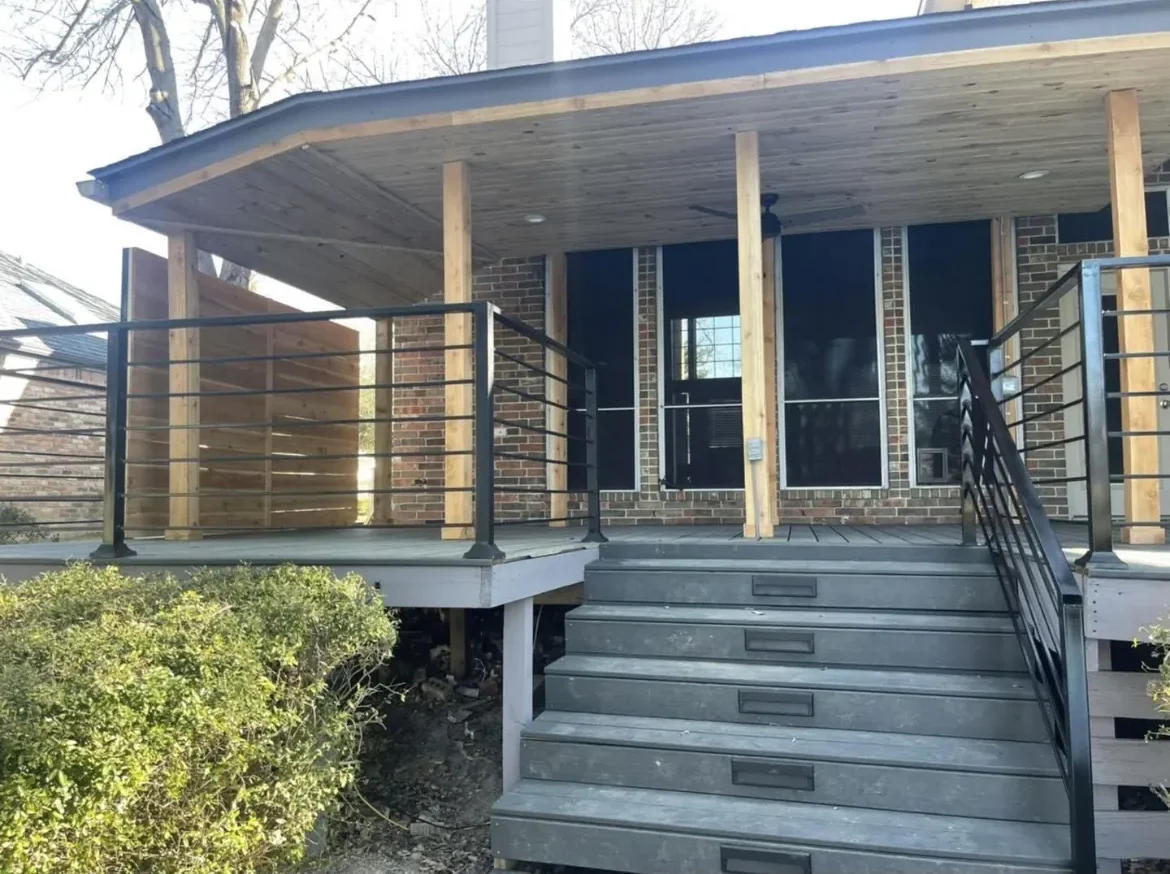
Each section below gives the short answer and the key number for one part of a Dallas deck project, then points you to the full guide on that topic. City rules come from the City of Dallas's own code documents, and weather numbers come from the National Weather Service station at DFW Airport.
What should you know before building a deck in Dallas?
Five things shape every Dallas deck: heat, clay, the city permit, your HOA or district, and budget. Here is the 60-second version.
- Heat: DFW averages about 20 days a year at 100°F or hotter, based on 1991 to 2020 normals.
- Clay: Houston Black, the classic Blackland Prairie clay, has high shrink-swell potential and cracks 1/2 to 4 inches wide in dry spells.
- Permit: a deck skips the City of Dallas permit only if it meets all five exemption conditions, including 200 sq ft or less and no more than 30 inches above grade at any point.
- HOA or district: the city's no-permit list does not apply in historic, conservation and planned development districts, and an HOA has its own approval on top of the city's.
- Budget: Block Renovation puts Dallas decks at $15 to $30 per sq ft in pressure-treated wood and $25 to $50 in composite, and Remodeling's 2025 Cost vs Value report puts a Dallas wood deck addition at $15,841.
How does Dallas weather affect a deck?
Dallas decks have to survive long, sunny, humid summers with about 20 days a year at 100°F or more, spring hail and storms, and roughly 29 freezing nights each winter. The National Weather Service describes DFW as humid subtropical with hot summers, July and August highs consistently in the 90s and often reaching 100 or more, and nights that occasionally stay above 80°F.
| DFW climate at a glance | Number |
|---|---|
| Normal high, July | 95.6°F |
| Normal high, August | 95.8°F |
| Days at 100°F or hotter | About 20 a year (June 1.6, July 7.4, August 9.7, September 1.4) |
| Most 100°F days in one year | 71 (2011) |
| Nights at 32°F or colder | 29.2 a year (10.6 in January) |
| Normal low, January | 36.1°F |
| Normal yearly rain | 37.01 inches |
| Wettest and driest months | May (4.78 in) and October (4.37 in); driest is July (2.08 in) |
| Sunshine | 75% of possible in July, 73% in August |
| Average July dew point | 70.9°F |
| Thunderstorm days | 46.5 a year, most in May (7.7) |
Source: NWS Fort Worth/Dallas, DFW Airport. Temperature, rain, 100°F-day and freeze rows are 1991 to 2020 normals; the sunshine, dew point and thunderstorm rows are longer-term averages from the same NWS page, and the 100°F record runs through 2024. Yearly rain swings a lot: the NWS says it has ranged from under 20 inches to over 50.
What the heat means for your deck. With about three-quarters of possible sunshine in July and the year's 100°F days landing mostly in July and August, an open deck in full sun gets very little relief in summer. That is why shade, board color and board type matter as much in Dallas as the size of the deck. A roof over part of the deck, a pergola, or a deck placed on the shady side of the house changes how many months you actually use it. Lighter colors and boards sold for lower heat are worth comparing side by side; the coolest decking materials for Texas heat guide has the surface-temperature numbers.
What storms mean. The NWS says large hail, damaging winds, flooding and tornadoes occur nearly every year in the Metroplex, with spring as the peak. Statewide, Texas had 902 major hail events (1 inch or larger) in 2025, the most of any state, according to the Insurance Information Institute; that figure is for all of Texas, not Dallas alone. Railings, covers and board choice all play into how a deck handles hail. See hail and storm damage on Texas decks for what to check after a storm.
What the cold means. DFW does get about 29 freezing nights a year, but the Dallas code sets a shallow 6-inch frost line, so cold is a smaller design factor here than heat and clay.
Go deeper: if you want shade built in from day one, see covered decks and pavilions in Dallas.
Why does Dallas clay soil matter for a deck?
Most of Dallas County sits on heavy Blackland Prairie clay that swells when wet and shrinks and cracks when dry, so deck footings move unless they are designed for it.
The Handbook of Texas describes Dallas County as 902 square miles of "primarily flat, heavy Blackland Prairie," with clayey soils across the eastern two-thirds of the county and along its western border. Texas Parks and Wildlife explains where that soil comes from: the Blackland Prairie sits on chalks, marls, limestones and shales that formed black, alkaline, heavy clay soils.
The best-known of those soils is Houston Black, a very deep, very slowly draining clay that the USDA classifies as a Vertisol and describes as "of large extent" in the Blackland Prairies. According to the USDA's official description:
- It is 40 to 60% clay.
- It has high shrink-swell potential.
- In dry periods, cracks 1/2 to 4 inches wide reach 12 inches deep or more.
- Those cracks stay open 90 to 150 cumulative days in most years.
For a deck, that means the ground under a footing can rise in a wet spring and drop in a dry August. A footing that is too shallow, too small or sitting in soil that stays soggy will move with it, and the deck goes out of level. Keeping water from pooling around footings helps, because the clay's movement is driven by wetting and drying.
What the Dallas code says. Dallas's amended code requires exterior footings at least 12 inches below undisturbed ground, sends deck footings to IRC section R507.3, and says decks not supported by the house do not need footings below the frost line, which Dallas sets at 6 inches. Dallas's amendment to section R401.2 also says foundations and footings regulated by the code must be designed and sealed by a Texas-registered engineer, so ask your builder how the footings on your plans are engineered.
Go deeper: footing depth, pier types and what a good footing plan looks like are in deck footings in Dallas clay soil. If you want a deck close to the ground, ground-level and floating decks in Dallas covers how low decks sit on clay.
Do you need a permit to build a deck in Dallas?
Usually yes: a Dallas deck skips the permit only if it is 200 sq ft or less, no more than 30 inches above grade at any point, not attached to the house, clear of overhead service lines and not serving the required exit door. Miss any one of the five and you need a permit, because Dallas requires one to build, enlarge, alter, repair or replace a structure.
| Dallas deck exemption test (single-family or duplex lot) | To skip the permit, the answer must be |
|---|---|
| Is the deck 200 sq ft or less? | Yes |
| Is every point 30 inches or less above grade? | Yes |
| Is it free of any attachment to the house? | Yes |
| Does it stay clear of overhead service-drop wires (the required clearance)? | Yes |
| Does it serve the home's required exit door? | No |
Source: Dallas Chapter 52, Sec. 301.2.1, item 13 (booklet current through April 23, 2025). Ordinance 33099, effective May 23, 2025, re-enacted the same five conditions.
Why answers online differ. The city's own FAQ gives a shorter deck line (30 inches high and not over a basement), and some websites repeat only that. The code text above is what controls. The FAQ also says its no-permit list does not apply in historic districts, conservation districts and planned development districts, so check your district before you rely on the exemption.
How the process works. The city's residential permits page lists a new deck as permit work, and DallasNow is the city's online portal for permits. Contractors must hold a City of Dallas registration to pull a permit; a homeowner doing their own work on the home they live in, with no paid help, registers as a homeowner. Required inspections include a footing inspection after the holes are dug and before concrete, and a rough frame inspection.
What it costs. Under the fee schedule effective July 1, 2025, Dallas charges a residential plan-review fee of at least $577, plus a permit fee, both figured at submittal. The full fee math is in the permit guide below.
Suburbs. Plano, Frisco, McKinney and the other suburbs set their own rules, so the Dallas exemption does not carry over. If you are not sure which city you are in, the Dallas service area page lists the nearby cities served.
Go deeper: Dallas deck and patio cover permits walks through fees, plans and inspections, and deck permits in Plano and Frisco covers the suburbs.
What building code does Dallas use for decks?
Dallas enforces the 2021 International Residential Code with local amendments (Ordinance 32424, effective May 12, 2023), not the 2024 edition some searches assume. The city council passed Ordinance 32424 on April 12, 2023, and violations can be fined up to $2,000.
A second ordinance updated it. Ordinance 33099, effective May 23, 2025, lets buildings with up to eight dwelling units count as residential (the code is now called the "Dallas One- to Eight-Family Dwelling Code"), kept the deck permit exemption, and says IRC section R507 "Exterior Decks" applies to newly installed and completely replaced decks. The city's Know the Code page lists Ordinance 33099 as the current Dallas amendment to the residential code.
The deck numbers most homeowners ask about:
- Guards (railings): required where the walking surface is more than 30 inches above the grade below at any point within 36 inches of the edge; guards must be at least 36 inches tall, or 34 inches along stairs. That is the 2021 IRC text, and we found no Dallas amendment to it. See deck railing height code.
- Stairs: Dallas's amendment allows risers up to 7 3/4 inches and treads at least 10 inches, with an exception for private steps serving fewer than 10 people (8-inch maximum riser, 9-inch minimum tread). See deck stair code in Texas.
- Footings: at least 12 inches below undisturbed ground, as covered in the clay section above.
- Ledger: how an attached deck connects to the house has its own detailed rules, covered in deck ledger board attachment.
Go deeper: for the order of work from the utility call and footings to the final inspection, see the deck building process step by step.
Do you need HOA or historic-district approval for a deck in Dallas?
If your home is in an HOA, a historic district or a conservation district, expect extra rules or a separate approval on top of the city permit, and settle those first.
HOAs. Community associations are common in Texas. The Foundation for Community Association Research counts about 23,500 associations in Texas, with about 6,407,000 residents and 2,322,000 housing units, and says 35.2% of US housing is in a community association. Those are state and national figures; we found no Dallas-only number. Block Renovation says master-planned DFW communities may restrict structures, including setbacks "often 5 to 15 feet" from rear and side lines, and that older neighborhoods without HOAs still follow city zoning. Treat that as Block Renovation's general statement and read your own HOA's rules.
Historic and conservation districts. The city's no-permit list does not apply in historic, conservation and planned development districts, so even a small, low deck may need review there. Dallas's Office of Historic Preservation handles historic districts, Landmark designation and Certificates of Appropriateness (the approval for work on landmark structures). Its phone number is (214) 670-4206.
Setbacks. Even outside an HOA, the city says required front, side and rear yards must stay clear and unobstructed except for fences, and the setback distance depends on your zoning district. Check your zoning before you set the deck's footprint.
Go deeper: what an HOA packet needs and how the review works is in HOA deck approval in DFW.
What kind of deck suits a Dallas house?
On Dallas's mostly flat lots, a low or ground-level deck often fits, while sloped yards, raised floors and pools call for elevated, multi-level or pool decks. Block Renovation notes that elevated decks are less common in DFW's generally flat terrain and cost more.
The age of Dallas housing shapes a lot of projects. U.S. Census Bureau ACS 2024 1-year figures (via Census Reporter) show:
- 599,962 housing units in the City of Dallas.
- A median year built of 1983.
- About 46.1% of homes built before 1980 (our calculation from 276,526 of 599,962 units).
- About 42.2% of occupied homes owner-occupied (our calculation from 226,859 of 537,317).
- A median value of $340,400 for owner-occupied homes.
With that many older homes, plenty of Dallas deck jobs replace an existing deck or attach to an older wall. Under Ordinance 33099, a completely replaced deck falls under the same R507 deck rules as a new one, so a replacement is built to current code, not to whatever was there before. If the new deck attaches to an older house, the condition of that wall and how the ledger connects to it matter.
How to think about the main choices:
- Attached or freestanding: a freestanding deck avoids the ledger connection and, if it is 200 sq ft or less and 30 inches or lower, may qualify for the permit exemption. An attached deck always needs a permit in Dallas.
- Low or raised: once any point is more than 30 inches above the grade below, the deck needs guards and a permit.
- Special decks: pool decks, multi-level decks, wraparounds, front-porch decks and rooftop decks each have their own cost and code questions.
Go deeper: types of decks compares the main styles, and attached vs freestanding decks covers the trade-offs of tying into the house.
Which decking material holds up best in Dallas?
There is no single best board for Dallas: pressure-treated wood costs less per sq ft than composite, and every option has to deal with full summer sun, so color and shade matter as much as the material. Only pressure-treated wood and composite have sourced Dallas per-foot prices in this guide, so those are the two in the table.
| Material | Dallas cost per sq ft (Block Renovation) | 12x16 ft deck (192 sq ft), before extras (our calculation) |
|---|---|---|
| Pressure-treated wood | $15 to $30 | About $2,880 to $5,760 |
| Composite | $25 to $50 | About $4,800 to $9,600 |
The 12x16 ft column is calculated from Block Renovation's Dallas ranges and leaves out stairs, railing and any cover.
Termites are a Dallas factor. The climate table in Dallas's code rates termite damage "Very heavy." Whatever you choose for the boards, ask how the wood in the frame and posts is protected and kept off the soil.
Cedar, PVC, hardwoods and metal are also options; the materials guides below compare them.
Go deeper: the Texas deck materials guide covers every option, and Trex vs cedar vs pressure-treated in Dallas is the head-to-head for the three most common choices. For a composite build, see composite decks in Dallas.
How much does a deck cost in Dallas, and does it pay back?
A new Dallas deck runs about $15 to $30 per sq ft in pressure-treated wood and $25 to $50 in composite (Block Renovation, 2026), and Remodeling's 2025 report puts a 16x20 Dallas wood deck at $15,841 with 99.8% recouped at resale.
Remodeling's Cost vs Value report prices one standard project in each city. Its wood deck is 16x20 feet with pressure-treated joists on 4x4 posts over concrete piers, pressure-treated boards, a built-in bench and planter, three steps to grade and a full pressure-treated railing.
| 2025 Cost vs Value | Job cost | Resale value | Cost recouped |
|---|---|---|---|
| Wood deck, Dallas | $15,841 | $15,813 | 99.8% |
| Wood deck, national | $18,263 | $17,323 | 94.9% |
| Composite deck, Dallas | $23,519 | $21,658 | 92.1% |
| Composite deck, national | $25,096 | $22,199 | 88.5% |
Spread over the 320 sq ft of that 16x20 spec, the Dallas job costs work out to about $49.50 per sq ft for wood and $73.50 for composite (our calculation from Remodeling's 2025 Dallas job cost). Those are higher than Block Renovation's per-foot ranges because the Remodeling project includes stairs, railing, a bench and a planter.
Dallas recoups more than the national average in both materials, though no report can promise what your house will sell for. Railings, stairs, a cover and permit fees all sit on top of the base deck price.
Go deeper: Dallas price ranges by material and add-on are in how much a deck costs in Dallas, and the full resale breakdown, including the regional numbers, is in deck ROI and resale value in Dallas.
How do you choose a deck builder in Dallas?
Dallas makes contractors register with the city before they can pull a permit, but the city says that registration is not a license and makes "no statement of the technical competency," so check finished work, reviews, insurance and who pulls the permit.
How to compare builders:
- Get a written scope. Size, height, material, railing, stairs, footings and any cover, so every price you compare covers the same deck.
- Confirm who pulls the permit. A registered contractor pulls it in their own name; a homeowner can register only for work on their own homestead with no paid help.
- Ask about the inspections. Dallas requires a footing inspection before concrete and a rough frame inspection, so ask when each will happen.
- Ask how the footings handle clay. Depth, footing type and whether the design is engineered, given Dallas's R401.2 amendment.
- Look at finished decks and recent reviews, and ask for proof of insurance.
Archetex Outdoor Design Co. is a Dallas deck builder that designs and builds custom composite and wood decks, covered decks and pavilions, pergolas and patio covers. Owner Matthew offers a free site visit and a written price, so you can compare it line by line with other bids.
Go deeper: the full list of questions and red flags is in how to choose a deck builder in Dallas.
How long does a Dallas deck last, and what upkeep does it need?
Sun, humidity, clay movement and very heavy termite pressure decide how long a Dallas deck lasts, so the frame, footings and finish schedule matter as much as the boards.
Each local factor wears on a deck differently:
- Sun: about 75% of possible sunshine in July and 73% in August bakes boards and finishes.
- Humidity and rain: an average July dew point of 70.9°F and about 37 inches of rain a year, with wet springs and falls, keep wood damp for long stretches.
- Clay: soil that cracks and swells through the year can shift footings, which shows up as sagging, gaps or a deck out of level.
- Termites: Dallas's code rates termite damage "Very heavy," so any wood in contact with or close to the ground needs regular checks.
Look underneath from time to time (posts, footings, ledger and joists) for movement, soft wood or termite signs.
Go deeper: expected lifespan by material is in how long a deck lasts in Texas, and termite signs and prevention are in termites and wood decks in Texas.
Dallas deck checklist: what to decide before you call a builder
Work through these in order and you will have what a builder needs for an accurate written price.
- Confirm your city. City of Dallas rules (2021 IRC with Dallas amendments) do not apply in the suburbs, which set their own.
- Check zoning setbacks and districts. Required yards must stay clear, and historic, conservation and planned development districts have extra review.
- Get HOA approval in writing first, if you have an HOA.
- Decide attached or freestanding, and the height. Over 30 inches above grade means guards at least 36 inches tall and a permit.
- Size it. Remodeling's benchmark deck is 16x20 feet (320 sq ft), a useful yardstick.
- Plan shade for July and August, when normal highs sit near 96°F and most 100°F days land.
- Pick a material and a lighter color. Block Renovation's Dallas ranges: $15 to $30 per sq ft for pressure-treated wood, $25 to $50 for composite.
- Ask how the footings will handle clay: at least 12 inches below undisturbed ground, the footing type, and how they are engineered.
- Confirm the builder is registered with the city and will pull the permit.
- Expect footing and frame inspections, and don't pour concrete before the footing inspection.
- Budget for the whole job, including railing, stairs, any cover and a plan-review fee of at least $577.
- Plan upkeep and termite protection from the start.
If you would like a second set of eyes on your plan, you can request a free site visit and written price from Archetex.