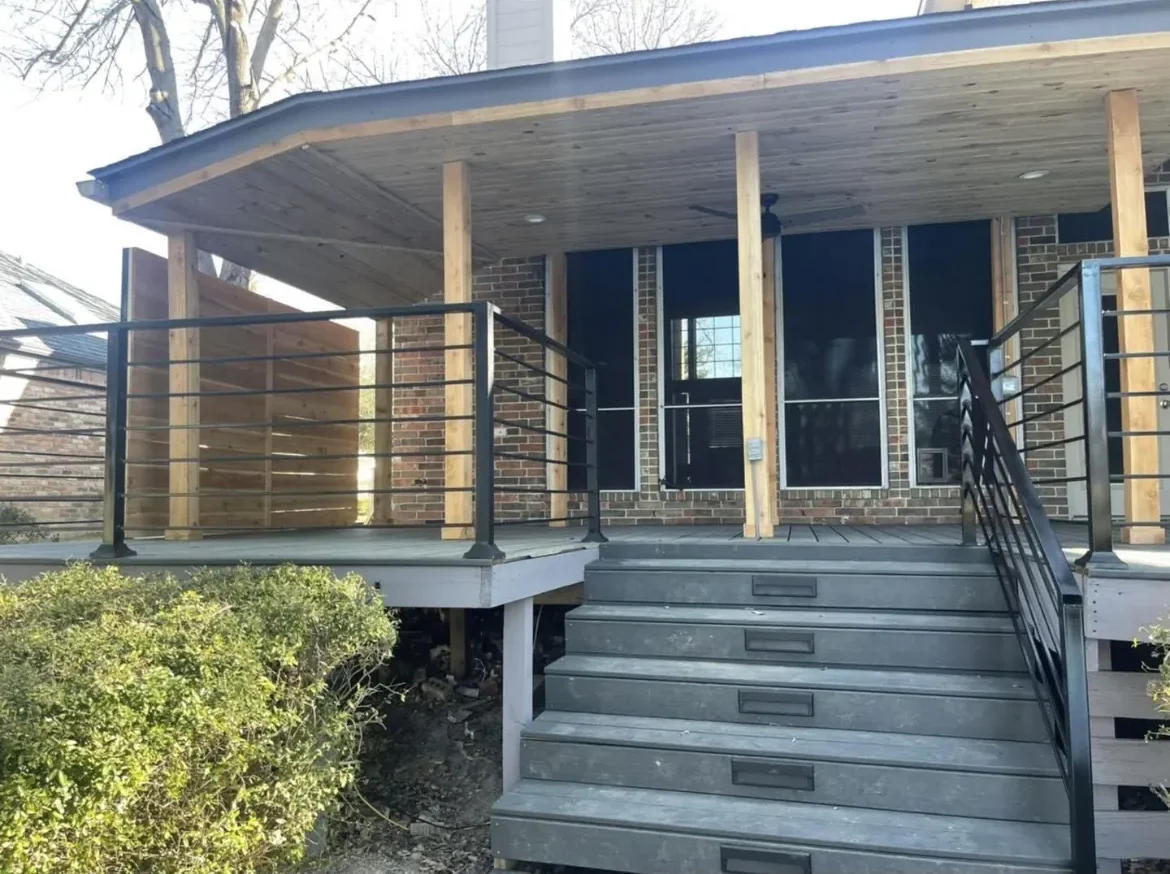
How often should you stain a deck in Texas?
Every 2 to 3 years for a penetrating semi-transparent stain and every 1 to 2 years for a clear water repellent, sooner on boards in full afternoon sun. The USDA Forest Products Laboratory (FPL) Wood Handbook gives semi-transparent stain on new smooth decking an expected life of 2 to 3 years and a tinted deck finish 1 to 2 years. A clear water-repellent preservative lasts only 1 to 2 years, though it's easy to reapply.
The FPL says these are estimates for an average US location and that finish life "depends on climate and exposure." It also says the shaded side of a structure may not need re-staining nearly as often as the sunny side. So on a Dallas deck, the sunniest boards set the schedule.
Ready Seal, made in Weatherford, Texas, since 1992, recommends a light cleaning and recoat every 2 years on horizontal surfaces and every 3 to 4 years on vertical ones such as rails.
The FPL says keeping water beading on the surface is the best way to prevent checking and get 40 years or more from a wood deck, and that decks are most often replaced for checking and splitting, not rot. See how long a deck lasts in Texas for the rest of the upkeep.
Deck stain maintenance schedule by wood: pressure-treated, cedar and ipe
The schedule depends more on the finish than on the wood, but each wood has its own first-coat and recoat quirks.
| Wood | First finish | Recoat | Notes |
|---|---|---|---|
| Pressure-treated pine | When water drops soak in (Viance says typically 60 days after installation) | 2 to 3 years for semi-transparent stain, 1 to 2 for a clear repellent (FPL) | The brown copper color lasts about 2 years; FPL says maintain it with a finish even if the treater added a water repellent. |
| Western red cedar | Ready Seal says 2 to 4 weeks of dry time | Same FPL ranges by finish | No steel wool or steel wire brushes: iron leaves blue-black stains. |
| Untreated pine, spruce or fir | Ready Seal says 1 to 3 weeks of dry time | Same FPL ranges by finish | Ready Seal wants wood at 12% moisture or less. |
| Ipe and other dense hardwoods | Follow the oil maker's label | Ready Seal says ipe, garapa and tigerwood may need it yearly | They don't soak up enough stain. |
| Composite and PVC | None | None | Not a stained material; care is cleaning. |
With new treated lumber, the FPL's rule is that nothing will coat wet wood well, so wait for it to dry or buy kiln-dried-after-treatment (KDAT) lumber. The full wait-time table is in our pressure-treated deck guide. Cedar care is in our cedar deck guide, oiling ipe or letting it go gray is in our ipe deck guide, and composite owners can skip stain and read our composite deck cleaning guide.
Why the makers disagree on when new wood is ready
Makers' waits before the first coat run from 3 days to 12 months:
| Maker and product | What the maker says about new wood |
|---|---|
| Cabot Australian Timber Oil | Dry in the open air 3 to 5 days, then do a water test. |
| Ready Seal | Treated lumber at least 1 month, 2 to 3 months recommended. Cedar 2 to 4 weeks. Pine, spruce or fir 1 to 3 weeks. |
| TWP 1500 Series (Gemini Coatings) | Weather 4 to 12 months, then clean, rinse and dry 48 hours. Strip the surface wax on new ACQ treated wood until it stops beading. |
Part of the spread is finish type. The FPL says film-forming finishes put on wood that has had about 1 week (low-density wood) or 4 weeks (high-density wood) of sun tend to peel, while finishes that don't form a film don't. It calls the old advice to let a deck weather before painting it "the source of much pain." The rest is how wet the lumber is. The rule every source shares is the water test: Cabot, Sherwin-Williams and Viance all say that if a few drops soak in, the wood is ready.
Stain or sealer? Penetrating vs film-forming finishes for decks
Use a penetrating finish on a deck (a clear water repellent or a semi-transparent oil stain). Solid stains and paint form a film that peels on horizontal boards.
The FPL says penetrating finishes flow into the wood and form no film, so "they cannot crack or flake," and refinishing is just cleaning and another coat. It calls them an excellent choice for decks, and says film-forming finishes on decks often last no longer and are harder to redo. Peeling is common with film finishes on decks, and solid-color stains peel like paint. Solid stains also lack abrasion resistance, and makers generally don't recommend them for decks.
| Finish | Forms a film? | How it fails | Expected life on decks (FPL) | UV protection |
|---|---|---|---|---|
| Clear water repellent | No | Loses repellency, fades | 1 to 2 years | Little; clear finishes are "not perfect" |
| Tinted or lightly pigmented | No | Wears and fades | 1 to 2 years new, 2 to 3 weathered | Partial; not enough pigment to stop UV damage |
| Semi-transparent oil stain | No | Wears away slowly | 2 to 3 years new, 3 to 6 weathered | More pigment, more protection |
| Waterborne "semi-transparent" | Often a thin film | Can peel and flake | Not rated separately | Depends on pigment |
| Solid stain or paint | Yes | Peels, wears under foot traffic | Low suitability for decking | Most pigment, but the film peels |
"New" means new smooth-sawn decking and "weathered" means weathered or saw-textured boards. Two catches: true clear water repellents are now hard to find, since almost all are lightly pigmented, and because of VOC limits it is now very hard to find a penetrating stain that doesn't form a film. Test any product sold as penetrating: if the stained surface has a sheen, it's a film and can peel. A second coat can form a film even when the first didn't, so wipe off the excess right away.
What the stain makers say about recoat intervals (and why they don't agree)
Makers' numbers on decks run from 1 year to "up to 6 years" for a semi-transparent stain (Behr claims up to 10 for a solid stain), so treat the label as a best case and the water test as the real signal. Every figure below is the maker's own claim.
| Maker and product | Maker's recoat claim for decks | Maker's application temperature |
|---|---|---|
| Ready Seal | Every 2 years on horizontal surfaces (3 to 4 vertical); life expectancy 1 to 3 years horizontal | No limit if wood is clean and at 12% moisture or less |
| Sherwin-Williams SuperDeck Waterborne Semi-Transparent | "Up to three years," 3 Year Limited Warranty | 50 to 90°F (Sherwin-Williams staining guide) |
| Behr Semi-Transparent Waterproofing Stain and Sealer | Up to 6 years (Transparent up to 4, Solid Color up to 10) | 50 to 90°F |
| TWP 1500 Series | None printed: clean first, then decide if a coat is needed | 50 to 90°F |
| Cabot Australian Timber Oil | None found | 50 to 90°F, air and surface |
| Olympic Elite Transparent Woodland Oil (Low VOC) | None found | Dries in 24 hours at an optimal 50 to 85°F |
Why the spread? Behr's figures are "up to" claims tied to the deck's age: Transparent for decks with up to 5 years of exposure, Semi-Transparent for 0 to 10 years, Solid Color for 15 years or more. The FPL's 2 to 3 years for semi-transparent stain on new decking is an average, not a best case, and Behr's 10-year Solid Color claim sits against the FPL's warning that solid stains peel on decks. Floors also take more weather than rails, which is why Ready Seal gives 2 years for one and 3 to 4 for the other.
Cost guides don't agree either: Angi says three to five years in one section and about 2 to 3 in its FAQ, and HomeGuide gives oil-based stain 3 to 5 years without a source. The FPL and Ready Seal are the stronger sources.
How Texas sun, heat and sprinklers wear out a deck finish
UV light breaks down the wood surface under a thin stain, heat and wetting cycles add stress, and daily sprinkler hits age boards faster, so DFW's 20 days a year at 100°F or more push you to the short end of every range.
The FPL says UV starts breaking down wood near the surface, and moisture, temperature swings, wind-blown grit and mildew make it worse. Bare wood erodes about 1/4 inch per century. Almost all pigments block UV, while clear finishes "are not perfect," and Ready Seal says UV-damaged surface cells on clear-finished wood slough off and take the finish with them.
National Weather Service normals for 1991 to 2020 show DFW averaging 20.2 days a year at 100°F or more, with 7.4 in July and 9.7 in August. By our math from those normals, July and August alone average 17.1 such days. No Texas stain-life study exists, so this is reasoning, not a test result: full sun and heat put you at the short end of the FPL's ranges, and shade at the long end.
Ready Seal says daily or every-other-day sprinkler contact ages wood early and leaves mineral rings, and recommends an extra coat on those areas.
How to tell if your deck needs stain: the water, sheen and tape tests
Sprinkle water on the sunniest boards: if it soaks in fast instead of beading, the deck is due, and if it still beads, wait.
- Water drop test. The FPL says that when pigment is still on the wood but a drop soaks in quickly, a coat of clear water repellent may be all you need, and may buy another year. Read your label first: Ready Seal says its stain beads water at first but is designed to spread water out so the wood dries faster.
- Sheen test (after you stain). If the finish still looks shiny an hour after you apply it, it hasn't soaked in. Remove the excess, because thin films may crack and peel within a year or two.
- Tape test. Press a strong tape onto the wood and snap it off. Wood fibers on the tape mean the surface is sunburned and a film finish will peel; the FPL says sand off about 0.004 inch and test again. This matters most if you're switching to solid stain or paint, since a penetrating finish lasts longer on sunburned wood than on fresh wood.
Mildew on the surface also usually means it's time to refinish.
Beading means two different things. On a new or freshly cleaned deck, beading means the wood isn't ready for stain yet. On a finished deck, it means the finish is still working.
How to prep a deck for stain: cleaners, brighteners, stripping and sanding
Clean every time, brighten when the wood is dark or stained, and strip or sand only when an old film is peeling. Olympic calls cleaning the most important step.
- Brush and clean. For a penetrating stain, the FPL says to brush off dirt and loose fibers with a dry stiff-bristle brush, remove mildew and re-stain, and the second coat often outlasts the first. Many deck cleaners use sodium percarbonate, an oxygen bleach that removes mildew and is reported to be gentler on cedar and redwood than chlorine bleach; sodium hydroxide cleaners pulp the wood and are a last resort. Ready Seal's light cleaning is 1 part bleach to 1 part water, two rinses, and 48 to 72 hours of drying.
- Brighten if needed. Oxalic-acid brighteners remove tannin bleed and iron stains but not mildew.
- Strip only a peeling film. Behr starts a worn, peeling deck with a stripper. TWP says any previous finish must come off first, by stripper, 60 to 80 grit sanding or power washing. Ready Seal can go over old Ready Seal without stripping.
- Sand lightly and let it dry. Behr calls for a light sanding of loose fibers (its supply list says 150 to 220 grit) and about 24 hours of drying after cleaning.
Keep a pressure washer at low pressure. The FPL says power washing wears away the soft wood between growth rings faster than the hard wood, leaving a washboard surface, and low-pressure washing does the least damage. Olympic says low to moderate pressure. On cedar or redwood, never use steel wool or steel wire brushes.
Don't put an oil-based semi-transparent stain over a film-forming finish. An old solid stain or paint has to come off first.
When to stain a deck in Dallas: the best months and the weather window
April, May, September and October are the four months when DFW's normal highs stay at or below 90°F and normal lows stay at or above 50°F, the range most stain cans list. That's our arithmetic from NWS normals; normals are averages, so check the forecast.
Sherwin-Williams, Behr, TWP and Cabot all list 50 to 90°F, and Olympic gives 50 to 85°F as optimal for drying. DFW's 1991 to 2020 normals:
| Month | Normal high (°F) | Normal low (°F) | Inside 50 to 90°F? |
|---|---|---|---|
| January | 56.5 | 36.1 | No (cold nights) |
| February | 60.9 | 40.1 | No (cold nights) |
| March | 68.6 | 47.8 | No (cold nights) |
| April | 76.1 | 55.2 | Yes |
| May | 83.6 | 64.5 | Yes (wettest month) |
| June | 91.5 | 72.2 | No (hot afternoons) |
| July | 95.6 | 75.8 | No (hot afternoons) |
| August | 95.8 | 75.7 | No (hot afternoons) |
| September | 88.6 | 68.5 | Yes |
| October | 78.4 | 57.1 | Yes (second wettest) |
| November | 66.6 | 46.2 | No (cold nights) |
| December | 57.9 | 38.3 | No (cold nights) |
May and October are also DFW's two wettest months, with normal rainfall of 4.78 and 4.37 inches and 6.4 and 4.8 days with a tenth of an inch or more. Pick a dry spell.
Mornings are damp. Normal relative humidity at 6 am runs 79 to 87% all year and drops to 49 to 61% by noon. The FPL's weather rule, written for latex coatings (so follow your can), says the dew point is a good estimate of the night's low and to avoid late afternoon if heavy dew is expected. DFW's average dew point is 54.7°F in April, 64.0°F in May, 65.4°F in September and 56.5°F in October. Let the dew burn off before you start and finish well before evening.
In summer, start early on the shady side: Sherwin-Williams says to avoid midday and direct sun, HomeGuide says to avoid staining above 90°F, and the FPL warns against hot surfaces in direct sun. In winter, the exception is Ready Seal, which says it has no temperature restrictions if the wood is clean and at 12% moisture or less.
How long after rain (and before rain) can you stain a deck?
Give the boards one to three dry days after rain or washing, and a dry forecast for one to three days after you finish. The exact numbers depend on the can.
| Source | Wait after rain or washing | Dry weather needed after |
|---|---|---|
| Sherwin-Williams | 2 to 3 days after a rainstorm | Not stated |
| TWP 1500 | 48 hours after the wood was last wet | No rain within 48 hours; no rain or cold for 2 to 3 days |
| Behr | At least 24 hours; no moisture 1 to 2 days before | No moisture 1 to 2 days after |
| Ready Seal | 48 to 72 hours after cleaning | Not stated |
| HomeGuide (cost guide) | 24 to 48 hours after rain | Dry all day |
- Brush it on. The FPL says brushing is best on decks, because rollers and sprayers can put too much on horizontal surfaces.
- Do two or three boards at a time with a wet edge to avoid lap marks.
- Wipe off what doesn't soak in. TWP says after 30 to 60 minutes, or it leaves an oily film and fails early.
- Two coats only if the label says so. TWP calls for two on floors; Cabot's timber oil is one coat.
- Plan the time. Sherwin-Williams says 4 hours between coats and 24 to 48 hours before use. HomeGuide estimates about 4 hours of work per 100 sq ft, over two days.
Safety: rags wet with oil-based stain can catch fire on their own, so put them in water in a sealed metal container. The fungicides in repellents and semi-transparent stains are toxic and may kill plants, so cover beds and soil.
VOC rules: what the g/L number on the can means in DFW
Deck stains made for sale in the US must meet federal VOC limits (550 grams per liter for clear and semi-transparent stains), and VOC limits are a big reason true penetrating stains are now harder to find.
The federal rule (40 CFR 59, Subpart D) covers coatings made on or after September 13, 1999 for sale in the US: clear and semi-transparent stains 550 g/L, opaque stains 350 g/L, low-solids stains 120 g/L, and waterproofing sealers 600 g/L. TWP 1500 lists 350 g/L maximum and Ready Seal says under 250 g/L.
VOCs help form ozone, and the 10-county DFW area (Collin, Dallas, Denton, Ellis, Johnson, Kaufman, Parker, Rockwall, Tarrant and Wise) is in severe nonattainment for the 2008 ozone standard. Nine of those counties, all but Rockwall, are in serious nonattainment for the 2015 standard, effective July 22, 2024. TCEQ's VOC surface-coating rules under 30 TAC Chapter 115 apply in those counties, but they cover surface coating processes, and the rules' exemptions section says architectural coatings applied in the field to stationary structures are not included in its calculations. We found no separate Texas VOC limit for the deck stain a homeowner buys, so the federal limits above are the ones to know.
TWP's official distributor says it can't ship the older TWP 100 Series to 18 states and areas because of low-VOC laws; Texas isn't on its list. The FPL's practical warning: low-VOC waterborne stains often get their look from a thin film that can peel, so do the sheen test.
How much does it cost to stain or seal a deck in Dallas? DIY vs pro
National cost guides put professional deck staining at about $1.57 to $5 a square foot and DIY at $0.50 to $1.50. We couldn't find a Dallas-specific price list, so treat these as national ranges.
HomeGuide says $1.57 to $4.04 per sq ft, with most people paying $450 to $1,000 and a national average of $730; labor is about 75% of it. Fixr says $2 to $5 per sq ft including light sanding and sealing, averaging $750. Angi says $2 to $4, typically $550 to $1,250, averaging about $850.
| Deck size | DIY (HomeGuide, national) | Pro (HomeGuide, national) |
|---|---|---|
| 10 x 10 ft | $41 to $134 | $157 to $404 |
| 12 x 16 ft | $78 to $222 | $301 to $775 |
| 16 x 16 ft | $104 to $283 | $401 to $1,034 |
| 20 x 20 ft | $164 to $422 | $628 to $1,616 |
| 24 x 24 ft | $236 to $590 | $904 to $2,327 |
| Job (pro) | Cost per sq ft (national) | Source |
|---|---|---|
| Stain and seal only | $0.50 to $1.50 | HomeGuide |
| Power wash, stain and seal | $1.00 to $2.50 | HomeGuide |
| Power sanding, stain and seal | $2.00 to $4.00 | HomeGuide |
| Strip, stain and seal | $2.50 to $5.50 | HomeGuide |
| Sealing only | $0.75 to $4.00 | Fixr |
| Power washing only | $0.35 to $0.77 | HomeGuide |
| Railings | $4 to $12 per linear ft | HomeGuide |
Worked example, 16 x 20 ft deck (320 sq ft). Calculated from HomeGuide's and Angi's per-square-foot ranges: about $502 to $1,293 for a pro at HomeGuide's rate, $640 to $1,280 at Angi's, and $160 to $480 to do it yourself at HomeGuide's DIY rate. HomeGuide says stain runs $20 to $50 a gallon and covers 200 to 300 sq ft per gallon, and a pressure washer rents for about $38 a day. By our math, one coat on 320 sq ft takes about 1.1 to 1.6 gallons, so buy 2, more for a two-coat product like TWP.
DIY or hire it out? DIY makes sense if the old finish is a penetrating stain in decent shape: clean, dry and recoat, with no stripping. Hiring out makes more sense when an old film is peeling and has to be stripped, which is where HomeGuide's price climbs to $2.50 to $5.50 a square foot.
What stain can't fix: end cuts, the frame and boards past saving
Stain protects the top of the boards, not the cut ends or the frame. Treated-wood makers say field cuts need a brush-on preservative, because deck stains and sealers don't count.
Viance, citing the AWPA M4 standard, says cuts and holes that reach past the treated zone must be field treated, and "deck stains and sealers do not provide adequate protection." The American Wood Council, quoting the AWPA, says cut ends and drilled holes need a preservative such as copper naphthenate, and that the copper naphthenate specified in AWPA Standard M4 for field treatment contains 2% copper.
A fresh coat won't fix the frame either, so check the deck safety inspection signs before you restain. If boards are badly checked and split, the most common reason decks get replaced, compare the cost of resurfacing or reboarding first.
If you're replacing the deck instead of refinishing it, composite boards need no stain at all, and Archetex Outdoor Design Co. designs and builds new wood and composite decks in Dallas and nearby towns.