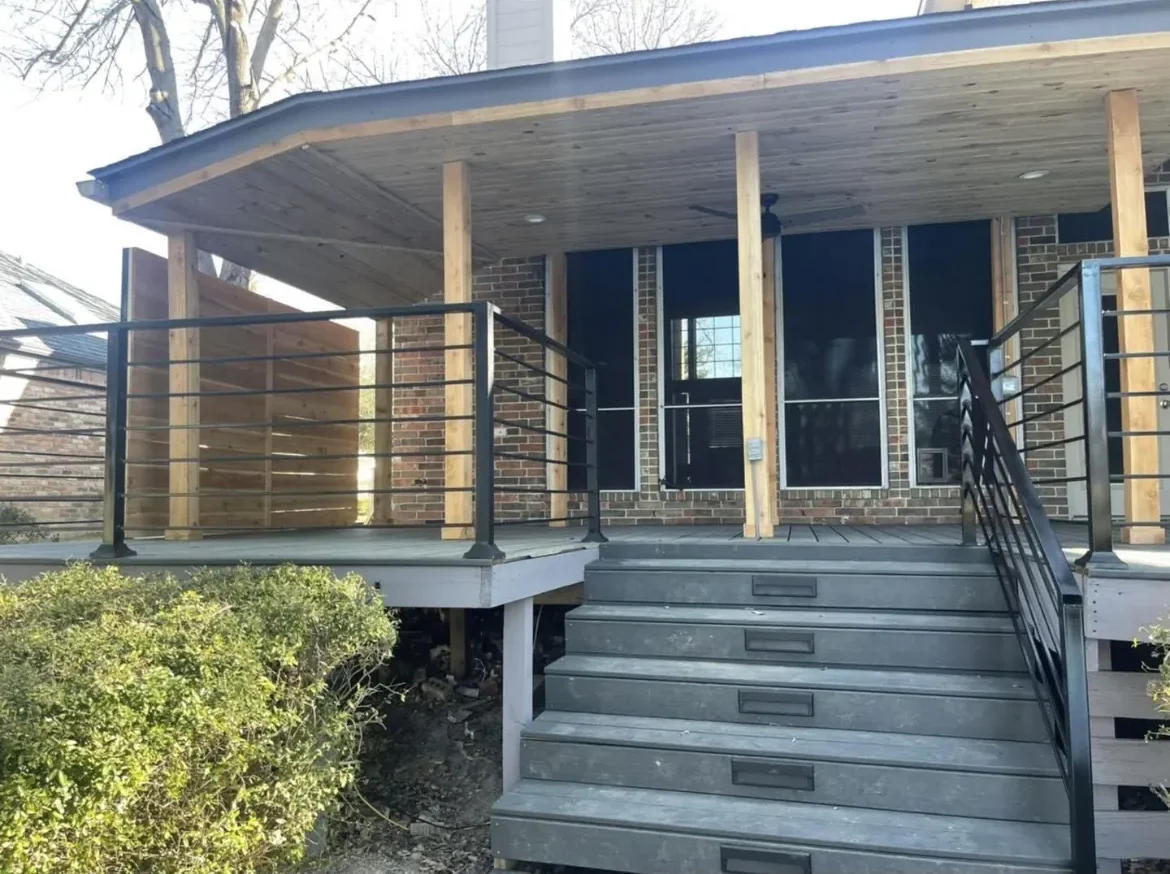
Use this page as a script when builders come out to see your yard. Ask each one the same 25 questions, write down the answers and compare. For reviews, portfolios and the full insurance check, see our guide on how to choose a deck builder in Dallas.
This is general consumer information, not legal advice; have a Texas attorney review any contract before you sign. Texas laws quoted here come from texas.public.law, a copy of the official statutes marked "verified" May 26, 2025, so later changes may not show.
What should you ask a deck builder before you sign?
Ask every builder the same 25 questions in six groups (credentials, permits, structure, materials and warranty, money, and the contract), then compare the answers side by side. Get written prices from at least three builders, as both the Better Business Bureau and Consumers' Checkbook advise.
Each question below gives the reason to ask, what a good answer sounds like and the answer that should worry you.
Credentials: is this builder who they say they are? (Questions 1 to 5)
Texas does not require general contractors to be licensed or bonded, according to TexasLawHelp.org, so ask for a city registration, insurance you can verify and customers you can call. The Texas Residential Construction Commission, which once registered home builders, was abolished when its law expired on September 1, 2009.
1. Are you registered with my city?
Dallas, Frisco and Plano each make contractors register with the city before they get a permit or start work.
What a good answer sounds like: They name your city and give the exact name they are registered under. In Dallas, an unregistered contractor can't get a permit; registration costs $120, lasts one year and, in the code's words, grants "no manner of license." You can check it on the city's DallasNow portal under "Search for a Licensee." Frisco requires registration before any work, and it expires the same day the builder's general liability insurance does. Plano requires the general contractor to register when the permit is issued.
Red flag: "Texas doesn't require anything."
2. What is your company's legal name, and is it registered with the state?
The name on your contract should be a business you can find again.
What a good answer sounds like: A legal name, address and phone number printed on the bid, which the Texas Department of Insurance (TDI) says a bid should include. The name should show up in a Texas Secretary of State search, which costs $1.00 per search on the Secretary of State's SOSPortal.
Red flag: Only a first name and a cell number.
3. Can I have your certificate of insurance and call the insurer?
A certificate of insurance is a one-page summary from the builder's insurer listing active policies and dates. TexasLawHelp.org says contractors should carry personal liability, workers' comp and property damage coverage.
What a good answer sounds like: They send it without being chased and expect you to call. TDI and the BBB both say to call the insurance company to confirm coverage.
Red flag: "I'm covered, trust me," or expired dates.
4. Do you carry workers' comp, or are you a non-subscriber?
A non-subscriber is a Texas employer that has opted out of workers' comp, which TDI says most private employers may do.
What a good answer sounds like: A plain yes with a carrier you can check on TXCOMP (NCCI), or a plain "we're a non-subscriber" and how they handle a worker injury. TDI requires non-subscribers to notify their employees and the state's Division of Workers' Compensation.
Red flag: They don't know the term, or change the subject.
5. Can I call three recent customers with decks like mine?
Past customers tell you how the job ran, not just how it looked at the end.
What a good answer sounds like: Names and numbers for similar jobs, plus an older deck you can see in person. Ask them TexasLawHelp.org's questions: how long ago, was it on time, were there unexpected costs, and did the crew show up on time and clean up?
Red flag: No references, or only relatives.
Permits, HOA and inspections (Questions 6 to 8)
A good builder tells you whether your deck needs a permit, pulls it in the company's name and books every inspection. TexasLawHelp.org notes most localities require permits "even for simple jobs like decks."
6. Does my deck need a permit, and will you pull it?
The permit is what gets an inspector to look at the parts you will never see again.
What a good answer sounds like: In Dallas, a deck skips the permit only if it is 200 square feet or less, no more than 30 inches above grade at any point, not attached to the house, clear of overhead service wires and not serving the required exit door. Anything else needs one, and the builder pulls it. Suburbs differ: see deck permit rules in Plano, Frisco and McKinney.
Red flag: "Pull it yourself." The FTC lists that as a scam sign and Consumers' Checkbook calls it "a huge, red flag." Dallas homeowner registration is for owners not helped by anyone being paid, so a permit in your name puts you in the contractor's role.
7. Which inspections will the city do, and will I see each one pass?
Inspections are timed to catch problems before they get covered up.
What a good answer sounds like: In Dallas, the footing inspection comes after the holes are dug and any steel is set, before concrete; work can't pass an inspection point without approval; and there is a final inspection before use. The American Wood Council's deck guide (DCA 6) also says a deck shall not be used until final approval.
Red flag: "We dig and pour the same day."
8. Who prepares the HOA submittal, and do you wait for approval?
If you live in an HOA, someone has to handle its approval process, and it should be clear who.
What a good answer sounds like: They say who draws and sends the HOA package and won't start until you have written approval. See HOA deck approval in DFW.
Red flag: "Build first, the HOA never checks."
Structure questions: footings, ledger flashing, PT joist framing, railings and stairs (Questions 9 to 15)
These questions decide whether a deck is safe, and a competent builder answers each with a number. Dallas enforces the 2021 International Residential Code (IRC) with local changes; DCA 6 is based on the 2015 IRC. The table shows which source each number comes from.
| Item | Number to listen for | Source |
|---|---|---|
| Footing depth | 12 in min below undisturbed ground (frost line 6 in) | Dallas amended IRC R403.1.4 |
| Ledger | 2x8 min, 2 lateral hold-downs at 1,500 lb | DCA 6 |
| Lumber treatment | UC3B above ground, UC4A ground contact | DCA 6 |
| 2x10 joist at 16 in on center | 14 ft 0 in span (No. 2 Southern Pine) | DCA 6 Table 2 |
| Guard | Over 30 in up; 36 in tall; no 4 in gap | 2021 IRC R312.1 (SMA guide) |
| Stairs | 7¾ in max riser, 10 in min tread | Dallas amended IRC R311.7.5 |
| Stair handrail | 4+ risers, 34 to 38 in high | DCA 6 |
9. How deep will the footings be, and what do they sit on?
A footing is the concrete base under each post that carries the deck down to firm soil.
What a good answer sounds like: In Dallas, at least 12 inches below undisturbed ground (the city's frost line is only 6 inches), sized to the load and inspected before the pour. DCA 6 adds that where soil may carry less than 1,500 pounds per square foot, a soils check sets the value. More in deck footings on Dallas clay.
Red flag: "We'll see when we dig."
10. How will the ledger be fastened and flashed?
The ledger is the board fastened to your house that carries one side of an attached deck, and it is where water gets in if done wrong.
What a good answer sounds like: Per DCA 6: siding off where the ledger goes, corrosion-resistant flashing, a 2x8 or larger ledger bolted into the house framing, and two lateral hold-downs rated 1,500 pounds each. DCA 6 says "DO NOT ATTACH TO BRICK VENEERS"; if the framing can't be confirmed, build freestanding or use an engineered plan. See how a deck ledger attaches and is flashed.
Red flag: Nails only, caulk instead of flashing, or bolts into brick.
11. What lumber will you frame with: species, grade and treatment rating?
Treated lumber is rated for above-ground use or ground contact, and the tag says which.
What a good answer sounds like: They name species and grade and use ground-contact lumber for posts and anything near soil. DCA 6 lists UC3B for above ground and UC4A for ground contact, with cut ends field-treated. The Texas Attorney General says you may write the grade or thickness of materials into the contract.
Red flag: "Just regular treated."
12. What joist size and spacing will you use?
Joists carry the deck boards, and too long a span makes a bouncy deck.
What a good answer sounds like: A size and spacing that match a span table. In DCA 6, a No. 2 Southern Pine 2x10 at 16 inches on center spans up to 14 feet 0 inches, and the overhang may not exceed one quarter of the span. Composite boards may need their maker's spacing (see question 13).
Red flag: "Sixteen inches, like always," with no span in mind.
13. What fasteners, hangers and flashing metal will you use?
Treated lumber corrodes cheap metal.
What a good answer sounds like: Per DCA 6: hot-dipped galvanized, stainless steel, silicon bronze or copper fasteners; galvanized (G-185) or stainless hangers; flashing at least 0.019 inch thick; no aluminum touching copper-treated lumber. For deck screws, clips and maker spacing rules, see hidden fasteners vs screws (and what voids a warranty).
Red flag: "Whatever's in the truck."
14. How tall will the railing be, and how are the posts attached?
A guard is the code term for a railing that stops falls. You can check it with a tape measure.
What a good answer sounds like: Guards wherever the deck is more than 30 inches above the ground within 36 inches out, at least 36 inches tall, with no opening a 4 inch ball can pass (2021 IRC R312.1, as reproduced in the Stairway Manufacturers' Association's 2021 IRC guide). DCA 6 calls for 4x4 or larger posts with hold-downs rated 1,800 pounds for a 36 inch guard. See deck railing height code.
Red flag: "Close enough."
15. What rise and run will the stairs have, and where do the stringers land?
Stairs show uneven steps and weak bases first.
What a good answer sounds like: Dallas's amended code: risers 7¾ inches max, treads 10 inches min, no more than 3/8 inch variation in a flight. DCA 6: 2x12 stringers, 36 inches wide, a 34 to 38 inch handrail at 4 or more risers, and 12 inch deep stair footings, not a patio slab unless it is founded that deep. See deck stair code in Texas. Planning a hot tub? DCA 6 says that load is beyond the guide, so ask who engineers it.
Red flag: Stringers resting on an old slab.
Materials, pro programs and warranty (Questions 16 to 19)
Get the exact product line in writing and keep two warranties apart: the maker's product warranty and the builder's workmanship warranty. Trex says it is not responsible for the work of the independent TrexPro contractors who install its boards.
16. Which exact decking line, color and railing system are you quoting?
Brands sell several lines, and two quotes only compare if they name the same one.
What a good answer sounds like: Brand, line, color, railing and fastener system written on the quote.
Red flag: "Composite" with no line named.
17. Are you a TrexPro or TimberTech pro, and what does that get me?
These are manufacturer programs, not licenses or quality inspections.
What a good answer sounds like: They name the tier and explain it: Trex tiers track how many Trex decks a builder installs each year, and TimberTech tiers track how much the builder buys. The main benefit is a maker labor warranty if the builder registers the job. Trex says choosing a builder is "the ultimate responsibility of the property owner."
Red flag: The badge offered as proof of quality.
| Program | How tiers are earned | Labor warranty | Conditions |
|---|---|---|---|
| TrexPro (TrexPro, Gold, Platinum) | Annual Trex builds; entry needs 3 registered Trex decks, 1 with Trex railing | 2023 document: 1 / 3 / 5 years for decking or railing; 2 / 6 / 10 for both | TrexPro installs and registers; labor only; residential. Ask for current terms. |
| TimberTech "The Board" (Member, Silver, Gold, Platinum) | Minimum sales: under $29,999 / $30,000 / $75,000 / $150,000 | 2026 brochure, launching June 2026: premium products 10 or 12 years (Platinum, Gold), 5 or 6 (Silver, Member) | TimberTech fasteners required |
Trex says TrexPro builders hold a contractor license and liability insurance "where required," so still check registration and insurance yourself (questions 1 and 3).
18. What workmanship warranty do you give, in writing, and will you register the product warranty?
The product warranty covers the boards; the builder's warranty covers the work.
What a good answer sounds like: A written term and scope in the contract covering materials and workmanship, as TexasLawHelp.org and the BBB advise, and the Texas disclosure statement says any warranty should be written into the agreement. They register the product warranty and follow the maker's instructions, since Trex excludes problems from improper installation, "including but not limited to improper gapping."
Red flag: "My word is my warranty." The same disclosure warns an oral promise left out of the agreement may not be enforceable.
19. If something goes wrong after you finish, how do we handle it?
Texas sets a process for construction defect claims.
What a good answer sounds like: They explain how to report a problem and point to the Chapter 27 notice in the contract. Under Texas Property Code §27.004, you send written notice by certified mail at least 60 days before suing; the builder may inspect up to three times within 35 days and make a written offer within 60 days. If the contract lacks the notice, the owner may recover a $500 civil penalty. Chapter 27 doesn't cover a builder who abandons the job.
Red flag: "Just call me," with nothing in writing.
Money questions: deposit, payments and liens (Questions 20 to 23)
Expect a partial deposit, payments tied to finished stages and paperwork showing every supplier and sub got paid. The Texas Attorney General says partial advance payment is normal, but don't pay in full until the work is done and inspected.
20. How much is the deposit, and what triggers each payment?
Paying ahead of the work is how homeowners lose money.
What a good answer sounds like: A modest deposit, then payments tied to stages you can see: footings inspected, framing, decking and rails, final walkthrough. Kevin Brasler of Consumers' Checkbook told WTOP a deposit of "say 10 or 20%" is reasonable for material-heavy jobs. TDI says pay by check or credit card, not cash.
Red flag: Most of the price up front, or cash only, both FTC scam signs.
21. Will my payments go into a construction account?
Texas treats homestead construction payments as trust funds.
What a good answer sounds like: Yes. Under Texas Property Code §162.006, a contractor with a written contract over $5,000 to improve a residential homestead must deposit the payments in a construction account. The Texas Attorney General says to ask for written proof.
Red flag: They have never heard of it.
22. Will you give me lien waivers with each payment and a bills-paid affidavit at the end?
A lien waiver is a signed statement that subs and suppliers have been paid, so they give up the right to a lien on your home.
What a good answer sounds like: Yes, on the Texas forms: a waiver counts only if it substantially follows a form in §53.284 (§53.281). At final payment they give an affidavit that everyone was paid, or list who wasn't; a false one can bring a fine up to $4,000, a year in jail or both (§53.259). Before work starts, they give a list of subs and suppliers, updated within 15 days of a change (§53.256). You, in turn, hold back 10% of the price during the work and for 30 days after (§53.101).
Red flag: "We don't do paperwork."
23. How do you price change orders and surprises like rotten framing?
Most budget fights start with work that wasn't in the price.
What a good answer sounds like: A written, priced change order signed by both of you before extra work goes ahead. The Texas Attorney General and the BBB both say change orders belong in the contract.
Red flag: "We'll settle up at the end."
Contract and schedule questions (Questions 24 and 25)
Before you sign, the contract should have no blanks, carry the Texas notices and name start and finish dates. The Texas Attorney General says not to sign a contract with blanks.
24. Will the contract include the Texas notices and disclosures?
Texas requires specific wording in home improvement contracts.
What a good answer sounds like: Yes, with a sample you can read before signing. Look for the items in the table below.
Red flag: Pressure to sign today.
| Document | What it says | Texas source |
|---|---|---|
| Homestead notice | 10-point bold "IMPORTANT NOTICE" in a contract to improve an existing homestead; leaving it out is a deceptive trade practice | Property Code §41.007 |
| Disclosure statement | "Know your rights and responsibilities," given before you sign | Property Code §53.255 |
| Homestead lien contract | Written, signed before work starts, by both spouses if married, filed with the county clerk; a notary other than the salesperson witnesses (Attorney General) | Property Code §53.254 |
| Chapter 27 notice | 10-point bold notice of the 60-day defect process | Property Code §27.007 |
| Three-day cancel | Sold at your home and over $25: cancel until midnight of the third business day | Bus. and Com. Code §601.051 |
25. Who will be on site, who is in charge, and what are the dates?
You need one person to call and dates to hold the job to.
What a good answer sounds like: They name the site lead and which work goes to subs, put estimated start and finish dates in writing and accept a "broom clause" making them responsible for cleanup. Don't sign a certificate of completion until the work is finished and the site is clean, the Attorney General says.
Red flag: "We'll fit you in."
Red-flag answers that should end the interview
Walk away if a builder won't write the price down, wants most of the money or cash up front, wants you to pull the permit or pushes you to sign today.
- Wants a signature before giving an estimate.
- Tells you to get the permit, or says you need none without checking.
- Shows up "in the area" with leftover materials.
- Steers you to a lender they know.
- Hands you a contract with blanks.
How to compare three builders' answers
Score every builder on one sheet with three columns: answers you could verify, answers with a number and answers they put in writing. Compare price last. The Texas Attorney General says most legitimate bids fall into a fairly close range, yet Consumers' Checkbook found some companies charge thousands more for the same work, so ask about any outlier.
Questions a good builder should ask you
A careful builder asks how you will use the deck, whether you have an HOA, whether it serves the back door and whether the wall is brick veneer, which DCA 6 says not to attach to. A quote with no questions is a guess.
Ask every builder these questions, us included. Archetex Outdoor Design Co. offers a free site visit and a written price, so you can set our answers next to everyone else's.