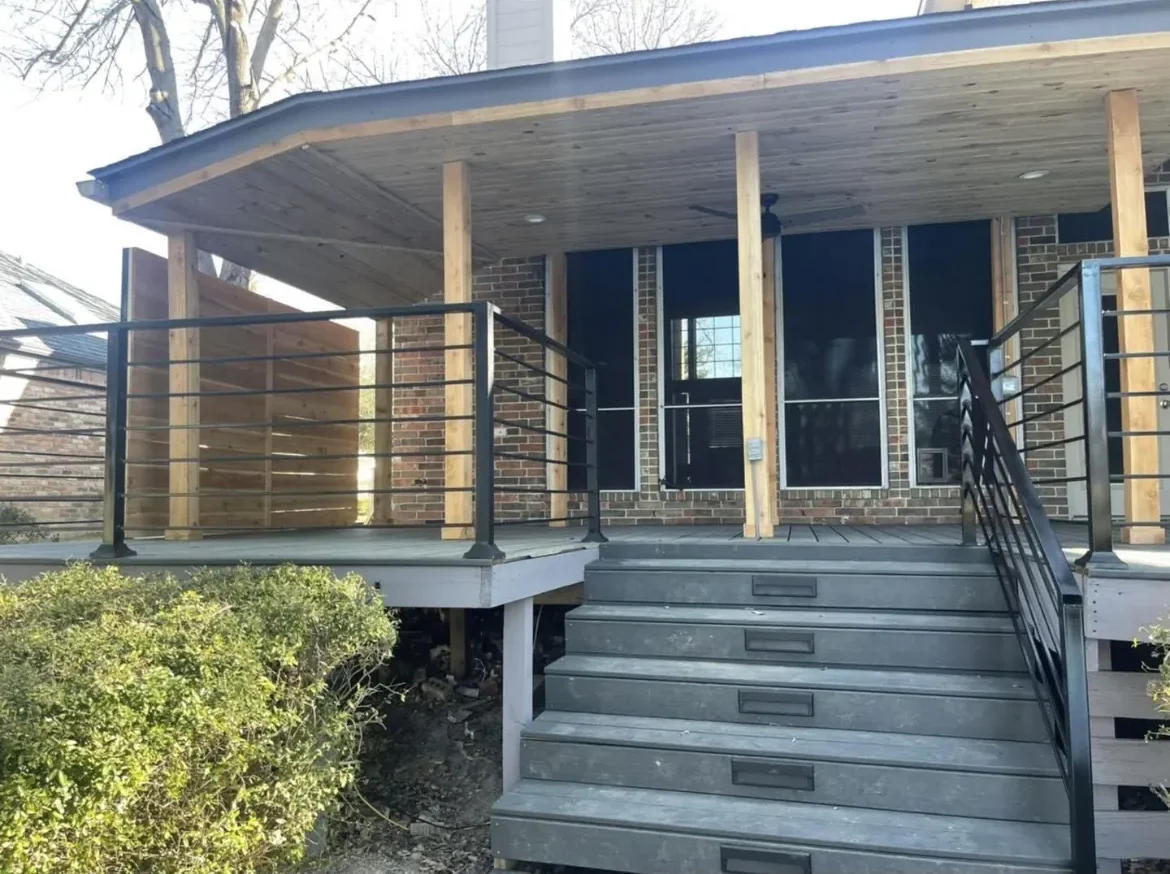
This guide uses the board makers' own install guides and warranties, an ICC-ES code report and dated trade-press figures, applied to a deck in Dallas heat. Where a number is our own arithmetic, we say so. For board widths and each brand's fastener lineup, see our Trex vs TimberTech vs Fiberon comparison.
Are hidden deck fasteners worth it?
For most composite decks, yes. They leave a smooth surface with no screw heads, and at Trex's list prices (November 2026) the clips add well under a dollar a square foot in hardware (about $0.84 against about $0.50 for color-matched screws, calculated below). The catch: more work at board ends and edges, and harder single-board swaps later.
Looks are the main reason people pay for them, contractors told the Journal of Light Construction (JLC) in 2011. As one builder put it in JLC's 2017 roundup: "There's not a perfect system out there."
Hidden fasteners are usually worth it if:
- Your grooved composite boards have a matching clip from the same maker.
- The deck sits high enough off the ground for good airflow. MoistureShield says hidden fasteners don't suit decks less than 12 inches above the ground.
Face screws make more sense if:
- You want to be able to swap a board easily. MoistureShield calls replacing a screwed board "generally easy," and Trex says a clipped board "takes a bit more finesse."
- The area is stairs, a picture-frame border or curved boards, which MoistureShield says may not suit clips.
- The frame is steel or aluminum and there's no clip made for it.
The four ways to fasten deck boards
There are three hidden methods (grooved-edge clips, edge screws and plugged screws) plus ordinary face screws, and the shape of the board's edge decides which ones you can use. A grooved-edge board has a slot milled along each long side for a clip to sit in. A square-edge board has plain, flat sides with no slot, so it has to be screwed through the top, through the edge at an angle, or screwed and plugged.
| System | How it works | Boards it fits | Examples | Gap set by |
|---|---|---|---|---|
| Grooved-edge clip | Clip sits in the grooves of two boards, screwed to each joist | Grooved boards (Trex says its square-edge boards can be routed for its clips) | Trex Hideaway, TimberTech CONCEALoc, Fiberon Phantom and EDGE | The clip (Trex's product page says about 1/4 inch; Fiberon Phantom 3/16 inch) |
| Edge screw | Screw angled through the board edge into the joist with a guide tool | Square-edge boards | CAMO Edge with the MARKSMAN PRO guide | The tool (3/16 inch; 1/16 inch on the pressure-treated version) |
| Screw and plug | Screw set below the surface, plug of board material tapped in | Square-edge boards | Cortex, Trex Hideaway Deck Plugs, Starborn PROPLUG | Spacers |
| Face screw | Color-matched composite screw driven flush through the top | Any board | Trex Color Match, TimberTech TOPLoc, Cap-Tor xd, TrapEase 3 | Spacers |
Which hidden fastener fits which board?
Grooved boards take the maker's own clip, square-edge boards take edge screws or plugs, and some clips only work on wood framing.
Trex
The Trex Hideaway Universal clip, for Trex grooved-edge boards, is a glass-filled nylon clip with a preset stainless steel screw, and a Trex answer on the product page says it is for wood framing only. Trex says its square-edge profiles can be routed for the clip. Its Hideaway Deck Plugs are made from Trex shell material for its solid-core lines, and on Trex Enhance they are the only approved plug system.
TimberTech
TimberTech says CONCEALoc is "Designed exclusively for TimberTech grooved boards," and that CONCEALoc is not compatible with steel or aluminum framing. Its Cortex and TOPLoc systems are for square-shoulder boards. TimberTech also warns that "Not all fastener types or brands work with every TimberTech board." Its install guide adds that Cortex isn't compatible with its Terrain, Prime or Prime+ lines.
Fiberon
Fiberon says hidden fasteners only work with grooved-edge boards. Its Phantom Universal clip is "For use with PE decking only," and its 2019 install guide says not to use Phantom clips on metal joists. Square-edge Fiberon boards are face fastened with Starborn PROPLUG (plugs made from Fiberon board material) or Cap-Tor xd color-matched screws.
CAMO edge screws
CAMO says its Edge Screws give "a fastener-free surface on square edge decking," including pressure-treated, composite, PVC, capped composite, cedar, redwood and hardwood boards. Its warranty does not cover hollow composite, hollow PVC, angled-edge grooved boards, aluminum, vinyl, or steel and metal framing.
PVC, pressure-treated, hardwood and steel frames
- PVC: it moves more with temperature than composite. See our PVC vs composite decking guide for expansion figures and handling rules.
- Pressure-treated pine: a 2001 JLC article noted that treated pine boards can vary in width by as much as 1/4 inch, which makes self-spacing clips harder to use.
- Hardwood: ipe and other dense woods use their own clips and pre-grooved boards. That detail lives in our ipe hardwood deck guide.
- Steel joists: Trex's Universal clip and TimberTech's CONCEALoc are wood-frame only. Our steel deck framing guide covers what to use on metal.
Do hidden fasteners void your deck warranty?
Not if you use the board maker's own system or one on its approved list. Trex won't cover conditions caused by non-approved fasteners, TimberTech denies claims caused by another fastener, and Fiberon says another maker's product voids its warranty. A decking consultant told JLC back in 2017 that some decking carries a warranty exclusion if you don't use the proprietary fasteners.
| Maker | What it says | What it means for you |
|---|---|---|
| Trex | Conditions caused by non-recommended or non-approved fasteners "shall not be covered under the Trex Limited Warranty" (2026 install guide). Approved list in Technical Bulletin TTB-031 Rev. A, dated 11/24/25. | Use a fastener on Trex's list, which includes other brands such as Tiger Claw TC-G, Cortex, Starborn Pro Plug, Simpson Deck-Drive DCU and CAMO Edge 1-7/8 inch in 316 stainless. |
| TimberTech | "Use of any alternative fastener does not void the TimberTech warranty," but if a decking failure is caused by that fastener, the related claims are denied. | Warranty stays, but fastener-caused problems aren't covered. |
| Fiberon | "Using another manufacturer's product will void your warranty." | On Fiberon boards, stick to Fiberon's own clips. |
| CAMO | If a correctly installed Edge screw causes a board to fail, CAMO replaces the board, except pressure-treated boards. | The screw maker backs the board, except treated lumber. |
How long the fastener warranties run
- Trex Hideaway clips: Trex's 2023 fastener warranty runs as long as the warranty on the Trex boards they hold. On another brand's composite, PVC or mineral decking it's 25 years residential and 10 years commercial, and claims from year 11 on are prorated.
- Fiberon: EDGE, EDGEX and STARTER clips carry a lifetime residential warranty; Phantom Universal and Phantom GT carry 20 years residential and 5 commercial.
- CAMO Edge: lifetime against defects and against rust and corrosion causing failure.
- Trex Color Match screws: Trex says they are "Backed by the same warranty as the Trex boards."
Both Trex's fastener warranty and its decking warranty exclude improper installation "including but not limited to improper gapping," and neither pays for labor or freight to remove and replace product. We found no current TimberTech fastener warranty to quote, so ask for it in writing.
Hidden deck fasteners vs face screws: cost per square foot
At Trex's list prices in November 2026, hidden clips run about $0.84 a square foot and color-matched face screws about $0.50, so the hardware difference on a 400 square foot deck is roughly $135. Labor comes on top of that and is harder to pin down; we found no current sourced figure for it, so ask for quotes both ways.
The hardware math (Trex's list price, November 2026)
- Clips: $41.99 divided by 50 square feet is about $0.84 per square foot. Clips only: the required install tool, start clips, butt-joint clips and edge-board screws are extra. Calculated from Trex's product page.
- Face screws: a 5.5 inch board plus a 3/16 inch gap covers 5.6875 inches, so one square foot of deck holds about 2.11 linear feet of board. Joists at 16 inches on center cross that board about 1.58 times, and Trex calls for two screws at each joist, so that's about 3.2 screws per square foot. At $222.99 for 1,400 screws ($0.159 each), that's about $0.50 per square foot. Calculated from Trex's install guide and product page. As a cross-check, CAMO's packs assume 350 screws per 100 square feet, or 3.5 per square foot.
- A 400 square foot deck: about $336 in clips against about $200 in color-match screws, so roughly $135 more for clips before tools and labor. Calculated from the two figures above, with boards square to joists at 16 inches.
What the trade press has reported (dated)
- JLC, 2017: some hidden systems add "$1 and up per square foot"; a Cortex kit for AZEK ran 77 cents per square foot; CAMO screws were about 20 cents per square foot once you owned the tool; pneumatic installation guns ran from about $300 to $800.
- Fine Homebuilding, 2011: one installer priced HIDfast clips at about $1.10 to $1.25 per square foot for 6 inch decking on 16 inch joists, which he called "comparable to other hidden fasteners on cost."
- JLC, 2011: one Virginia deck designer estimated a hidden fastener system on tropical hardwood added $2 to $3 per square foot.
Those older figures show scale, not today's prices. We found no prices on TimberTech's, Fiberon's or CAMO's own product pages.
Why hidden fasteners take longer to install
Clips go on at every joist, every butt joint needs a doubled joist or blocking plus extra clips, and the first and last boards still need face screws, plugs or brackets. A butt joint is where two boards meet end to end over the framing.
- Every joist: Trex says "Hidden Fasteners MUST be used at every joist." TimberTech's guide says to install one clip and one screw at each joist.
- Butt joints: Trex says a clip must always be at board ends and every board end must rest on framing; over a single joist you use its Butt Joint Clip, or add a 2x4 nailer and two clips. TimberTech calls for a doubled joist or sister block with two clips per board end, four per splice. The 2023 issue of ESR-3168, the ICC-ES code report for Trex Transcend and Select, requires multiple joists or blocking at board ends.
- First and last boards: TimberTech suggests an L-bracket or Cortex plugs on the first and last boards for a fastener-free look. A picture frame is a border of boards run around the deck's edge, and MoistureShield says clips may not suit it.
- Pre-drilling: to pre-drill is to bore a small pilot hole before driving the screw. TimberTech says Cortex needs a 7/32 inch pre-drill at every hole.
- Tools help: Tiger Claw, a fastener maker, said its gun lays "400 square feet of decking an hour" (JLC, 2017), and in 2011 a Fine Homebuilding installer laid 100 square feet of HIDfast in 10 to 15 minutes. Neither is an independent test.
Gapping and joist spacing rules by maker
Each brand sets its own side and end gaps, and improper gapping is a listed exclusion in Trex's warranties. For 1x6 Trex Transcend and Select, the ICC-ES code report allows joists 16 inches on center when boards run square to the joists and 12 inches when they run at 45 degrees.
| Rule | Trex (2026 guide) | TimberTech CONCEALoc | Fiberon (2019 guide) |
|---|---|---|---|
| Side gap | 3/16 in minimum; 3/8 in in heavily wooded areas; never over 1/2 in | 1/8 in minimum to 3/16 in maximum | 3/16 in |
| End gap by install temperature | 1/8 in above 40°F; 3/16 in below 40°F | 3/16 in at 32°F and below; 1/8 in at 33 to 74°F; 1/32 in at 75°F and above | Set by product line and install temperature (table in the guide) |
| Fasteners per joist | Clip at every joist; two screws per joist when face screwing | One clip and one screw per joist | Two face screws at every joist when surface fastening; two surface screws at the mid-board joist to pin clipped boards |
| Butt-joint framing | Butt Joint Clip, or 2x4 nailer plus two clips | Double joist or sister block, two clips per board end | Add 2x blocking where temperature swings are extreme |
| Distance from board end | At least 1 in from end and edge | Pre-drill within 1-1/2 in of the end | No face screws within 1-1/2 in of the end or 1 in of the side |
The 2023 issue of ESR-3168 lists these span ratings for 1x6 Trex Transcend and Select: 16 inches at 90 degrees to the joists, 14 inches at 60 degrees, 12 inches at 45 degrees and 8 inches at 30 degrees. Thicker 2x6 square-edge boards go to 24, 20, 16 and 12 inches. Every board must span at least three supports. On an older frame, check the joist spacing before choosing new boards.
Thermal movement in Texas heat: do composite boards move with hidden fasteners?
Yes. Composite and PVC boards grow and shrink along their length as they heat and cool, and clipped boards can creep, so Trex and Fiberon both tell installers to pin boards with screws where temperatures swing. That matters in Dallas, where the National Weather Service says July and August highs are consistently in the 90s, "often reaching or exceeding 100 degrees," and some nights stay above 80.
How much a board can move
Trex lists a thermal expansion rate of 0.000019 inch per inch per degree F for Transcend. For a loose 16 foot board, that works out to 192 inches times 0.000019 times 50 degrees, or about 0.18 inch (just under 3/16 inch) for every 50 degree change in board temperature. Calculated from Trex's spec sheet; fastened boards move less, and real movement depends on color, sun and how the board is held down.
What each maker tells installers to do
- Trex: where temperatures shift a lot within 24 hours, pre-drill and toenail a screw in the groove at both ends (at least 1 inch from the end) and at the center of each board.
- Fiberon (2019 guide): where extreme temperature swings are common, add 2x blocking at butt joints, and with hidden fasteners drive two surface screws at the joist nearest each board's midpoint to "pin" it, so it expands and contracts equally both ways.
- TimberTech: its butt-joint end gap shrinks to 1/32 inch when installing at 75°F and above. On a hot Dallas install day, that tight end gap is the one that applies.
PVC moves more (AZEK lists 0.0000337 against Trex's 0.000019), and Fine Homebuilding reported in 2019 that PVC installed with standard hidden clips "has been known to annoy homeowners with audible pops." AZEK also warns that sunlight reflected off low-E windows can make its boards "melt, sag, warp, discolor," and in those spots TimberTech recommends joists 6 to 8 inches on center and top-down fastening only.
Corrosion: stainless (305, 316) vs coated screws and clips
Coated carbon-steel screws are approved for ordinary inland composite decks, but CAMO requires stainless Edge screws for PVC, cedar, redwood and hardwood, and 316 is the grade named for salt, chlorine, wood strippers and ice melt. Simpson Strong-Tie puts it simply: "Stainless Steel is always the most effective solution to corrosion risk."
| Situation | What the makers say |
|---|---|
| Inland composite deck | Trex lists 300-series stainless or carbon steel with a corrosion-resistant coating as compatible. CAMO sells Edge screws in PROTECH coating or 316 stainless. |
| PVC, cedar, redwood, hardwood | CAMO says stainless is required. |
| Corrosive settings | Fiberon: "always use 305-grade or 316-grade stainless steel" screws. |
| Pool, chlorine, wood strippers, ice melt | CAMO requires 316. Trex's later fastener warranty excludes its decking screws exposed to pool and hot tub chemicals. |
| Near salt water | TimberTech and CAMO name 316 stainless; Trex says to use stainless near saltwater. Trex's later screw warranty excludes its decking screws within 1,500 feet of salt water. |
| The clips themselves | CONCEALoc clips are SAE 304 stainless. Trex Hideaway clips are glass-filled nylon with a preset stainless screw. |
Pool decks
A later version of Trex's Fasteners Limited Warranty (dated 2023-11-14, a Trex document we read in a copy hosted by the distributor Amerhart) excludes its color-match decking screws from installations "exposed to chemicals used in pools and hot tubs." It also excludes those screws on ground-level decks, sleeper systems and consistently wet uses. That exclusion covers Trex's screws, not its Hideaway clips. For a pool deck, check the screw's own warranty; CAMO calls for 316 stainless around chlorine. More in our pool deck guide for Dallas.
Framing and structural fasteners are a separate topic
Treated framing has its own fastener coating rules, covered in our pressure-treated deck guide. Deck-board screws and clips are not structural and never replace the ledger bolts or structural screws that hold a deck to the house; see our ledger board attachment guide.
Can you replace a deck board installed with hidden fasteners?
Yes, but it's more work. With clips you loosen the damaged board and its neighbors and slide boards apart; screwed and plugged boards come out one screw at a time.
Clipped boards
Trex's guide describes loosening the clips on both sides of the bad board, prying it out, sliding the new board in and retightening the clips. Trex says this "takes a bit more finesse than removing one that is held down with screws," and it's easiest when you can get at one end of the board.
Plugged boards
Fiberon's 2019 guide says to keep the spare plugs from each box, because "the plugs are destroyed when they are removed and are not available separately." A plug comes out by driving a small trim screw into its center and backing it out.
Edge-screwed and face-screwed boards
JLC's 2017 overview noted that CAMO and Cortex systems let you back out the screws on a single board. For face-screwed boards, Trex's guide says to pull any plugs, remove the screws, seal the old holes with sealant or Trex Protect tape, and screw down the new board. MoistureShield calls swapping a screwed board "generally easy."
Face-screw best practice on composite decks
Use the board maker's color-matched composite screws, two per joist, driven flush (not countersunk), at least 1 inch from the side and 1 to 1-1/2 inches from the end, and pre-drill near board ends and in cold weather.
- Use an approved screw. Trex's approved list includes its Hideaway Color Match screws, FastenMaster TrapEase 3, Starborn Cap-Tor xd, GRK Kameleon and others. A compatible screw not on the list must be pre-drilled.
- Two screws per joist. "Trex requires the use of two screws per joist." The 2023 issue of ESR-3168 calls for two No. 8 or No. 10 by 2-1/2 inch composite screws at each support on square-edge boards, with an allowable head pull-through of 237 pounds per screw.
- Drive flush. Trex says color-match screws install flush: "DO NOT countersink screws." Fiberon says "Do not use traditional bugle-head screws" and to keep heads flush unless you're using Cortex plugs.
- Pre-drill where told. TimberTech says to pre-drill within 1-1/2 inches of board ends and below 45°F. Fiberon recommends pre-drilling and says it's needed at board ends in cold weather.
- Don't over-tighten. Fiberon warns against it, and Trex says pneumatic screws sit flush with the cap, never through the shell.
ESR-3168 also gives clipped grooved boards an uplift rating of 100 psf up to a 16 inch span. That's a different test from screw pull-through, so the two numbers don't show which holds better.
Hidden fasteners or face screws: how to choose for your deck
Pick hidden fasteners for a main composite deck where looks matter, and face screws or plugs for stairs, borders, low decks, metal frames without a matching clip, and tight budgets.
Pick hidden clips if:
- Your boards are grooved and the same maker sells a clip for them (Trex Hideaway, TimberTech CONCEALoc, Fiberon EDGE or Phantom).
- The frame is wood, since Trex Universal and CONCEALoc are not for steel or aluminum.
- The deck is at least 12 inches off the ground with good airflow and drainage (MoistureShield's guidance for its boards).
Pick face screws if:
- It's stairs, a picture-frame border or curved boards.
- It's a low or ground-level deck. Note that Trex's later fastener warranty excludes its decking screws on ground-level decks and sleeper systems, so check the screw maker's terms.
- You want the easiest board swaps later.
Pick plugs or edge screws if:
- Your boards are square-edge and you still want a clean surface. CAMO Edge screws and plug systems such as Trex Hideaway Deck Plugs are made for this.
Whichever way you go, ask each builder to name the exact fastener on the quote and confirm the board maker approves it. Archetex Outdoor Design Co. designs and builds custom composite and wood decks across the Dallas area and gives a free site visit and written price. See our composite deck builder page for Dallas.