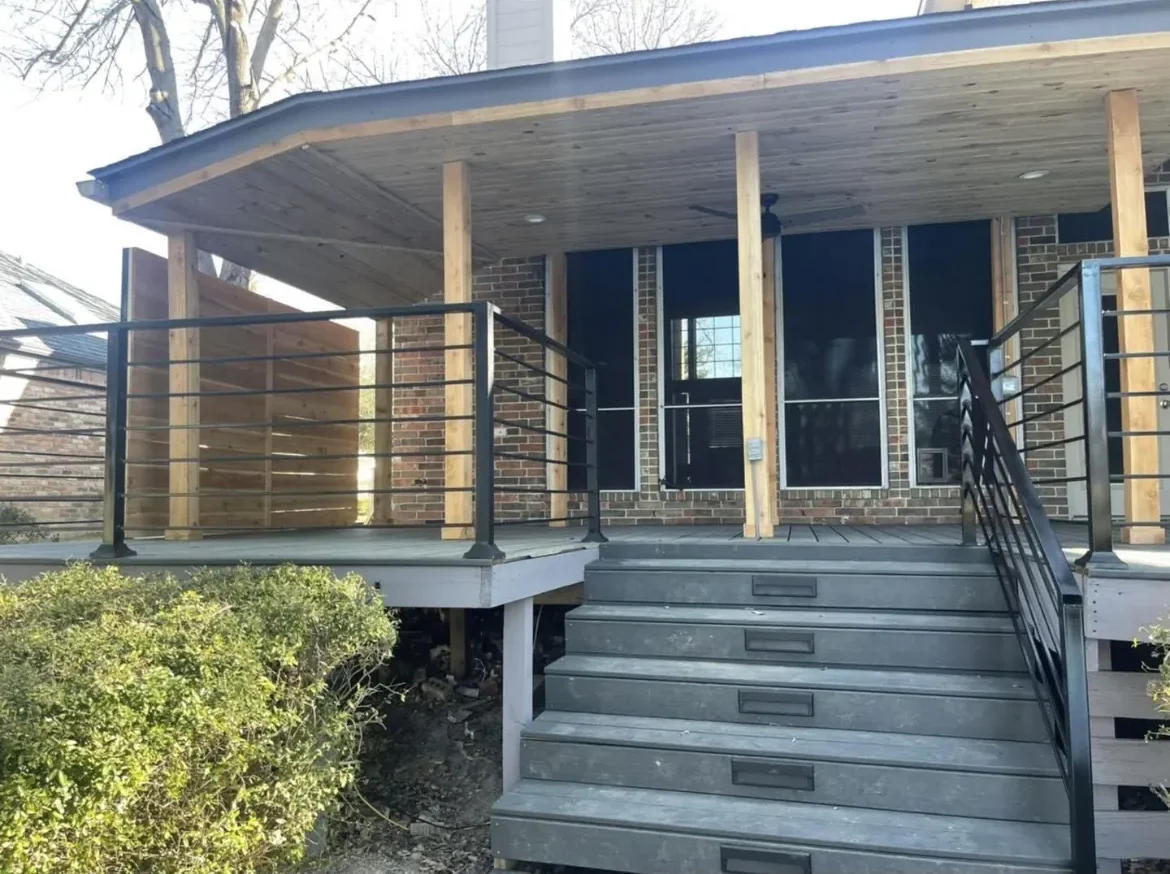
This guide is for Dallas-area homeowners who have a deck in mind and are deciding whether to build it themselves or hire it out. It puts a sourced do-it-yourself materials budget next to sourced Dallas installed prices for the same deck, then adds the costs most DIY guides skip: rentals, the permit and inspections you handle yourself, your time, warranty terms and insurance. Every number is labeled with its source and whether it is national or local. We build decks for a living, so we have tried to be fair: for some decks, DIY is a perfectly good choice.
Is it cheaper to build your own deck? (the short answer)
Yes, a DIY deck usually costs less in cash, because you skip labor, and labor is the biggest part of a pro-built deck. Block Renovation puts labor at 50% to 65% of a deck budget, Decks.com says the material and labor split often comes out close to 50/50, and Trex says materials are up to one third of the total cost for most professionally installed projects.
Viance, which makes wood treatment and runs TreatedWood.com, says a competent DIYer is "likely to cut" a professionally built pressure-treated deck's cost "in half." Advantage Lumber, a decking retailer, says the labor savings can run into the thousands, but that DIY is "only cheaper if you do it the right way."
Three things eat into the savings:
- Time. Sources put a DIY build at two to three times as long as a crew.
- Tools, rentals and paperwork. You need tools you may not own, and you become the person who pulls the permit and books the inspections.
- Mistakes. Decking warranties only cover boards installed to the maker's instructions, and the standard Trex warranty does not pay labor to replace boards.
If you have the skills, the time and a simple deck, DIY can save real money. If any of those three is missing, the gap closes fast.
2026 Dallas-Fort Worth deck cost: DIY materials vs contractor estimate
For the same 300 sq ft deck, sourced figures put DIY materials at about $3,030 to $5,550 in pressure-treated wood and $4,880 to $10,150 in composite, against about $4,500 to $9,000 and $7,500 to $15,000 installed at Dallas rates. The DIY side is calculated from Decks.com's national line items; the installed side is calculated from Block Renovation's Dallas per-square-foot rates.
Decks.com's budget is for a 15 x 20 ft (300 sq ft) deck with 50 linear feet of railing and no stairs, priced as materials only for an experienced DIYer. Block Renovation's Dallas guide gives installed prices of $15 to $30 per sq ft for pressure-treated wood and $25 to $50 for composite. Block's figure doesn't say whether railing is included, so read the installed column with that in mind.
| 300 sq ft deck | National DIY materials (Decks.com, calculated) | Dallas installed (Block, calculated) |
|---|---|---|
| Pressure-treated decking, wood railing | $3,030 to $5,550 | $4,500 to $9,000 |
| Composite decking, composite railing | $4,880 to $10,150 | $7,500 to $15,000 |
| What's included | Footings, framing lumber, hardware, fasteners, decking, 50 ft of railing. No stairs, permit or demolition. | Per sq ft installed rate x 300. Railing not stated. |
How the DIY column adds up (calculated from Decks.com's national line items):
- Pressure-treated: footings $250 to $450, framing $1,130 to $1,800, decking $900 to $1,800, wood railing $750 to $1,500.
- Composite: footings $250 to $450, framing $1,130 to $1,800, decking $1,500 to $3,900, composite railing $2,000 to $4,000.
To that, add the city permit and a cushion of about 10% for anything you run out of or forget, which is what Viance suggests adding to an itemized material list.
A third reference point: Cost vs Value for Dallas
The 2025 Cost vs Value report for Dallas gives a job cost of $15,841 for a wood deck addition and $23,519 for a composite deck addition. Those are bigger jobs than the 300 sq ft example: the report's wood deck is 16 x 20 ft with pressure-treated joists on 4x4 posts set on concrete piers, pressure-treated boards, a built-in bench and planter, three-step stairs and a full railing. The report builds its job cost from construction cost data and installer wage data; it doesn't say the figure is a contractor's quote, so treat it as a reference, not a price.
| Cost vs Value 2025, Dallas | Job cost | Resale value | Cost recouped |
|---|---|---|---|
| Deck addition, wood (16 x 20 ft, bench, planter, stairs, railing) | $15,841 | $15,813 | 99.8% |
| Deck addition, composite | $23,519 | $21,658 | 92.1% |
Why material cost figures disagree so much
Per-square-foot material prices vary widely depending on what they include. Decks.com's calculator lists boards alone at $3 to $6 per sq ft for pressure-treated and $5 to $14 for composite, with no framing, railing or labor. Trex's own estimate for composite deck materials is $15 to $30 per sq ft (excluding its Signature line), but that figure includes the substructure, decking, hardware and fasteners. When you price a DIY deck, make sure you are comparing the whole build, not just the boards.
For full installed price tables by material, see what a deck costs in Dallas.
How much of a deck's price is labor?
Labor is the biggest line on a pro-built deck: Block puts it at 50% to 65% of a deck budget, Decks.com at about half, and Trex says materials are at most a third of a professionally installed deck. Here is what each source says, in its own terms:
| Source | Labor share or labor rate | Scope |
|---|---|---|
| Block Renovation (2026) | Labor is 50% to 65% of a deck budget | Planning guide |
| Decks.com (2026) | Often close to 50/50; can shift to 35% materials and 65% labor with a high-end contractor and the cheapest materials | National |
| Trex (FAQ) | Materials are up to one third of total cost on most professionally installed projects | Not location-specific |
| Fixr (2023) | Labor about $10 to $35 per sq ft, depending on material | National |
| Advantage Lumber (2026) | Professional installation $15 to $35 per sq ft, depending on complexity and location | National |
| Decks.com calculator | Labor estimated separately at $8 to $22 per sq ft | Varies by location |
Read Trex's figure the other way around and it sets the ceiling on DIY savings: if materials are up to one third of a pro-installed price, roughly two thirds or more is labor, overhead and everything else (calculated from Trex's share). That is the most you could save, before tools, rentals, mistakes and the value of your own time.
Viance gives a worked example. It cites Remodeling's Cost vs Value national average of $45 per sq ft for a basic 320 sq ft deck built professionally in pressure-treated wood, notes that complex designs can add 30% to 50%, and says a competent DIYer is likely to cut that $45 in half. So there is no single "you save X%" number. Depending on the source and the deck, the labor share runs from about half to two thirds or more.
Labor on a quote also pays for things you would otherwise supply yourself: the crew's equipment, insurance, the builder's overhead and the time spent on drawings, permits and inspections.
The DIY costs people forget: tools, rentals, waste and a cushion
A DIY budget needs more than boards: footings, framing hardware, fasteners, a post hole digger rental, tools you don't own, and about 10% extra for anything you run out of or forget.
Decks.com's national line items for the 300 sq ft deck break the hidden parts out like this:
- Footings, $250 to $450: post hole digger rental $75 to $100, form tubes $75 to $100, bagged concrete $100 to $250.
- Framing, $1,130 to $1,800: framing lumber $800 to $1,200, structural hardware $250 to $400, fasteners $80 to $200.
- Permit: $50 to $200 in rural areas and $100 to $700 in urban areas (national figures; for local fees, see the permit guides linked below).
- Tearing out an old deck: landfill fees $80 to $180, or a dumpster at $300 to $500.
Decks.com's overall range for that project is $3,160 to $14,850 or more, depending on materials, and it does not count the time spent planning, getting permits, buying and hauling.
Tools you'll need
TimberTech's tool list for a DIY deck covers:
- Safety glasses, ear protection and gloves
- Tape measure, speed square, combination square, chalk line, bubble level, laser level and plumb bob
- Posthole, digging and flat shovels
- C clamps, bar clamps and spring clamps, plus sawhorses
- Circular saw, miter saw, table saw and jigsaw
- Drill and sander
TimberTech notes that power tools cost more and can be rented from a hardware store. Price out the ones you don't own before you decide. Plan on a helper too: Viance points out that some boards are long and heavy and may need more than one person to place.
Power saws carry real risk for anyone who doesn't use them often. A U.S. Consumer Product Safety Commission special study of 2007 and 2008 estimated about 67,300 medically treated table saw blade-contact injuries a year, about 11 amputations a day. That figure covers all table saw use, not deck building in particular.
Your time: how much longer a DIY deck takes
Plan on two to three times as long as a crew: Remodeling.com says a DIY deck "could easily take twice as long," though a skilled hobbyist may match a pro, and Viance says a non-professional is likely to take three times longer. Decks.com says a simple single-level deck takes two people 1 to 3 weeks, and a larger, multi-level deck with stairs, built-in seating and lighting may take a few weeks longer.
Our guide on how long a deck takes, pro vs DIY has the full timeline by deck size.
Permits and inspections when you're the builder (Dallas and Plano)
Doing it yourself doesn't skip the permit: you become the person who applies, builds to the approved plan and books every inspection. Viance notes that most US cities require a building permit for any renovation that changes the home's structure, including adding a deck, and that skipping it can bring a hefty fine. Advantage Lumber adds that bypassing permits and inspections can mean fines and tearing down and rebuilding parts of the deck.
Plano
Plano's 2025 code ordinance says permit applicants must be registered contractors, but homeowners may obtain permits to do work at their own residence without registering. A deck is exempt from a Plano permit only if it meets all of these:
- Not over 200 sq ft
- Not more than 30 inches above grade at any point
- Not attached to the house
- Not serving the required exit door
Anything else needs a permit, whether you build it or a contractor does. For Plano and Frisco fees and the details, see Plano and Frisco deck permits.
Dallas
A 2016 City of Dallas article says that work performed by a homeowner requires a permit whenever the city's building code (Chapter 52) requires one, and that electrical work must be done by a licensed electrician, while an owner who lives in and has homesteaded the home may do their own plumbing and mechanical work there. That article is from 2016, so check the current rules. Our guide to Dallas deck permit rules and homeowner permits explains the city's Homeowner's Exemption from Registration as a Contractor, which names patio covers and fences. If your project is a deck, ask the city whether it fits the exemption.
Before anyone digs
- Call 811. Texas law requires homeowners and excavators to contact 811 two business days before digging, not counting weekends and holidays, even for backyard work. The call is free.
- Draw the plan. TimberTech notes that a permit usually means submitting a drawing to your local building department, and that a contractor will guide you through it or get the permit for you.
Does building it yourself affect the decking warranty?
Doing it yourself doesn't void a Trex warranty by itself, but the warranty only covers boards installed per Trex's instructions, and it doesn't pay the labor to replace them. The Trex decking warranty we read does not require a professional installer.
What the Trex decking, fascia and cladding limited warranty says:
- Installation: the product must be properly installed per Trex's written instructions. Any condition caused by improper installation or failure to follow Trex's installation guidelines is excluded, "including but not limited to improper gapping."
- Labor and freight: the cost of removing defective product and installing replacements, including labor and freight, is excluded. The remedy is replacement boards or a refund of the purchase price, not the cost of the original installation.
- Terms: Signature, Transcend and Refuge carry 50 years on residential use, Select 35 years and Enhance 25 years. The warranty can be transferred once, within 5 years of purchase, to a later buyer of the home.
Trex's FAQ adds that boards installed with non-recommended fasteners are not covered under the Trex Limited Residential Warranty. Its 2026 installation guide shows how specific the rules get: joists must be spaced per the span chart, and if boards run at a 45 degree angle the maximum joist spacing is 4 inches less than the chart; at 30 degrees, it is half the chart.
The labor warranty only comes with a TrexPro install
Trex offers a separate TrexPro Labor Warranty that pays reasonable labor to replace defective products, but only when a TrexPro contractor installed them on a residence and the warranties were registered. It runs for a set number of years, depending on the contractor's level and the products. A DIY install doesn't qualify. Trex also says its dealers and TrexPro builders are independent and that the property owner is responsible for choosing them.
Hidden clips have their own rules
CAMO's hidden clip warranty (EdgeClip, EdgeXClip, Wedge and others) covers clips installed per the manufacturers' instructions and building codes. If properly installed clips cause a board to fail, CAMO replaces the board. There's no coverage if the damage is attributable "in whole or in part, to improper installation," or if "you or your installer" fail to follow the instructions. It doesn't cover labor, a claim must be made in writing within 30 days, and it isn't transferable.
Whoever builds it, keep the installation guide, the receipts and photos of the framing before the boards go down.
Safety, injuries and insurance
The biggest safety question for any deck, DIY or pro-built, is the structure. A Legacy Services study of U.S. Consumer Product Safety Commission emergency room data estimated that 224,000 people were injured nationally due to a wood deck or porch from 2003 to 2007, and nearly 15% of those injuries came from a structural failure or collapse. That data is old, and it does not separate decks built by homeowners from decks built by contractors, so it says nothing about which is safer. It does show why the structural steps matter.
If friends help you build
The Texas Department of Insurance explains that personal liability coverage on a home policy pays medical bills, lost wages and other costs for people you're legally responsible for injuring, plus court costs if you're sued, and that medical payments coverage pays the medical bills of people hurt on your property. You can also buy an umbrella policy for more coverage. Whether your policy covers a friend hurt while helping build a deck is a question for your agent, so ask before the work starts.
If you hire a builder
Private employers in Texas can choose whether to carry workers' comp, and TDI lets you verify coverage on TXCOMP or by email. TDI also advises asking for the contractor's certificate of insurance and calling to confirm it. Our guide on how to choose a deck builder covers the rest of the checks.
Does a DIY deck add the same resale value?
The Cost vs Value numbers for Dallas are high for both wood (99.8% of cost recouped) and composite (92.1%), but they describe a finished, code-built deck like the report's 16 x 20 ft spec. The report doesn't compare DIY and pro-built decks, and we found no data showing that one resells for more than the other.
What can cause trouble is a deck built without a required permit, since that can bring fines and the need to tear out and rebuild parts of it. Keep your permit and inspection records with the house papers.
When DIY makes sense (and when to hire a deck builder)
DIY makes the most sense for a small, low, freestanding deck in pressure-treated wood. Hire for anything attached to the house, elevated, large, multi-level or on a tight schedule. Decks.com says smaller, lower-to-the-ground decks may suit beginner DIYers, while intricate decks may not suit beginner or intermediate skills.
| Deck | DIY-friendly? | Why |
|---|---|---|
| Small, low, freestanding deck (Plano: 200 sq ft or less, 30 in or less above grade, not attached, not at the exit door) | Yes, for a handy owner | Decks.com calls smaller, lower decks a possible beginner project, and in Plano a deck that meets all four conditions is exempt from a permit. |
| Simple single-level deck, pressure-treated | Often | Decks.com puts it at 1 to 3 weeks for two people. Materials are the lowest-cost option in the tables above. |
| Deck attached to the house | Hire, or get help | Needs a permit in Plano whatever its size, since the exemption only applies to decks not attached to the house. You also take on the connection to the house yourself. |
| Elevated or second-story deck | Hire | Block says elevated decks cost more in Dallas because of framing and railing requirements. |
| Composite with hidden fasteners | Only if you'll follow the guide to the letter | Trex and CAMO warranties exclude damage from improper installation, gapping and fasteners included, and joist spacing changes for angled boards. |
| Large, multi-level or intricate design | Hire | Decks.com says intricate decks may not suit beginner or intermediate skills, and larger decks take longer. |
| You need it done by a date | Hire | DIY can take two to three times as long as a crew. |
For the best DIY candidate, see our guide to ground-level and floating decks. For the clearest hire case, see elevated and second-story decks.
The middle option: hire part of the job
You can split the work: have a pro set the footings and frame the deck, then handle the boards, staining, demolition or cleanup yourself. Decks.com says demolition, staining or even cleanup can cut costs if you're handy, and Fixr suggests contracting out certain jobs, such as the concrete work or site preparation, even on a DIY deck.
If you split the job, settle two things up front:
- Who holds the permit. In Plano a homeowner can pull a permit for work at their own home, and the city can suspend a contractor's registration for failing to finalize permits with the required inspections. Agree in writing whose name is on the permit and who books each inspection.
- Who installs the boards. Board warranties depend on following the manufacturer's install instructions, and the TrexPro labor warranty only applies when a TrexPro contractor installed the products.
How to compare a DIY budget with a builder's quote
Price the same deck both ways: list every material, rental and permit line for DIY, then get itemized written quotes for that exact scope. Remodeling.com puts the trade-off simply: a contractor can build your deck relatively quickly, but that usually comes at a higher cost. TimberTech makes a similar point: DIY saves on labor, but a contractor's skills and equipment better ensure the deck meets your needs.
For the DIY side:
- Footings, framing lumber, structural hardware and fasteners (the parts Decks.com lists separately)
- Decking and railing for your chosen material
- Rentals and tools you'd have to buy
- The permit, plus demolition and disposal if you're replacing a deck
- About 10% extra for anything you run out of or forget
- Your weekends, at two to three times a crew's build time
For the builder side, ask for a written, itemized bid with the same size, height, material and railing, plus who pulls the permit. TDI advises asking for a certificate of insurance, calling to confirm it, and never paying the whole bill up front.
If you'd like a builder's number to set next to your DIY budget, Archetex Outdoor Design Co. is a Dallas deck builder that designs and builds custom composite and wood decks, with a free site visit and a written price. You can start on our Dallas deck builder page.