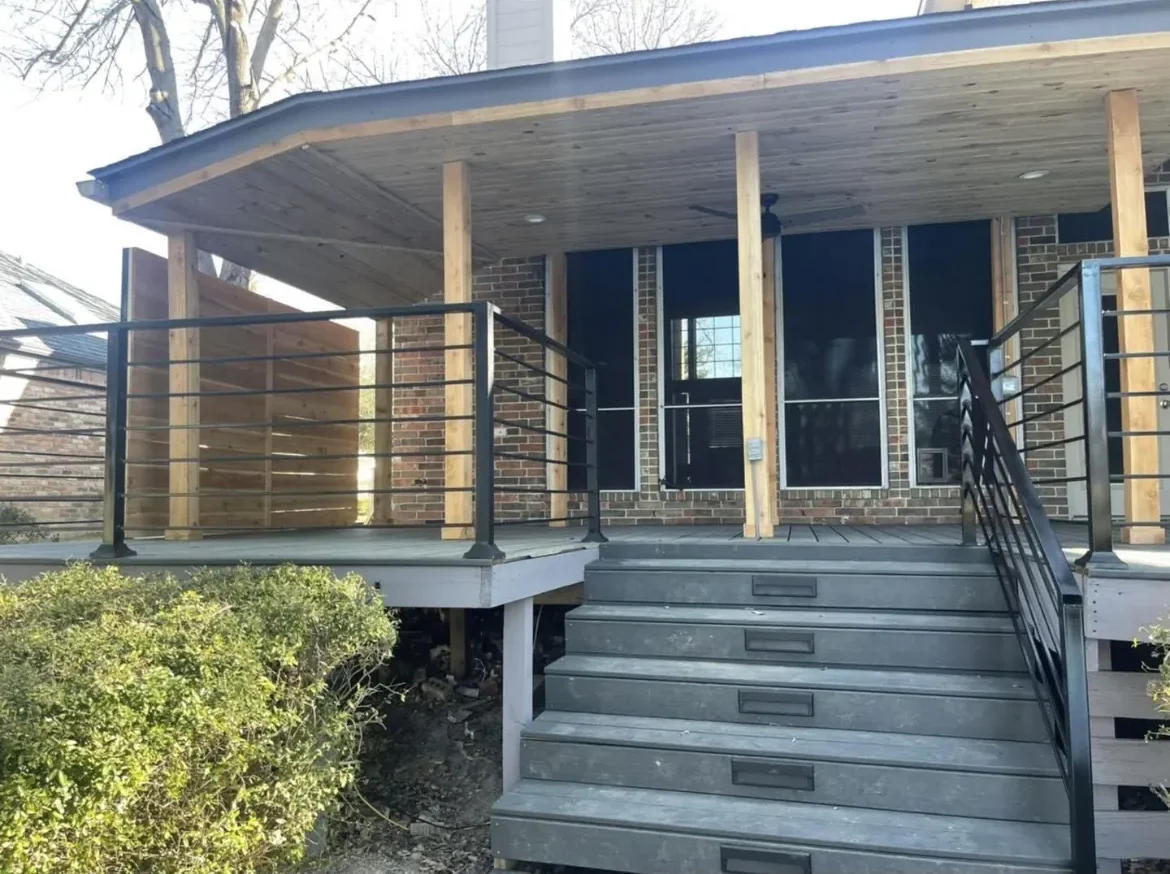
This guide puts the care rules from five makers (Trex, TimberTech, Fiberon, MoistureShield and Deckorators) side by side and ties them to Texas weather. Where the makers disagree, we show both sides. The rule that beats every other: follow the current care guide for your own brand and board line.
How to clean composite decking (the short answer)
Most capped composite decks need four things: a sweep, a rinse with a garden hose, a scrub with warm soapy water and a nylon or soft-bristle brush, and a thorough final rinse. Every maker we checked starts with soap and water before anything stronger.
A few rules show up in almost every care guide:
- Rinse well. Trex says dirty water left to dry leaves a film, and TimberTech says cleaner left to dry leaves a white film.
- No wire or metal brushes for routine cleaning. Trex's care guide says do not use a wire brush, and Fiberon calls for a non-metal brush. Fiberon's 2019 guide does allow a soft brass brush on stubborn stains, except on Symmetry and Good Life boards.
- Never sand the boards. Trex says sanding voids the warranty for any condition that results.
- No paint, stain or sealer. Trex says painting or staining may void its fade and stain warranty, Fiberon says sealants aren't required or recommended, and MoistureShield says its boards need no sealing or staining.
First, find out what boards you have: capped, uncapped or PVC
Check your brand and board line before you clean, because capped composite, older uncapped composite and PVC take different cleaners, brushes and pressure limits. TimberTech's 2026 care guide makes identifying your decking the very first step, and its Customer Care team will identify a board from four photos.
| Maker | Board types | What changes for cleaning |
|---|---|---|
| Trex | Capped shell lines: Signature, Transcend, Enhance, Select. Early-generation, uncapped: Accents, Origins, Contours, Profiles, Brasilia. | The shell wraps three sides of the board. Trex does not recommend a pressure washer on early-generation boards at all. |
| TimberTech / AZEK | TimberTech Composite (capped wood-plastic) and AZEK Advanced PVC (all plastic). Discontinued uncapped lines: ReliaBoard, TwinFinish, Earthwood, Floorizon, DockSider. | Composite takes a medium-to-stiff nylon brush, PVC a stiff natural-fiber brush. "Composite deck cleaners" are out on current boards but fine on the old uncapped lines. |
| Fiberon | Capped composite lines, plus Paramount, which is PVC. | Iron or carbon steel above an uncapped deck can leave dark extractive stains. |
| MoistureShield | Vantage is uncapped. Elevate, Meridian and Vision are capped. | Let Vantage weather 3 to 6 months before using the usual stain methods. Vantage has no fade and stain warranty. |
TimberTech names Corte Clean, Thompson's Water Seal Oxy Action and Olympic Deck Cleaner as the composite deck cleaners to keep off its current boards, because the cap isn't a wood-plastic composite. It also says a stiff natural-fiber brush "can dull the surface" of its composite.
If you're not sure whether you have PVC or composite, our PVC vs composite decking guide explains the difference, and Trex, TimberTech, Fiberon and Deckorators compared covers capping by brand.
Step by step: how to clean a composite deck
Clear the deck, sweep, rinse with a hose, scrub with a soft brush and soapy water one small section at a time, then rinse again before moving on.
- Move everything off: furniture, grill and planters (Fiberon).
- Sweep with a broom or leaf blower, and clear the gaps. TimberTech says clearing dirt and leaves from the gaps helps drainage and helps prevent mildew. Fiberon says gaps under 3/16 inch clog.
- Rinse the composite deck with a garden hose. TimberTech says a garden hose is all that's required for rinsing.
- Scrub the composite deck boards with a soft brush and soapy water. Work in small sections and keep each one wet the whole time. Fiberon suggests a pump sprayer and says tough stains can sit 10 to 15 minutes. If you use TimberTech DeckCleaner, it mixes 1 part cleaner to 3 parts water, and one gallon of mixed solution cleans about 1,000 square feet.
- Rinse the composite deck again, thoroughly, before you start the next section. TimberTech says not to let cleaner dry on the boards.
- Let it dry before the furniture goes back.
The Texas timing rule: on summer days, clean early or late in the day. The National Weather Service in Fort Worth says July and August highs are consistently in the 90s and often reach or exceed 100 degrees, and TimberTech warns that heat can dry cleaner on the surface before you've rinsed it. In sun, Fiberon says to work in very small sections.
Can you pressure wash composite decking?
Yes, on most capped boards, as long as you stay within your maker's limit: Trex allows up to 3,100 psi, Fiberon 2,500 psi (its pages disagree, see below), TimberTech 1,500 psi for rinsing only and MoistureShield 1,300 psi, always with a fan tip, and at least 8 to 12 inches away where the maker gives a distance. The exceptions are Trex's early-generation boards, where Trex does not recommend a pressure washer, and any deck with mold on it.
| Maker | Max pressure | Distance | Tip and direction | Notes |
|---|---|---|---|---|
| Trex shell lines (Signature, Transcend, Enhance, Select) | 3,100 psi | At least 8 in | Fan tip, with soap and a soft-bristle brush | Going over 3,100 psi could damage the boards and void the warranty |
| Trex early-generation | Not recommended | n/a | n/a | Pressure washing voids the warranty for any condition it causes |
| TimberTech Composite and AZEK Advanced PVC | 1,500 psi | Not stated | Fan tip, along the grain, never across the board; never a pinpoint or needle tip | Rinsing only; a garden hose is all that's required |
| Fiberon | Under 2,500 psi (care article) or under 3,000 psi (care page, FAQ) | 12 in (article, FAQ) or 10 in (care page) | Wide fan or oscillating tip, along the grain; test first | "Best left to the professionals"; never with mold present |
| MoistureShield | 1,300 psi | At least 10 in (care page) or 8 to 10 in (FAQ) | Fan tip | Let uncapped Vantage weather 3 to 6 months first |
| Deckorators | No number given; lowest setting | At least 8 in | Fan tip | Don't "blast" mold; only lightly wet or rinse it |
Fiberon's own pages disagree, so use the lower figure
Fiberon's care article says under 2,500 psi at 12 inches. Its care page says under 3,000 psi at 10 inches, and an FAQ answer says skilled pros may use under 3,000 psi at 12 inches, warning that improper use could void the warranty. Use the lower pressure and longer distance: 2,500 psi at 12 inches.
Never pressure wash over mold
Fiberon says the pressure pushes mold further down into the pores of the board, so it doesn't recommend power washing when mold is present. If a pressure washer was used, Fiberon says to apply cleaner at least twice. Deckorators says not to "blast" mold either; a fan tip may only lightly wet or rinse it.
The best cleaners for composite decking, and what to avoid
Start with soap and water or your maker's own cleaner. Bleach and acid products can work on some stains, but they can lighten the boards, and some brands warn against products that other brands recommend.
| Product type | What the makers say |
|---|---|
| Soap and water | Every maker's first step. Fiberon also allows a mild household cleaner. |
| Maker's own cleaner | TimberTech DeckCleaner is bleach-free and mixes 1 part to 3 parts water. |
| "Composite deck cleaners" | TimberTech says not to use them on its current boards. They are fine on its old uncapped lines. |
| Deck washes | Deckorators says they usually contain sodium percarbonate. |
| Degreasers | Used by Deckorators and Fiberon for grease (see the grease section). Trex warns they can damage Signature boards. |
| Oxalic-acid deck brighteners | Trex uses them for tannins. MoistureShield and Deckorators use oxalic-acid cleaners for rust. MoistureShield says they may lighten the surface. |
| Bleach | Trex says products with bleach or acid lighten its surface, without structural harm. TimberTech's FAQ allows a 1-to-4 bleach and water mix for mold. MoistureShield's mold cleaner is bleach-based. |
Three safety rules:
- Test first in a hidden spot (Trex, Fiberon).
- Never mix cleaners, and never mix bleach with acids. That is Fiberon's rule.
- Trex Signature is more sensitive. Trex says solvents, acids, plasticizers, ammonia, alcohols and accelerated hydrogen peroxide (AHP) disinfectants can damage Signature boards, with insect repellent, sunscreen and degreasing cleaners as examples. Check the label and call Trex before using an acid brightener or degreaser on Signature.
TimberTech and bleach: two answers from one maker
TimberTech sells a bleach-free DeckCleaner, yet its FAQ says surface mold comes off with DeckCleaner or a 1-to-4 mix of bleach and water. Both are TimberTech's own words, so check the current guide for your line before using bleach.
Mold, mildew and black spots in humid Texas weather
Mold grows on the film of pollen and dirt that sits on top of the boards, so removing that film is the cure, and pressure washing over mold makes it worse. Trex calls this film a biofilm that mold feeds on.
The NWS Fort Worth office says Gulf moisture keeps humidity high and that springs and falls are wet. Deckorators says mold is most prevalent in consistently wet, shaded areas.
What each maker says to use on mold:
- Trex: a hose, warm soapy water and a soft-bristle brush.
- TimberTech: surface mold doesn't penetrate the board, and it comes off with DeckCleaner or a 1-to-4 bleach and water mix.
- Fiberon: no pressure washer while mold is present. Repeat the cleaning until no mold "shadows" show on the wet deck, then use a mold inhibitor. Fiberon says your climate may call for more frequent cleaning.
- MoistureShield: Olympic Premium Deck Cleaner, which is bleach-based and may lighten the boards, so clean the whole deck for an even color. Where mold is heavy, Spray and Forget once a year.
To prevent it, keep the gaps clear, and Fiberon says to keep at least 6 inches of ventilation under the deck.
Does the warranty cover mold stains?
Only Trex and Deckorators, and only if the mold is cleaned within one week of first appearing. TimberTech's composite warranty, Fiberon and MoistureShield exclude mold.
Grease, food and grill stains
Clean spills the same day. Deckorators' warranty wants spills wiped within 48 hours, and Trex, TimberTech and MoistureShield want food stains cleaned within one week. MoistureShield says grease that sits more than two hours calls for Pour-N-Restore rather than dish soap.
- Trex: a hose, warm soapy water and a soft-bristle brush to lift spills out of the embossing, within seven days.
- MoistureShield: dish soap right away, and Pour-N-Restore if the grease sat more than two hours.
- Fiberon: Fantastik for grease and grime, De-Solv-It Citrus for tar, oil, grease and gum.
- Deckorators: a degreaser, and rinse any solvent spot remover off at once.
- Trex Signature: check with Trex before using a degreasing cleaner.
Grill mats: use one that's safe for composite (TimberTech), and check the backing, since Trex and TimberTech warn rubber-backed mats can discolor boards.
Warranty note: Trex covers food and beverage spills cleaned within a week, and TimberTech's composite warranty covers food stains, including grease, cleaned within a week. Fiberon, MoistureShield and Deckorators exclude grease and oil stains.
Rust, fertilizer, planters, tannins and hard-water spots
Prevent these stains rather than count on the warranty: all five warranties exclude rust, four exclude plant food, and Fiberon also excludes mineral stains. That means lifting pots onto stands, keeping metal off the boards, and drying off sprinkler overspray.
Rust
Rust comes off with an oxalic-acid cleaner, say MoistureShield and Deckorators. TimberTech says not to cut metal, such as railing, on the deck, because hot debris embeds and rusts. Fiberon says wrought iron or carbon steel above an uncapped deck can leave dark extractive stains.
Fertilizer and planters
Fiberon says pots trap moisture, and that minerals plus fertilizer or plant food build up into white marks, so it recommends a plant stand. Trex, TimberTech, MoistureShield and Deckorators all exclude plant food stains from their warranties.
Tannins from leaves
Leaves that sit in clogged gaps steep a tannin "tea", in Fiberon's words. Trex says to sweep or hose the debris off, then put a deck brightener on the dry deck, since brighteners contain oxalic acid. On TimberTech's wood-polymer boards, tannin bleeding weathers away in about 8 to 10 weeks.
Hard-water spots from sprinklers
The North Texas Municipal Water District calls its treated water "moderately hard", mainly because of minerals in Lavon Lake, and says those minerals leave spots once the water evaporates. Its 13 member cities include Plano, Frisco, McKinney, Richardson, Garland and Rockwall. Dallas itself is not on that list, and we found no hardness figure for Dallas water.
Trex calls hard-water spots a water issue, not a defect. Its fix is white vinegar followed by a rinse with water that isn't hard. If hard water is all you have, dry the boards with a cloth or blower, and a deck brightener can also help. Fiberon's warranty excludes staining from "air or water borne minerals". Aim sprinkler heads away from the deck.
How often to clean a composite deck in Texas (a seasonal schedule)
At least twice a year, by Fiberon's rule, and in Texas the sensible times are after spring pollen and after fall leaves, with quick sweeps in between. Fiberon's care page says to clean as often as needed, at least twice each year.
Trex's "spring and fall" advice is written for its early-generation boards, to stop pollen buildup feeding mold. It gives no set frequency for its current shell lines.
| When | What to do | Why |
|---|---|---|
| Every week | Sweep with a broom or leaf blower | MoistureShield's care advice |
| As needed | Clear leaves and dirt from the gaps | TimberTech: drainage, a dry surface, less mildew |
| After cedar season (mid-December to early March) | Full wash | Texas A&M says mountain cedar sheds pollen from mid-December, peaking mid-January |
| After oak pollen (March and April) | Full wash | Texas A&M Forest Service describes "a light dusting of green everywhere" from oaks |
| Summer | Wash early or late in the day; stay on top of grill grease | Highs often reach or exceed 100 degrees, and heat dries cleaner before you rinse |
| Fall | Full wash after the leaves drop and the wet weather | Rain is heaviest in spring and fall; leaves leave tannin stains |
| Any spill | Clean within 48 hours to one week, depending on brand | Warranty stain clocks |
| Regularly | Look at the frame under the deck | TimberTech's care page calls for regular substructure inspections |
These pollen dates are Texas-wide guides from Texas A&M, not exact DFW dates. The Forest Service says cedar fever is worst west of I-35.
TimberTech's care page calls for regular inspections of the substructure, so check the frame under the boards. For what shortens or stretches a deck's life overall, see how long a deck lasts in Texas.
Grills, fire pits, fire tables and heat
Keep flame and hot metal off the boards: Trex says its decking can soften at temperatures as low as 176°F, the warranties exclude heat damage (Trex over 275°F, Fiberon and MoistureShield over 250 degrees), and Fiberon says to keep grills and fire features at least 12 inches from the deck and railing.
- Wood-burning fire pits: Trex says they shouldn't sit directly on its decking without a heat barrier.
- Gas fire pits: usually cut into the decking, over fire-resistant material (Trex).
- Propane fire tables: Trex calls them "generally safe", because they don't produce downward heat.
- Metal fire pits: never directly on the boards (Deckorators).
- Grills: TimberTech says to follow the grill maker's clearances (the vinyl-siding numbers work for railing) and use a grill mat that's safe for composite.
TimberTech's PVC warranty also excludes fire, hot ashes or embers and fire pits, Fiberon excludes heat from cooking devices, and Deckorators excludes grills and fire pits.
TimberTech, MoistureShield and Deckorators exclude low-E window glare, and Fiberon says it can melt, warp or discolor boards. For surface temperatures and glare, see how hot composite gets in Texas sun.
Scratches, rugs, furniture and the occasional ice storm
Prevent scratches rather than trying to fix them, because no capped board is scratch-proof, sanding voids warranties, and several warranties exclude scratches.
Scratches and furniture
Trex says none of its boards are scratch-proof, and its scratch resistance runs from one star (Enhance) to five stars (Signature). TimberTech recommends plastic, felt or rubber pads on furniture legs, and Deckorators says not to drag furniture.
If you do scratch a board:
- Fiberon says to let normal scratches fade. Its bulletin on light brushing or a heat gun (900°F, at least 1 inch away) calls the method "not a guaranteed fix", and a gouge through the cap still shows the core.
- MoistureShield says light scratches on uncapped Vantage fade in 12 to 16 weeks, and says not to sand, fill or paint scratches.
TimberTech's Advanced PVC warranty and the Deckorators warranty exclude scratches. If boards are too scratched or stained to clean up, look at new boards on the old frame.
Rugs and mats: the makers disagree
Trex, TimberTech and Fiberon all warn about rubber-backed mats. On the rug itself, Trex and Fiberon give opposite advice:
- Trex recommends natural-fiber rugs such as jute, sisal or bamboo. It warns that polypropylene or rubber-backed rugs can draw colorant out of the boards, sometimes irreversibly, and that viscose dyes can bleed.
- Fiberon says to use polypropylene or colorfast woven rugs only, because rubber, vinyl or latex backing leaves marks.
- TimberTech says to avoid rubber-backed mats and rugs, and not to leave tarps, pool toys or other nonporous items down for long.
- MoistureShield and Deckorators exclude color differences under a rug or mat from their warranties.
So follow your own brand's rule.
Ice and snow
North Texas gets some wintry weather every winter, but the NWS says many seasons end with little or no measurable snow. When ice does come, here is what the makers say:
- Shovels: plastic only. TimberTech and Deckorators say no metal edge, and Trex says shovel scratches on early-generation boards aren't covered. Fiberon says to shovel parallel to the boards and never use an ice chipper.
- Calcium chloride: Trex, TimberTech and Fiberon allow it. TimberTech says it may leave a white residue to wash off later, and also lists most magnesium chloride products as safe.
- Rock salt: the makers disagree. Trex (shell lines), Fiberon and MoistureShield allow rock salt. TimberTech says to avoid rock salt and abrasive ice melt.
- No sand, and no colored ice melt. Fiberon and MoistureShield both say no sand, and Fiberon says no ice melt with colorant.
- Hose off the residue (Fiberon).
What voids a composite deck warranty, and what fade and stain coverage means
Fade and stain warranties promise no more than 5 Delta E of color change and resistance to food stains, but only if you follow the care guide, clean spills on time and avoid what they exclude. Fiberon measures Delta E in Hunter units, and the others use CIE.
| Maker | Food stain clock | Mold stains | Heat named | Color under rugs or mats |
|---|---|---|---|---|
| Trex | 1 week, soap and water | Covered if cleaned within 1 week | Over 275°F | Not in the warranty (the FAQ warns about some rugs) |
| TimberTech Composite | 1 week (grease included) | Excluded | Heat, including low-E glare | Not stated |
| Fiberon | Must have tried cleaning first; claim within 30 days of discovery | Excluded | Over 250 degrees; cooking devices | Not stated |
| MoistureShield | 1 week (Vantage has no fade and stain warranty) | Excluded | Over 250 degrees (grills, fire pits, low-E glass) | Excluded |
| Deckorators | 48 hours | Covered only if cleaned within 1 week | Grills, fire pits, low-E glass | Excluded |
Trex adds that "no material is fade proof", and allows up to 5 Delta E of fade for 25 years, then up to 15 Delta E for the rest of the term.
What voids or falls outside coverage:
- Too much pressure: over 3,100 psi on Trex, or improper power washing on Fiberon.
- Sanding (Trex).
- Paint, stain, solvents or coatings (Trex and TimberTech).
- Shovel gouges and surface damage (Trex and TimberTech).
- Rust stains (all five) and plant food stains (Trex, TimberTech, MoistureShield and Deckorators).
- Not following the care guide. Fiberon calls following its care instructions "a condition precedent" to any claim, MoistureShield excludes "neglect", and TimberTech's PVC warranty and Deckorators exclude failure to follow the care guidelines.
How a stain claim works
Trex and TimberTech use the same three steps, in their warranty wording: clean the stain yourself within one week; if that fails, have it cleaned by a professional deck cleaner at your own expense; then file the claim within 30 days of that professional cleaning. Fiberon requires a claim within 30 days of discovery, after you have tried cleaning. Neither Trex nor Fiberon pays the cost of installing replacement boards.
MoistureShield purchases from April 7, 2026 have updated terms, available by email request. Fiberon, MoistureShield and Deckorators exclude hail by name. For storms, insurance and claim photos, see our guide to hail and storm damage. Warranty lengths by board line are in the brand comparison linked above.
If you're planning a new deck, Archetex Outdoor Design Co. designs and builds custom composite decks in Dallas, with a free site visit and a written price.