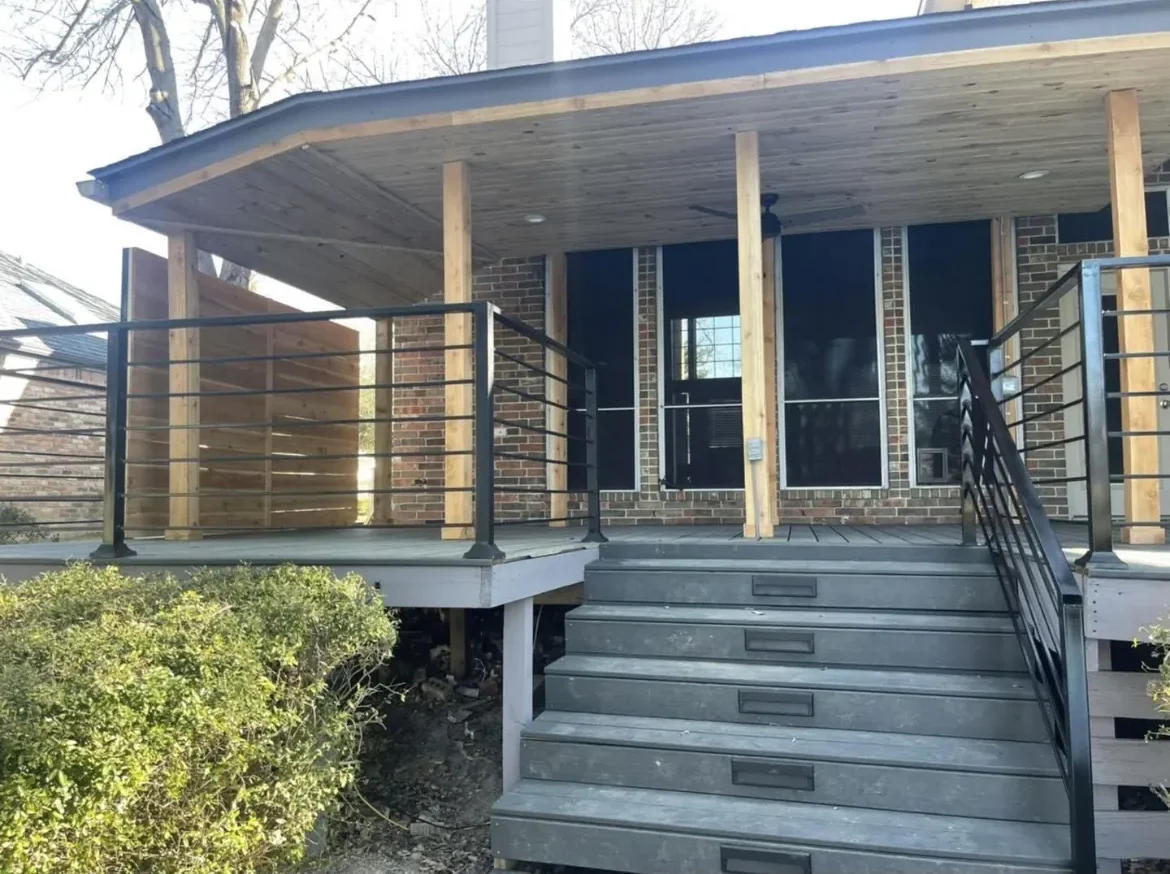
Most Dallas homeowners choosing between a pergola and a covered patio want the same two things: a seat they can use in July and a price that makes sense. This guide puts the sourced numbers for both side by side: shade, rain, hail, cost, orientation, permits and how to pick a builder. To see what we build, start with our page on covered patios and pergolas in Dallas.
Should I get a pergola or a covered patio in Texas? The short answer
If you want shade in a Dallas July and a dry seat in a spring storm, build a solid-roof covered patio. If you want filtered light, airflow and a lower price, build a pergola, and add louvers or a cover later if you need more.
Block Renovation's 2026 Dallas guide is blunt about it: the defining Dallas structure is a solid roof, "Not a pergola (too little shade for Texas summers)." Here is how the two compare on the points that matter most here.
| Point | Open pergola | Solid-roof covered patio |
|---|---|---|
| Shade | 75% to 90%, depending on slat size and placement (Fixr, 2022) | Full overhead cover; 15 to 25 degrees cooler underneath than an exposed surface (Block Renovation, 2026) |
| Rain | Does not block rain unless a roof is added (Fixr, 2022) | "Complete protection" (Angi, 2026) |
| Hail | Open top; DFW hail damages exposed furniture, electronics and grills (Block Renovation) | Metal patio-cover roofing resists hail better than shingles (Block Renovation) |
| Ceiling fans | Need wet-rated fans (Hunter) | Damp-rated fans; plan one per 150 to 200 sq ft (Hunter; Block Renovation) |
| Average cost, national | $5,000 (Angi, 2026) | $8,500 for a solid roof (Angi, 2026) |
Texas climate outdoor living: how heat, rain and hail change the pergola vs covered patio decision
North Texas summers run in the 90s to 100s, July and August are the sunniest months, and large hail and damaging winds hit the Metroplex nearly every year. That makes the roof over your seating matter more here than in most places.
- Heat: the National Weather Service in Fort Worth says July and August highs are "consistently in the 90s, often reaching or exceeding 100 degrees." DFW's first 100°F day comes on July 1 on average and the last on August 27; the record is 71 such days, in 2011.
- Sun: Block Renovation's Dallas guide says UV is intense from May through September.
- Rain: DFW's yearly rainfall swings from under 20 inches to over 50, and spring and fall are the wettest seasons (NWS).
- Hail: the Southern Climate Impacts Planning Program says northern Texas had the highest frequency of large hail in the US from 1955 to 2024. By our count of NOAA storm records, every year from 2015 to 2025 had at least one golf-ball-size hail report in Dallas, Tarrant, Collin, Denton and Rockwall counties, and 86% of reports fell March through June.
Block notes that DFW hail, sometimes golf-ball sized, damages exposed furniture, electronics and grills. An open pergola doesn't protect any of that; a solid roof does. More on storm risk is in how often North Texas gets hail.
How much cooler is a covered patio than a pergola?
A solid roof blocks all direct sun; an open pergola blocks most of it. Block Renovation puts a covered patio 15 to 25 degrees cooler underneath than an exposed surface, while Fixr rates open pergola slats at 75% to 90% shade and louvers at about 90% to 95%.
This Old House gives a similar figure for a cover: in summer it "could feel 15 to 20 degrees cooler than in direct sun." Fixr also says a true pergola gives at most roughly 75% of the shade of a gazebo or pavilion, and HomeGuide notes a wooden-lattice roof over a patio "doesn't give full shade." No source we found measured a pergola and a solid cover side by side in the same yard, so we don't put a degree number on the gap. Shade percentages and every other option, sails and awnings included, are in our Texas shade guide.
Dallas TX pergola installation cost 2026 vs covered patio roof cost in Dallas, Texas
On the same cost guides, a pergola usually costs less: Angi averages $5,000 for a pergola and $8,500 for a solid roof, and This Old House puts pergolas at $4,000 to $15,000 and gable roofs at $13,000 to $30,000. Dallas figures run higher for full builds: Block Renovation prices a 300 to 500 sq ft covered patio with posts, electrical and ceiling fans at $20,000 to $60,000.
| Option | Published cost | Source, year, area |
|---|---|---|
| Pergola vs solid roof, average | Pergola $5,000; solid roof $8,500 | Angi, 2026, national |
| Pergola vs gable roof vs shed roof over a patio | Pergola $4,000 to $15,000 (avg $6,600); gable $13,000 to $30,000 (avg $18,500); shed $1,100 to $10,500 (avg $5,800) | This Old House, 2026, national |
| 12x18 patio, total installed | With pergola $4,228 to $11,400; with gabled roof $3,928 to $18,900; with louvered roof $6,048 to $26,100 | Fixr, 2025, national |
| Pergola, arbor or trellis, Dallas | Typical $3,093 to $8,072, average $5,422 | HomeAdvisor Dallas page, archived 2024 |
| Covered patio, 300 to 500 sq ft, Dallas | $20,000 to $60,000, with posts, electrical and fans | Block Renovation, 2026, Dallas |
| Metal awning or metal patio cover, Dallas | Typical $1,554 to $3,664, average $2,756 | HomeAdvisor Dallas page, archived 2024 |
| Louvered pergola | $6,500 to $18,000 on average; $45 to $125 per sq ft | HomeGuide, 2026, national |
Three things to know about these numbers:
- Size and scope drive the gap. Fixr's gabled-roof low end ($3,928) is below its pergola low end ($4,228), so a small, simple cover can undercut a big pergola.
- The Dallas figures cover different jobs. Block's $20,000 to $60,000 includes wiring and fans on a large roof; HomeAdvisor's $5,422 blends pergolas with arbors and trellises. Don't subtract one from the other.
- HomeAdvisor's $2,756 Dallas figure comes from its metal awning and patio cover category, a different scope from Block's full solid-roof builds with wiring and fans, which is why it sits far below Block's figure.
For full tables by size and material, see the full Dallas pergola cost breakdown and what a 20x20 patio cover costs. Archetex doesn't publish set prices; you get a written price after a free site visit.
Which way does your yard face? West-facing patios need a solid roof most
Afternoon sun comes in low from the west, and Fine Homebuilding notes that overhead trellises block the sun when it's high but are less effective in low morning and evening sun. So a west-facing patio is where a solid roof, or screens on the west side, earns its cost.
Fine Homebuilding calls the sun's daily path one of the most critical things to plan around. In warm climates the east side of a house gets late-afternoon and early-evening shade, and in very hot climates the north face of a building is the coolest side at midday. That makes an east- or north-side patio the easier place for an open pergola. The US Department of Energy says the west side is where shade from the afternoon sun is needed.
If you love the look of a pergola on a west-facing patio, Fine Homebuilding's fix is to use the posts to carry extra sun-blocking screens on the west. This is guidance from how the sun moves, not a measured Dallas result.
Louvered pergolas: the middle option between open slats and a solid roof
A louvered roof opens for sun and closes for shade and rain, but it costs more than a basic pergola and more than many solid covers: HomeGuide puts it at $6,500 to $18,000 on average, or $45 to $125 per sq ft.
- Shade: louvers raise shade to about 90% to 95%, per Fixr.
- Rain: HomeGuide says adjustable louvered pergolas are waterproof because the slats close, while rain falls through fixed pergola beams. Some models have built-in gutters; a rain or wind sensor for automatic closing runs $125 to $175.
- Wind: StruXure, a louvered pergola maker, says its Pivot 6 louvers were tested to 150 mph with the roof fully open and its sensors open the roof at 60 mph. StruXure also says the right model depends on design wind speed, site exposure, attachment method, local codes and site-specific engineering. Those are maker claims.
Louvers suit a spot where you want sun some of the day and shade or shelter the rest, such as a pool edge. We found no independent data on louvered roofs at pools, so judge them by what they do, not by marketing.
Pergola extension beside a covered patio: getting both
You don't have to pick one. One layout puts a solid roof over the seating next to the house, where the fans and lights go, and an open pergola beyond it over a dining area, grill or pool edge where some sun is welcome.
This splits the work between the two: the cover handles the hot afternoons and storms, and the pergola keeps the yard open and bright. Fans under the solid part can be damp-rated, while any fan under the open pergola has to be wet-rated, per Hunter. Plan both pieces together so the rooflines, posts and drainage line up. Archetex plans multi-feature jobs like a cover plus a pergola as one design, starting with how you use the yard and accounting for grading, drainage and how the space connects to the house. See how we approach planning the whole outdoor living space as one design.
Roof choices for a Texas covered patio: insulated panels, metal and hail
If you go solid, the roof material decides how hot it is underneath and how it handles hail: insulated panels keep summer heat out, plain aluminum dents easily, and Block Renovation says metal patio-cover roofing resists hail better than shingles.
| Roof type over a patio | Installed cost per sq ft (HomeGuide, 2025, national) |
|---|---|
| Wooden-lattice pergola roof | $20 to $40 |
| Solid aluminum, no insulation | $20 to $50 |
| Insulated roof (aluminum over a foam core at least 3 in thick) | $30 to $60 |
| Solid-wood shed roof | $60 to $120 |
| Gable roof | $70 to $155 |
- Insulated panels: This Old House says they keep summer heat out, and the foam-core sandwich prevents the condensation problems of single-layer roofs. HomeGuide says insulated aluminum costs 20% to 50% more than plain.
- Hail: HomeGuide warns that aluminum dents easily from hail. Block says metal roofing resists hail better than shingles, that Class 4 impact-rated shingles are worth a 10% to 20% premium, and that black or dark bronze standing-seam metal is increasingly popular in DFW.
- Insurance: the Texas Department of Insurance says roofing tested under UL 2218 is rated Class 1 to 4, Class 4 gets the highest premium credit, and each insurer sets its own discount.
Fans, lights and drainage: what only a solid roof can carry
Ceiling fans and wired lights need a ceiling, so plan at least one fan per 150 to 200 sq ft under a cover (Block Renovation). A solid roof also sheds every drop of rain, so it needs gutters and a place for the water to go.
- Fans: Hunter says damp-rated fans are for covered spaces and wet-rated fans for open spots like pergolas, and that a fan near the edge of a cover may still get wet in a windy storm.
- Add-on prices: Angi lists ceiling fans at $300 to $800, integrated lighting $200 to $1,000, heaters $500 to $2,000, and drainage or gutters $500 to $1,500 (2026, national).
- Wiring: Block says hardwired lighting, outlets and appliance connections need electrical permits, and the City of Dallas says electrical work must be done by a licensed electrician.
- Water: This Old House says water management prevents foundation damage, with gutters at $3 to $20 per linear foot. That matters on Blackland Prairie clay, which the USDA says shrinks and swells markedly with moisture.
Wire fans and lights during the build, not after.
Wind: the posts and connections that hold either one down
Both structures need posts set and fastened for wind, not just for weight. HomeGuide says high-wind areas need patio-cover posts cemented into the foundation, and the City of Rowlett requires accessory buildings, including pergolas and patio covers, to resist a 115 mph wind load.
Rowlett's form says a patio cover complies with posts in concrete piers at least 30 in deep and 12 in across, a Simpson CBS/CBSQ column base or equivalent, or a sealed Texas engineer's plan. That is Rowlett's rule only; we did not find a Dallas design wind speed to quote. Our page on Rowlett's 115 mph rule has the details. HomeGuide adds that high-wind locations need stronger systems and extra reinforcing, and heavier roof designs need cemented posts.
Building considerations: permits and HOA approval in Dallas and the suburbs
In the City of Dallas, only a one-story detached patio cover under 200 sq ft, outside the front and side setbacks, skips the building permit. Attached covers, bigger structures and any wiring need permits, and if you have an HOA, check its rules before you get bids.
The Dallas code doesn't name pergolas, so treat a freestanding pergola like a detached patio cover. Historic, conservation and planned development districts can have different rules. Our post on Dallas permit rules for patio covers and pergolas has the full detail.
Block Renovation says DFW HOA rules commonly set maximum heights for patio covers and pergolas, setbacks often 5 to 15 ft from the rear and side lot lines, and approved materials and colors. Ask the architectural committee what it has approved recently.
Best pergola and patio cover builders in Dallas TX: how to check reviews and custom patio covers (2026)
Texas doesn't license general contractors, so the checks fall on you: read reviews you can verify, look at photos of finished covers and pergolas, get an itemized written quote, and make sure the builder pulls the permit and uses a licensed electrician.
TexasLawHelp says Texas doesn't require general contractors to be licensed or bonded, but they must be a state-registered business, and you should check local licensing with your city. A short checklist:
- Reviews you can read on Google, not just quotes on the builder's own site.
- Photos of finished covers and pergolas, not stock images.
- A written, itemized quote: size, roof type, footings, fans and lights, gutters, permit and HOA steps.
- The building permit pulled in the builder's name.
- Help with your HOA packet.
- A licensed electrician for fans, lights and outlets.
Archetex Outdoor Design Co. is owned by Matthew and rated 5.0 on Google from 17 reviews. We build covered patios and pergolas, from cedar to black slatted designs, across Dallas, Plano, Frisco, McKinney, Richardson, Garland, Rockwall, Rowlett, Addison and Farmers Branch. If you're not sure which one fits your yard, Matthew will start with how you use the yard, then look at grading, drainage and how the space connects to the house, and give you a written price after a free, no-obligation site visit. Call or text (430) 318-6275.