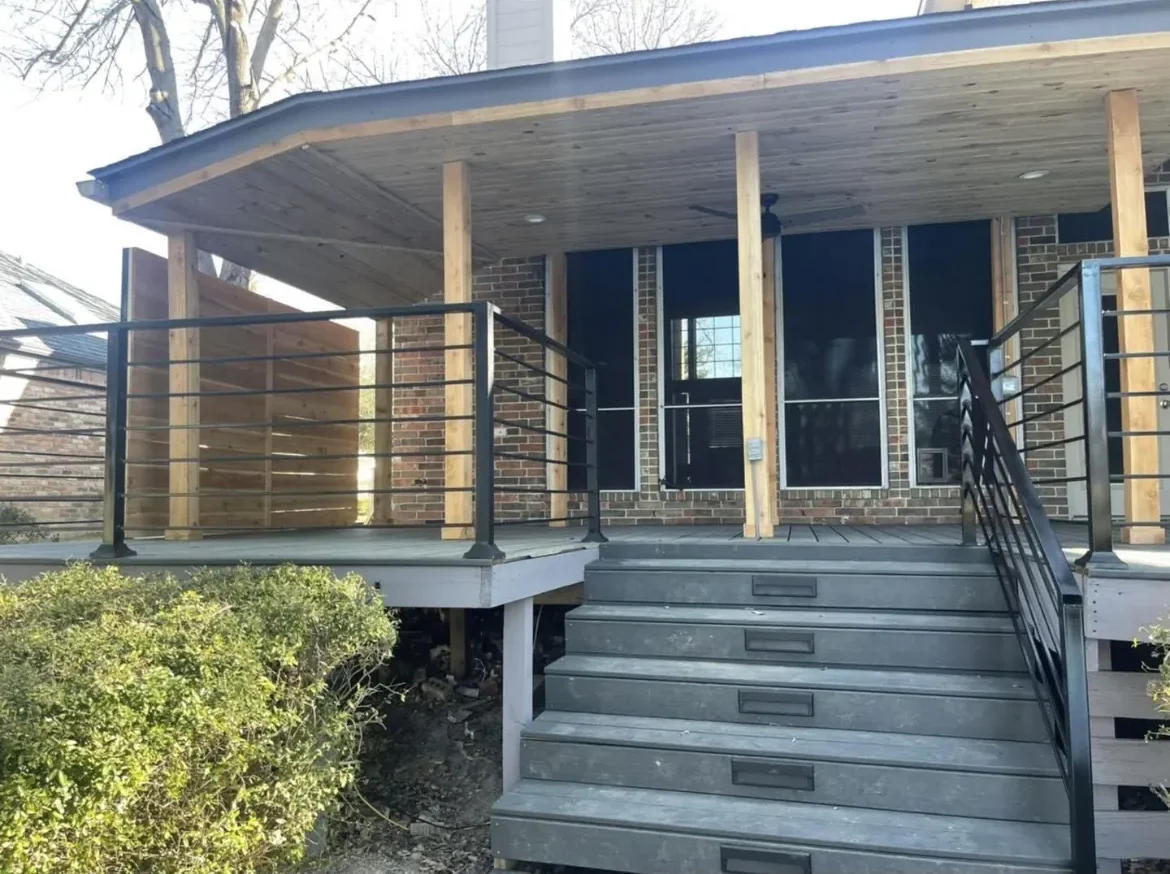
Costs below are national figures from named guides, except Block Renovation's labeled Dallas range. Wind numbers are maker or guide claims, not our tests.
Best ways to shade a deck in Texas: pergola, retractable awning, shade sail or covered deck (2026 costs)
The best way to shade a deck in Texas is a solid roof over the part you sit in, then a louvered pergola. Open pergolas, retractable awnings, shade sails and umbrellas cost less, but they give partial or spot shade and most of them have to be closed, retracted or taken down before a storm.
The shade column mixes three measures, so each cell names its own: "shade" is Fixr's shade percentage, "UV block" is a fabric spec, and "UV reached the shade" is a field measurement. They can't be converted into each other.
| Option | Shade or UV figure (what it measures) | Cooler underneath | National cost (source, year) | Wind limit (maker or guide) | In a severe storm |
|---|---|---|---|---|---|
| Solid roof cover or pavilion | Solid overhead cover; "solid shade" ranked among the best of about 30 shade types in early ASU findings | 15 to 25 degrees (Block, Dallas); 15 to 20 degrees (This Old House) | Shed roof $1,100 to $10,500; gable roof $13,000 to $30,000 (This Old House, 2026). Dallas: $20,000 to $60,000 for 300 to 500 sq ft (Block, 2026) | No sourced figure | Fixed roof, nothing to close |
| Open pergola | 75% to 90% shade, depending on slat size and placement (Fixr, 2022) | No sourced figure | $4,000 to $15,000, average $6,600 (This Old House, 2026); $2,500 to $6,000 for the cover (Fixr, 2025) | No sourced figure | Open roof, no rain or hail cover |
| Louvered pergola | About 90% to 95% shade with louvers (Fixr, 2022) | No sourced figure | $10,000 to $25,000, average $13,000 (This Old House, 2026); $4,320 to $20,700 for the cover (Fixr, 2025) | StruXure says 150 mph with louvers open; its sensors open the louvers at 60 mph | Sensor models open the louvers automatically (maker claim) |
| Retractable awning | Sunbrella Shade Linen fabric: 1.2% UV transmittance (fabric spec) | No sourced figure | $800 to $4,000 installed, average $2,700 (Fixr, 2025) | Many models up to 25 mph (Bob Vila) | Retract it |
| Shade sail | 80%, 90% or 95% UV block (Coolaroo knitted fabric spec) | Playground surface about 116°F under a sail vs about 189°F in sun (converted from °C) | Sail kits $64.99 to $250.99 (Coolaroo store, 2026); DIY with posts $350 to $600 (Bob Vila, 2023); deck sail on steel posts $1,000 and up (This Old House, 2026) | No sourced figure | Take it down before severe weather |
| Patio umbrella | More than 17% of UV reached the shade in one study | No sourced figure | No sourced figure | Close at 25 mph sustained (Tuuci) | Close it |
| Shade trees | More than 5% of UV reached the shade in one study | Playground surface about 108°F under a tree (converted from °C); shaded surfaces 20 to 45°F cooler (EPA) | No sourced figure | No sourced figure | Not applicable |
Most of these prices are for patios. A roof over a raised deck can cost more, so for deck-specific numbers see what a covered deck costs in Dallas. This Old House and Fixr also price different sizes and scopes, which is why their ranges don't match.
Why Texas decks need more shade than most: Dallas UV and heat by the numbers
NOAA's UV graph for Dallas counted 123 days in 2025 forecast at Very High or Extreme (UV Index 8 or more), and DFW's first 100°F day comes on July 1 on average, the last on August 27. That is a long season of sun strong enough that the EPA says to take extra protection.
The 123 days is our sum of NOAA's 2025 counts: 17 days forecast Extreme and 106 Very High. In 2024 the same graph showed 19 Extreme and 109 Very High, or 128 days (our arithmetic). On the 2025 graph the curve sits mostly in the Very High and Extreme bands from about late May into early September. NOAA notes some days can be missing from these graphs.
- EPA's scale: UV Index 3 to 7 means seek shade during late morning through mid-afternoon; 8 and up is very high to extreme and needs extra protection. If your shadow is shorter than you are, seek shade.
- Heat: the National Weather Service in Fort Worth says July and August highs are consistently in the 90s and often 100 or more, some nights stay above 80, and those are also the sunniest months of the year.
- Record: DFW's most 100°F days in one year is 71, in 2011.
- Season: Block Renovation's Dallas guide says Dallas UV is intense from May through September and summers regularly top 100°F from June through September.
The same NWS page says large hail, damaging winds, flooding and tornadoes hit the Metroplex nearly every year.
Solid roof covers and pavilions: the most shade and the least to manage
A solid roof gives the deepest shade and keeps rain and hail off, and Block Renovation's Dallas guide says a covered patio drops the temperature underneath by 15 to 25 degrees compared with an exposed surface. This Old House puts the summer difference at 15 to 20 degrees cooler than direct sun.
Researchers point the same way. In early findings from Tempe, where ASU's Ariane Middel sampled about 30 kinds of shade, the best performers were "solid shade, like awnings, buildings and some types of trees with dense canopies," according to a Cronkite News report.
Block is blunt about the Dallas choice: the defining structure is a solid roof, "Not a pergola (too little shade for Texas summers)." Its other Dallas advice for a covered area:
- Fans: plan at least one ceiling fan per 150 to 200 sq ft of covered space. For a 16x20 deck section (320 sq ft), that works out to 2 to 3 fans (our arithmetic from Block's guideline).
- Roofing: metal roofing on patio covers resists hail better than shingles.
- Budget: a 300 to 500 sq ft covered patio with a solid roof, posts, electrical and ceiling fans runs $20,000 to $60,000 in Dallas.
Nationally, This Old House says most people pay $14,000 to $31,000 to add a roof over a patio, about $21,000 on average, or $15 to $60 per sq ft. A shed roof runs $1,100 to $10,500 and a gable roof $13,000 to $30,000. Archetex Outdoor Design Co. builds covered decks and pavilions in Dallas; the covered decks and pavilions we build page shows how the roof ties into a deck.
A solid roof is also the base for screens. If mosquitoes ruin your evenings as much as the sun does, see what it costs to screen in a covered deck.
Open pergolas: partial shade, and how to get more from one
An open pergola gives roughly 75% to 90% shade depending on slat size and placement, according to Fixr's 2022 pergola guide, so in Texas it works best with louvers, a fabric canopy or vines on top. Fixr also says a true pergola gives roughly 75% of the shade of a gazebo or pavilion.
That gap is why Block calls a plain pergola too little shade for Texas summers. The Skin Cancer Foundation notes that overhead shade covers you best when the sun is high and less as it rises and sets, so a pergola's striped shade shifts and thins through the afternoon.
Ways to get more shade from a pergola:
- Add louvers: Fixr says this raises shade to about 90% to 95%.
- Add a UPF-rated fabric canopy: the Skin Cancer Foundation's Seal requires a minimum of UPF 50 and lists awnings, umbrellas and outdoor shade among the products it covers. Sunbrella makes Shade fabrics for awnings and pergolas (details in the awning section).
- Grow vines on the west side: an archived EPA page says deciduous trees or vines to the west are typically most effective for cooling a building. Which vines grow well here is covered in where to put the deck and which vines to grow.
On cost, This Old House lists a pergola at $4,000 to $15,000 (average $6,600) and Fixr puts the cover itself at $2,500 to $6,000, both national. For sizes and wood vs metal, see pergola prices by size and material.
Louvered pergolas: adjustable shade that can close for rain
Louvers raise a pergola's shade to about 90% to 95%, per Fixr, and maker StruXure says its Pivot 6 louvers were tested to 150 mph with the roof open. Sensor-equipped StruXure models close for rain and open the louvers automatically at 60 mph.
Those wind numbers are maker claims under the maker's test conditions, and the 150 mph figure is with the louvers open. StruXure itself says the right model depends on the required design wind speed, site exposure, attachment method, local codes and site-specific engineering, and that wind performance depends on dealer anchoring and code compliance.
Prices vary a lot between guides. This Old House's cost table lists a louvered roof at $10,000 to $25,000 (average $13,000), but the same page's text gives $4,500 to $21,500, so the page conflicts. Fixr puts a louvered cover at $4,320 to $20,700. All are national.
Pick louvers over an open pergola if you want close to full shade at midday but still want to open the top when you want sun or a breeze.
Retractable awnings: shade on demand, but not in a storm
A retractable awning costs about $800 to $4,000 installed nationally, with Fixr's average at $2,700, but Bob Vila says most aren't made for very windy weather and many models tolerate winds up to 25 mph. It has to come in before a storm.
Fixr's national installed prices by size (2025):
| Awning size | Installed cost, national (Fixr, 2025) |
|---|---|
| 8x10 | $1,200 to $2,400 |
| 10x10 | $1,500 to $3,000 |
| 12x10 | $1,800 to $3,600 |
| 12x12 | $2,160 to $4,320 |
| 20x12 | $3,600 to $7,200 |
| 20x20 | $6,000 to $12,000 |
- Manual vs motorized: motorized awnings run $1,200 to $10,000 installed; labor is $200 to $400 for manual and $500 to $1,000 for motorized.
- Wind sensors: usually come on high-end motorized awnings starting around $2,000.
- Lifespan: most last about 10 years, some up to 15.
- Wind ratings: Bob Vila cites product examples rated 18, 30 and 35 mph, and says to retract when the wind makes sitting outside uncomfortable.
- Other national figure: This Old House lists an awning at $1,500 to $7,000, average $3,000.
The fabric decides how much UV gets through. Sunbrella's Shade Linen fabric lists UV transmittance of 1.2% and solar transmittance of 13.4%, and Shade Parchment lists 3.8% UV and 19.7% solar, which is about 98.8% and 96.2% of UV blocked (our arithmetic). Sunbrella gives its shade fabrics a 10-year limited warranty, with some listed fabrics at 5 years.
Shade sails: cheap UV protection if they are installed right
A shade sail can block up to 95% of UV for under $300 in fabric, but the posts, anchors and tension decide whether it lasts a Texas storm. Coolaroo's knitted fabrics come in 80%, 90% and 95% UV block, and its PVC fabrics in 80% and 92%.
Three price levels, all national:
- Sail only: Coolaroo's own store lists permanent sail kits from $64.99 (a 15x12x9 right triangle) to $250.99 (a 17 ft 9 in square Premium 95% UV sail), before posts and hardware. Prices were as shown on November 7, 2026 and may change.
- DIY with posts in concrete: Bob Vila estimates $350 to $600.
- Sail on a deck with steel posts: This Old House's project came to "$1,000 and up."
Fixr's covered patio guide lists a sailcloth or shade sail canopy at $100 to $200 for the cover itself.
How cool is it under one? In a playground test in Gilbert, Arizona, at noon with the air at about 107°F, the same rubber surface read about 189°F in the sun, 116°F under a shade sail and 108°F under a tree (converted from °C). The tree beat the sail by about 8°F (our arithmetic). Coolaroo claims its HeatShield fabric reflects infrared so surfaces under it feel up to 15°F cooler than under traditional fabrics, and that its sails let breezes pass through; that is a maker claim compared with other fabrics, not with open sun. Coolaroo also says lighter colors reflect sunlight and help lower temperatures.
Install rules that matter in Texas wind
- Posts: Coolaroo says set posts in concrete at least 2 ft deep; Bob Vila's project uses holes 3 ft deep and 1.5 ft wide.
- On a deck: in This Old House's project, 2x3 in steel posts with a quarter-inch wall attach with lag screws and carriage bolts, with the flange under the deck fastened to a joist. Anchors on the house go into studs or rafters and must take the wind load.
- Weak anchors: don't attach to thin fences or gutters.
- Slope: Coolaroo says 10 to 20 degrees for rain runoff and never flat, because water pools; Bob Vila says 15 to 25 degrees is common.
- Tension: keep it taut with minimal sag, since a sagging sail risks wind damage. Bob Vila puts tension at 20 to 100 lb per corner depending on the sail.
- Storms: take the sail down before severe weather, and never try to take it down in high winds. Check tension after storms and inspect the shade twice a year.
No sail maker we checked publishes an mph wind rating, so the only safe plan is to take it down when severe weather is forecast.
Patio umbrellas: spot shade that has to close in the wind
An umbrella is the easiest shade to move, but in one study more than 17% of UV still reached the shade under a sun umbrella, and umbrella maker Tuuci says to close a parasol when sustained winds reach 25 mph.
The study measured one umbrella and one tree in Sacramento between 12:30 and 3:00 p.m., and the authors say UV in shade "is not zero," so keep using sunscreen. The Skin Cancer Foundation says awnings and trees cover you best when the sun is overhead and less as it rises and sets, and that the less sky you can see, the better.
- Fabric: look for umbrella fabric that meets the Skin Cancer Foundation's current bar of UPF 50.
- Wind: Tuuci says to close it at 25 mph sustained. The National Weather Service counts gusts over 58 mph as severe, so never leave one open in a storm.
- Cost: we found no sourced umbrella price, so we don't quote one.
Shade trees and vines: the slowest, coolest shade
Tree shade measured cooler than a shade sail in an Arizona playground test, and an archived EPA page says shaded surfaces may be 20 to 45°F cooler than the peak temperature of unshaded materials. The catch is time, and trees still let some UV through.
In the Sacramento study, more than 5% of UV reached the shade under a tree, far less than the more than 17% under the umbrella. The same EPA page says evapotranspiration, alone or with shade, can cut peak summer temperatures by 2 to 9°F, and that deciduous trees or vines to the west are typically most effective for cooling a building.
One North Texas example is the cedar elm. Texas SmartScape lists it as native, deciduous, 30 to 80 ft tall with a 25 to 80 ft spread, full sun, low water and suited to all soils. It also warns that winged elms, which don't grow well in North Texas, are often sold as cedar elms, so check for sandpaper-rough leaves.
Placement and vines are in our Dallas backyard deck ideas guide.
How much cooler is a shaded deck? What the studies measured
In a Las Vegas study, sunlit surfaces peaked at 143 to 170°F while the same materials in shade topped out at 104 to 108°F, and in an Arizona playground test tree shade beat a shade sail by about 8°F. These are desert surface readings, not Dallas deck boards, but they show the size of the gap.
- Las Vegas (UNLV, August 6, 2020, 2:10 p.m.): in sun, porous rock 170°F, asphalt 166°F, brick 152°F, concrete and metal 144°F, sand 143°F. In the shade of an open-sided structure, none passed 108°F or reached the 110°F burn threshold the authors use.
- Gilbert, Arizona (noon): about 189°F in sun, 116°F under a sail, 108°F under a tree (converted from °C).
- Covered patio estimates: 15 to 25 degrees cooler underneath (Block, Dallas) and 15 to 20 degrees (This Old House). Neither says whether that is air or surface temperature.
No study we found measured the temperature under an awning or an umbrella, or compared air temperature under every deck shade type side by side. For how hot each decking board gets in sun and shade, see which decking stays coolest in the sun.
Can you still get sunburned in the shade? UV under trees, umbrellas and fabric
Yes. No shade blocks all UV, because indirect UV still reaches you, so pick UPF 50 fabric and keep sunscreen on. The Skin Cancer Foundation says no shade structure can completely shield you from indirect UV.
| Shade | UV figure | What the figure is |
|---|---|---|
| Sun umbrella | More than 17% reached the shade | Field measurement, one umbrella, Sacramento |
| Tree | More than 5% reached the shade | Field measurement, one tree, Sacramento |
| Coolaroo knitted sail fabric | 80%, 90% or 95% UV block | Maker's fabric spec |
| Sunbrella Shade Linen | 1.2% UV transmittance | Maker's fabric spec |
| Sunbrella Shade Parchment | 3.8% UV transmittance | Maker's fabric spec |
| Skin Cancer Foundation Seal | Minimum UPF 50 | Certification bar for fabrics, raised from September 1, 2024 |
A field reading under a real umbrella and a fabric maker's spec measure different things, so don't compare them directly. On a day forecast at UV Index 8 or higher, the EPA says extra protection is needed, which in practice means shade plus sunscreen.
Wind, permits and HOAs: what to check before you build shade in DFW
Plan around storms first. The National Weather Service counts gusts over 58 mph as severe, which is well past the 25 mph at which Tuuci says to close an umbrella and the roughly 25 mph Bob Vila gives for many awnings; that comparison is our reading of the ratings, not a test.
- Umbrellas and awnings: close or retract them before any storm.
- Sails: take them down before severe weather, never during high winds.
- Louvered pergolas: StruXure says its sensors open the louvers at 60 mph and its rating depends on engineering and anchoring at your site.
- Solid roofs: some DFW suburbs set their own wind rules for covers. Those rules, and what storms do to pergolas and covers, are in our hail and storm damage guide.
Permits: in the City of Dallas, only a one-story, detached patio cover under 200 sq ft (and not in a front or side setback) is exempt, so an attached cover needs a permit; the details are in Dallas permit rules for patio covers and pergolas. We found no City of Dallas source on whether a shade sail or awning needs a permit, so ask the city before you set posts. If you have an HOA, check its rules before any fixed structure goes up.
Which shade should you pick? (decision guide)
Pick a solid roof if you want the deck usable every summer afternoon and through storms; pick a cheaper option if you need shade this season or only for one spot.
- Pick a solid roof cover or pavilion if you eat or cook out there from June to September and don't want to close anything when a storm rolls in. Expect 15 to 25 degrees cooler underneath and a national cost of $14,000 to $31,000 for a patio roof, more over a deck.
- Pick a louvered pergola if you want 90% to 95% shade at midday but the option to open the roof. Check the wind rating is engineered for your site.
- Pick an open pergola if you like dappled light and will add a canopy or vines; on its own it gives 75% to 90% shade.
- Pick a retractable awning if you want shade only some of the time and will retract it in wind; budget $800 to $4,000 installed and plan for about 10 years of life.
- Pick a shade sail if you want UV block on a budget and can set posts 2 to 3 ft deep in concrete and take it down before storms.
- Pick an umbrella if you need movable shade over one table, and close it in wind (Tuuci says at 25 mph sustained).
- Plant a tree if you can wait; it gives the coolest natural shade and works alongside any of the above.
You can also combine them: a solid roof over the dining area and a sail, umbrella or tree over the rest. Archetex builds covered decks, pavilions, pergolas and patio covers, and gives a free site visit and a written price for the fixed options.