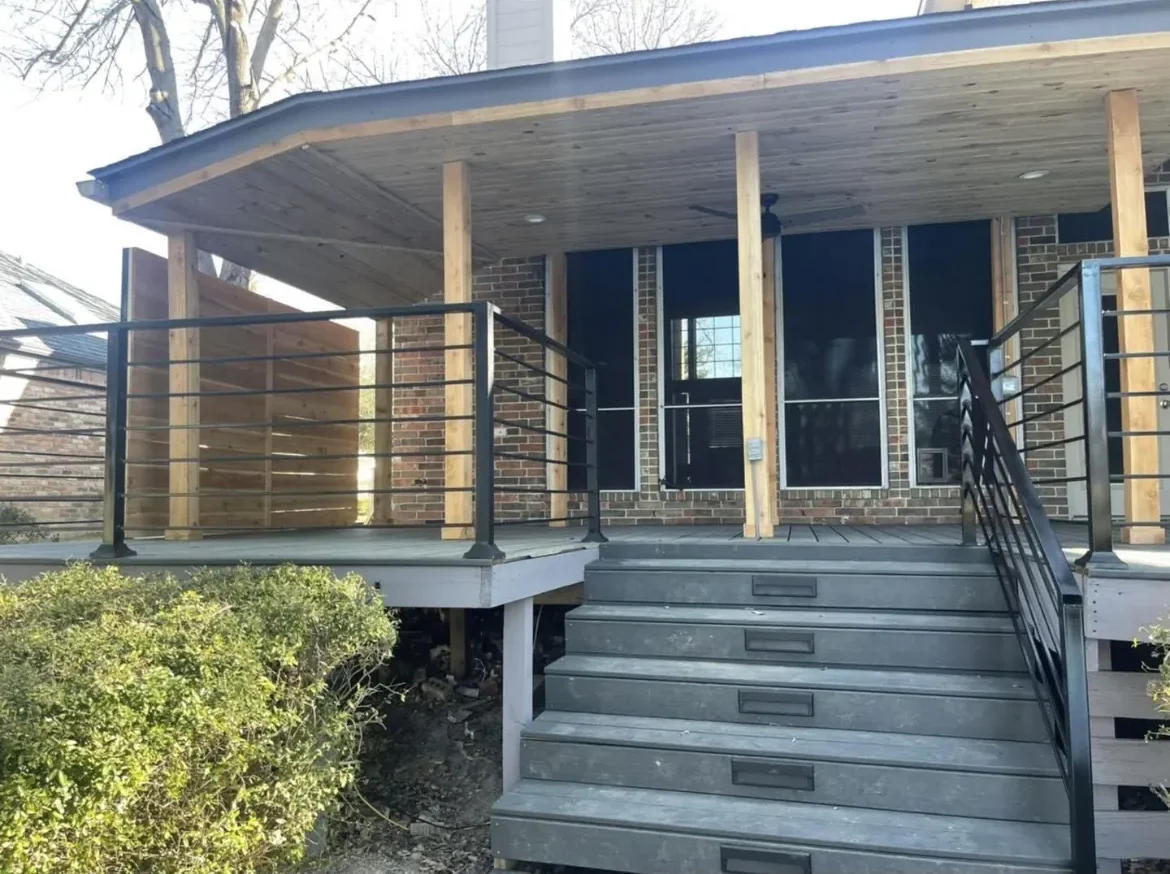
This guide combines the lighting makers' own spec and install pages, national cost guides, electrical code explainers and the Texas and Dallas licensing and permit rules. All costs are national figures with their source and date. Where a number is our own arithmetic, we say so.
The best deck lighting ideas, ranked by what they do
Start with safety lights (stairs, level changes and the path to the door), then add soft light on posts and rails, and finish with mood lighting over the seating area. That order puts the money where people trip.
- Stairs and edges first. Riser lights on each step and recessed lights along the outer boards show where the deck ends; Trex's lighting guide pitches riser lights for cutting trip risk and recessed lights for marking edges. The code also asks for a light at the top landing of deck stairs; our Texas deck stair code guide covers that rule.
- Posts and rails next. Post cap and under-rail lights give low, even light around the edge. Trex says post cap and riser lights can be added to an existing deck later.
- Seating and dining last. String lights over a table, or downlights under a roof.
Before anything gets screwed down, do what the Journal of Light Construction (JLC) recommends: test the kit in the dark to check spacing and light levels, and connect and test each fixture before you install it. For shade, layout, kitchens and fire pits, see our backyard deck ideas for Dallas heat.
Deck light types: post caps, riser lights, recessed, under-rail, string lights, sconces and downlights
Post cap, riser, recessed and under-rail lights are low-voltage fixtures built into the deck. String lights, wall sconces and ceiling downlights usually run off regular household power and belong on a cover, a pergola or the house wall.
Post cap lights
Post cap lights sit on top of the rail posts and mark corners and edges. Trex makes them in a 4-inch composite profile and 2.5-inch and 3-inch aluminum profiles. Its 2.5-inch aluminum cap (maker spec) is built for the Trex 24-volt DC system, with a UL Wet Location Listing and a 5-year limited warranty. Fiberon sells flat and pyramid tops with halo lighting (thrown outward) or downward lighting, in 4x4 and 5x5 inch pyramid sizes. The cap has to fit the post, so your rail decides the options; see our deck railing types and cost guide.
Stair riser lights
Riser lights mount on the face of each step and light the tread. Trex sells linear riser lights in 32 and 44 inch lengths; Fiberon makes flush and recessed riser lights. Trex says to install stair lights before the treads and fascia if you can, with at least a 1/2-inch tread nosing to protect them. Fixr puts each LED step light at $85 to $100 installed (2025, national).
Recessed in-deck lights
Recessed lights sit flush in the boards or fascia like small runway markers. TimberTech's In-Deck Light (maker spec) is 1 watt, 12 volts AC/DC, 4.75 lumens and about 1¾ x 1¼ x 1⅛ inches. DEKOR's DEK·DOT lights (maker spec) are 12-volt DC, waterproof and made to be walked on, just under 1 inch across and 5/8 inch deep.
Under-rail lights
Under-rail lights tuck under a rail and wash light onto the boards. Trex makes them in 30 and 42 inch lengths and mounts them beneath the bottom rail.
String lights
Fixr puts professionally installed string lights at $50 to $200 per 50-foot string, and says no guide wire is needed when they hang from a pergola, fence or railing, but a metal-wire suspension kit stops sagging over open space (2025, national). The Electrical Safety Foundation (ESFI) says outdoor lights and cords should be marked for outdoor use, plugged into GFCI-protected circuits, fastened to firm supports without damaging the cord and kept out of standing water.
Wall sconces and downlights
Sconces on the house wall and downlights in a deck roof are usually 120-volt fixtures. JLC notes that the required light at an exterior door is usually a line-voltage fixture installed by an electrician. For lights and fans in a deck roof, see our covered deck cost guide.
| Light type | Where it goes | Power | Maker example (maker spec) | National installed cost |
|---|---|---|---|---|
| Post cap | Top of rail posts | Low voltage | Trex 2.5 in aluminum, 24 V DC | $75 to $150 per deck light (Fixr) |
| Stair riser | Face of each step | Low voltage | Trex linear riser, 32 or 44 in | $85 to $100 per LED step light (Fixr); $100 to $300 (Angi) |
| Recessed in-deck | Flush in boards or fascia | 12 V | TimberTech In-Deck, 1 W, 4.75 lm | $75 to $150 per deck light (Fixr) |
| Under-rail | Under a rail | Low voltage | Trex, 30 or 42 in | $75 to $150 per deck light (Fixr) |
| String lights | Pergola, rail, fence or wire | Plug-in | n/a | $50 to $200 per 50 ft string (Fixr); $50 to $150 (HomeGuide) |
| Wall sconce | House wall, by the door | 120 V | n/a | $50 to $250 porch light (HomeGuide) |
| Downlight | Deck roof or pergola | 120 V | n/a | $100 to $400 (HomeGuide; Angi, $250 average) |
Costs: Fixr (2025-01-31), HomeGuide (2023-12-12), Angi (2025-10-15 and 2025-03-19). No guide we found prices post cap or under-rail lights on their own, so those rows use Fixr's general range for one deck light.
12-volt vs 24-volt vs 120-volt deck lighting
TimberTech and DEKOR deck lights are 12-volt, Trex runs on 24-volt DC to cut voltage drop, and 120-volt line voltage is for fixtures on the house wall or a roof.
A low-voltage system plugs a transformer (or "power supply") into an outdoor outlet, and the transformer turns household power into low-voltage power. Trex says its 24-volt system has less voltage drop than 12-volt systems, which matters on long runs. DEKOR says most landscape lights are 12 volts, with some up to 24.
- The 2023 NEC's Article 411 covers lighting systems of 30 volts or less, and generic low-voltage cable may not be fished inside walls or ceilings (411.7), according to IAEI Magazine (2025).
- JLC notes a UL 1838 landscape transformer is limited to 15 volts output and 300 watts.
Anything at 120 volts (a new outlet, a new circuit, a sconce or a ceiling light) is electrician work. JLC says that if there's no GFCI outlet near the deck for the transformer, an electrician installs one.
Trex, TimberTech, Fiberon and DEKOR lighting systems compared
Each brand sells a matched plug-in system, and the big differences are the voltage, the power supply and the controls. All specs below are the makers' own.
| System | Voltage | Power supply | Control | Warranty | Maker's claim |
|---|---|---|---|---|---|
| Trex | 24 V DC | 60 W or 96 W transformer | Timer: dusk to dawn, or 2, 4 or 10 hours | 5 years | UL wet-location listed |
| TimberTech | 12 V AC/DC | Not listed on the page we checked | Not listed | 5-year limited | Pairs with its post cap, riser, under-rail and accent lights |
| Fiberon | Not listed | 50 W Smart Power Supply (sold separately) | Wi-Fi, app, Alexa, Google Home, dimming, photocell | 5 years | "No electrical skills or know-how required" |
| DEKOR | 12 V DC | 60 W, 100 W or 200 W transformers | Not listed | Not listed | Walk-on, waterproof DEK·DOTs |
Before you mix brands: Fiberon's lights need Fiberon's own 50-watt supply, and Trex says cutting its extension wires can cause failures and void the warranty, so coil the extra and tie it to the framing.
Brightness is hard to compare. Of the maker pages we checked, only TimberTech's In-Deck Light lists lumens (4.75). For scale, HomeGuide puts pathway lights at 100 to 200 lumens, uplights at 50 to 300 and motion lights at 300 to 700. For the decking itself, read our Trex vs TimberTech vs Fiberon comparison.
How to size a transformer for deck lights
Add up the watts of every fixture and pick a transformer rated above that total; if the load equals the transformer's maximum, go up a size.
That's DEKOR's rule: multiply the number of lights by their wattage for the minimum size (its example: 10 x 15 watts = 150 watts), and step up if the load matches the maximum. JLC's LED example: 25 lights at 1 watt each gets at least a 50-watt transformer. Older fixtures drew at least 4 watts and sometimes over 10 watts for similar light, so LED systems need far smaller transformers.
Worked example (calculated from DEKOR's multiply rule and TimberTech's 1-watt rating): 20 in-deck lights x 1 watt = 20 watts minimum. A 60-watt unit, the smallest transformer on DEKOR's DEK·DOT page and Trex's install page, clears that with room to add lights later. Use the transformer made for your brand's system.
- Trex sells 60-watt and 96-watt transformers, says splitting lights into branches lets one transformer carry more lights, and counts three Oval Riser Lights as one light.
- JLC says 12-gauge cable works for most LED systems, moving to 10-gauge on very long runs to limit voltage drop; the cable has a direct-burial sheath.
Outlets, GFCI and wet-location rules for deck lighting (NEC 210.8, 210.52, 406.9, 410.10)
A deck should have at least one GFCI-protected 120-volt outlet serving it, no more than 6½ feet above the boards, under a weatherproof "in-use" cover, and every fixture out in the open should be rated for wet locations. These points come from trade-press and fire marshal explainers, each with its code edition.
- The deck outlet. JLC says code requires at least one 120-volt GFCI-protected receptacle serving the deck, and low-voltage systems need it for the transformer. The North Carolina Fire Marshal's reading of NEC 210.52(E)(3) (2014 NC Electrical Code) puts that outlet no more than 6½ feet above the decking; in its example, on a deck 4½ feet up, an outlet no more than 2 feet above the boards also stays within 6½ feet of the ground, so one outlet meets both the deck rule and the rule for an outlet reachable from grade.
- GFCI outdoors. In the 2020 NEC, 210.8(A)(3) "Outdoors" puts 125- through 250-volt receptacles on single-phase circuits of 150 volts or less to ground on the home GFCI list (IAEI Magazine, 2020). Under the 2023 NEC, 210.8(F) as amended by NFPA's TIA 23-3 (2022) requires GFCI for outdoor outlets on circuits of 150 volts or less to ground and 50 amps or less, but not for lighting outlets (other than those in 210.8(C)).
- In-use covers. NEC 406.9(B)(1) says 15 and 20 amp receptacles in wet locations need an enclosure that stays weatherproof with a plug inserted, with an extra-duty hood and weather-resistant receptacles (EC&M, 2015; NC Fire Marshal, 2017). Trex says to plug its timer into a GFCI-protected outlet with that kind of cover, mounted vertically, receptacle down, at least 12 inches above the ground.
- Wet vs damp. The NEC treats spots partly protected under canopies and roofed open porches as damp, and areas exposed to the weather as wet (EC&M, 2015). An open deck is wet; under a deck roof is damp.
- Fixture labels. Under the 2017 NEC's 410.10(A), fixtures marked "Suitable for Wet Locations" can go anywhere, while "Damp" fixtures only go in damp or dry spots (EC&M, 2019). Trex lighting is UL wet-location listed.
Imported fixtures often carry an IP code instead. Under EN/IEC 60529 the first digit covers dust (6 means fully dust-protected) and the second covers water: 4 is splashing, 5 low-pressure jets, 6 powerful jets, 7 immersion up to 30 minutes at 15 cm to 1 meter. RS Components notes IP65 "is not completely waterproof."
Near a pool: the NEC has long sent low-voltage lighting within 10 feet of a pool, spa or fountain to its pool article (Article 680). Ask your electrician before putting lights near the water.
Do you need an electrician for deck lights in Texas?
Plugging a listed low-voltage kit into an existing GFCI outlet is the simplest case, but in Dallas any new outlet, circuit or 120-volt fixture is licensed electrician work unless the homeowner satisfies the city's Chief Electrical Inspector.
Plenty of advice online says low-voltage deck lights (12 to 24 volts) "usually" don't need an electrician, as Decks.com puts it, and Fiberon says its kit needs "no electrical skills." That holds for the plug-in side only.
Texas. TDLR (the Texas Department of Licensing and Regulation) says anyone doing non-exempt electrical work must be licensed and work through a licensed electrical contractor. License types include Master, Journeyman, Residential Wireman and Electrical Contractor; check one at tdlr.texas.gov/LicenseSearch. TDLR's exemptions include:
- A person working on a home they own and live in (Occupations Code 1305.003(a)(6)).
- "Landscapers who perform electrical work on low-voltage exterior lighting, excluding power sources" (1305.003(a)(13)).
- Work on Class 1, 2 or 3 power-limited circuits (1305.003(a)(12)).
TDLR says city or regional rules may override these (Sec. 1305.201). Note "excluding power sources": the outlet and circuit feeding the transformer aren't covered.
Dallas. The city says electrical work must be done by a licensed electrician unless the homeowner proves to the Chief Electrical Inspector they can do it on their own home, and permits are required unless Chapter 52 exempts the work.
Dallas electrical permits for deck lighting
Dallas requires an electrical permit unless Chapter 52 exempts the work, and its exemptions cover small changes, not low-voltage or landscape lighting by name.
Chapter 52, Sec. 301.2.4 (current through April 2025) exempts:
- Replacing lamps and plugging portable equipment into permanent receptacles (item 2).
- Repairing or replacing an existing light fixture, receptacle, switch or fan with no service change, if the work is $1,000 or less (item 5).
- Up to six new 120-volt outlets or devices within an existing occupied single-tenant space or structure, on an existing circuit or one new circuit (item 6).
Dallas's permit exemptions don't mention low-voltage lighting, so ask before running any new outlet or circuit. We found no city page that says whether a plug-in low-voltage kit needs a permit; ask the city or a licensed electrician about your plan.
Code edition. Texas adopted the 2023 NEC, effective September 1, 2023. Dallas's codes page (captured October 21, 2026) lists Chapter 56 as the 2020 NEC with Dallas amendments, effective June 13, 2022. Your electrician and the permit reviewer will know which edition applies.
Fees. Angi says permit fees for new wiring run $50 to $300 by location (2025, national), and TDLR notes cities can collect building permit fees. For the Dallas permit process and inspections, see our Dallas deck and patio cover permit guide.
2026 deck lighting installation cost: low-voltage stair lights, post cap lights and labor
Nationally, one installed deck light runs about $75 to $150 and an LED step light $85 to $100 (Fixr, 2025), while a small job of 4 to 8 fixtures is about $800 to $2,000 (Angi, 2025). No source we found gives a Dallas-only price.
| Item | National cost | Source and date |
|---|---|---|
| One deck light, labor and materials | $75 to $150 | Fixr, 2025-01-31 |
| LED step light, installed | $85 to $100 | Fixr, 2025-01-31 |
| Deck/patio lighting, per fixture | $125 to $300 | Angi, 2025-10-15 |
| Low-voltage fixture, installed | $90 to $150 (Fixr); $100 to $150 (HomeGuide) | Fixr 2025; HomeGuide 2023 |
| Pergola lights | $50 to $400 per light | Fixr, 2025-01-31 |
| Transformer, installed | $200 to $500 | HomeGuide, 2023-12-12 |
| New GFCI outlet, installed | $150 to $350 | HomeGuide, 2023-12-12 |
| New breaker | $150 to $300 | HomeGuide, 2023-12-12 |
| Trenching | $5 to $12 per linear foot | HomeGuide, 2023-12-12 |
| Electrician | $40 to $100/hr (Fixr); $50 to $130/hr (HomeGuide); at least $150 for the first hour (Angi) | Fixr 2025; HomeGuide 2023; Angi 2025-03-19 |
| Wiring plus one new outdoor light | 3 to 5 hours, about $350 to $600 | Fixr, 2025-01-31 |
Fixr doesn't price post cap or under-rail lights separately; its $75 to $150 range covers one deck light, with stair, recessed, under-rail, post cap, under-deck, landscape and solar listed as the choices.
A whole deck (calculated from Fixr's ranges, national): 12 deck lights at $75 to $150 each is $900 to $1,800, and eight LED step lights at $85 to $100 each is $680 to $800.
By number of lights, the guides differ, so here they are side by side: HomeGuide (2023) puts 5 lights at $400 to $1,500, 10 at $800 to $3,000 and 20 at $1,600 to $6,000. Angi (2025) puts 4 to 8 fixtures at $800 to $2,000, 9 to 16 at $2,000 to $4,500, and 17 or more at $4,500 to $10,000. For lighting across a whole backyard project, see our outdoor living space cost guide.
The biggest swing is whether you need new 120-volt work. A kit plugged into an outlet you already have skips the outlet, breaker and trenching lines. Archetex Outdoor Design Co. gives a written price for the deck itself after a free site visit.
Adding lights to an existing deck vs a new build
Lighting is easiest to run while the deck is being built, but post cap and riser lights can be added to an existing deck later.
Trex's install page says to build the lighting in as the deck goes up whenever possible, and to fit stair lights before the treads and fascia. Fiberon also advises planning lights at the early design stage. On a new build, decide where the posts, risers, recessed lights and transformer outlet go before the boards go down. If Archetex is building your deck, bring the lighting plan to the design stage; the 120-volt outlet or circuit itself is a job for a licensed electrician. Our composite deck builder page covers the deck side.
On an existing deck, Trex says post cap and riser lights are "able to be added later." Solar lights skip wiring entirely: Fixr says they need no electricity and puts them at $100 to $200 installed. We found no sourced data on how solar deck lights hold up in Texas heat, so ask the seller about runtime.
Warm white, dark skies and Texas bird migration
Use warm-white LEDs (DarkSky International suggests 2700K or lower), aim them down, and put them on a timer, especially from 11 p.m. to 6 a.m. during spring and fall bird migration.
DarkSky International and the Illuminating Engineering Society list five principles: light only what's useful, target it (shield and aim down), keep it low, control it with timers or motion sensors, and use warm colors that limit blue-violet light. For homes, DarkSky recommends fully shielded fixtures aimed no higher than 80 degrees from straight down, at 2700K or lower; 3000K only if well shielded, on a motion sensor or timer and carefully aimed. Applied to post caps, DarkSky's aim-down guidance points to downward-lighting caps: Fiberon says its halo caps project light outward, while its downward caps light the ground below. Texas Parks and Wildlife defines light pollution as light that is too bright, misdirected or shining where it isn't wanted, and says it affects human and animal health.
Birds. Texas A&M's Natural Resources Institute (2021) says about 1 in 3 birds migrating through the U.S. in spring and 1 in 4 in fall pass through Texas. The Lights Out, Texas! campaign it takes part in asks people to turn off non-essential lights from 11 p.m. to 6 a.m. during migration (spring: March 1 to June 15; fall: August 15 to November 30), and not to light trees or gardens where birds rest. In DFW, the City of Fort Worth set the 2026 spring critical peak as April 22 to May 12. A timer set to switch off by 11 p.m. covers it.
Bugs. A 2016 field study at 18 sites in southern England (Ecology and Evolution) found LEDs drew significantly fewer insects than other bulb types, with no significant difference between cool-white and warm-white LEDs. Switching from old bulbs to LEDs helps; choosing warm over cool white won't, by that study.
Energy use and upkeep
LED deck lights use very little power: the U.S. Department of Energy (DOE) says LEDs use up to 90% less energy and last up to 25 times longer than incandescent bulbs, and expects good-quality white LEDs to last 30,000 to 50,000 hours or longer.
The guides disagree on running cost. HomeGuide (2023) says $20 to $60 a year ($2 to $5 a month). Angi (2025) says a standard LED landscape system costs $5 to $15 a month, with LEDs using up to 80% less electricity than halogen. Trex's timer runs dusk to dawn or for 2, 4 or 10 hours, and Fiberon's supply has a dusk-to-dawn photocell and schedules.
Repairs are mostly the transformer: Angi puts a repair at $150 to $400 and a replacement at $300 to $1,000 (2025, national). Trex covers its lights and transformers for five years.
Mistakes to avoid:
- Cutting plug-and-play extension wires (Trex says it can void the warranty).
- Plugging the transformer into an outlet without GFCI protection and an in-use cover.
- Putting damp-rated fixtures on an open deck.
- Fishing generic low-voltage cable inside walls.
- Lighting up trees where birds rest during migration.
- Loading a transformer to its maximum instead of stepping up a size.